Add Elite as Preferred
 Almost everyone has the same fear about elevators, and almost everyone got it from a film: the cable snaps, the car plummets, and the needle spins. It is a memorable image, and it is very nearly fiction.
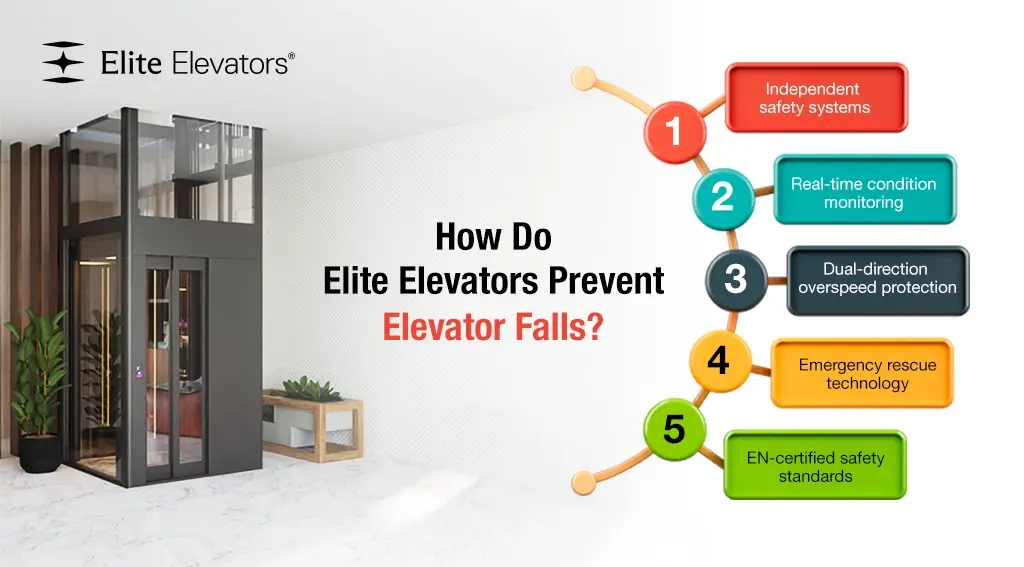
Free fall in a modern passenger lift is extraordinarily rare, rare enough that documented cases are usually traceable to catastrophic building damage, or to a lift that had been tampered with or left unmaintained for years. It is not rare because engineers are optimistic. It is rare because a lift is designed so that no single failure can drop it, and because the protection has been layered since the 1850s.
Table of Contents
- Elevator Fall Protection: The Principle Solved in the 1850s
- Layer 1: suspension with heavy redundancy
- Layer 2: overspeed governors and safety gear
- Layer 3: Hydraulic Systems Have Different Failure Risks
- Layer 4: Buffers for Safer Landing
- Layer 5: Systems That Handle Real-World Situations
- Layer 6: standards, which are how you verify any of this
- So what are the real chances?
- Fall protection across the Elite Elevators range
- Why Elite Elevators
- See the mechanisms for yourself
Understanding how that works is more reassuring than being told not to worry, so here is the actual mechanism and where Elite Elevators sits within it.
Our lifts carry EU Type Examination Certificates issued by Liftinstituut, an independent Notified Body in the Netherlands. The E-series is certified to EN 81-41, the European standard for home lifting platforms; our E50 stairlifts to EN 81-40; and the X300 series to EN 81-20 and EN 81-50, the standards written for commercial passenger elevators. Those certificates exist precisely because fall protection cannot be left to a manufacturer’s word, and we will produce them on request.
Elevator Fall Protection: The Principle Solved in the 1850s
Elevators already existed in the 1850s. What did not exist was the safety gear, and it was the invention of the safety gear, not the lift itself, that made passenger elevators viable.
The breakthrough was a mechanism that detected the suspension going slack and immediately clamped the car to its guide rails. It was proven in public: a platform suspended above a crowd, the rope deliberately cut, and the platform dropping a few centimetres before locking solid. Nothing about passenger lift design has been the same since.
Every passenger lift since has been built on that principle: the lift does not rely on its suspension being intact. There is an independent system whose only job is to arrest the elevator if it moves faster than it should, in either direction. Modern implementations are more sophisticated, but the logic is unchanged.
Layer 1: suspension with heavy redundancy
Traction lifts are suspended by multiple steel ropes or reinforced belts, not one. Each is engineered with a substantial safety factor, and the set is sized so that the failure of a single member does not compromise the elevator. Regulatory codes specify minimum factors precisely so that “the cable snapped” cannot be a single point of failure.
The Elite X300 series uses a gearless belt drive rather than conventional ropes. Belt systems distribute load across a wide reinforced section and, importantly, they can be monitored. The X300 Mark II includes real-time belt tension and alignment sensors that track condition continuously, so degradation is flagged as a service item long before it becomes a structural concern. This is the meaningful modern shift: not just stronger components, but components that report on themselves.
Layer 2: overspeed governors and safety gear
This is the direct descendant of that original safety-gear mechanism, and it is the single most important reason free fall does not happen. A governor monitors the car’s actual travel speed independently of the drive system. If speed exceeds a set threshold, the governor mechanically triggers safety gear that grips the guide rails and brings the elevator to a controlled stop. It is not electronic. It does not need power. It does not need the control system to be working, which matters, because if the control system were working correctly, you would not be in this situation.
The X300 series carries dual overspeed governors that monitor movement in both directions. Both directions is not a throwaway detail: uncontrolled upward movement is a genuine hazard in traction systems, and single-direction protection leaves it uncovered.
The E300 uses dual emergency brakes that engage on overspeed or system fault, again as an independent layer rather than an extension of the drive.
Layer 3: Hydraulic Systems Have Different Failure Risks
Elite’s X200, X200 Plus, and E200 are hydraulic chain-driven indirect mechanisms working from a hydraulic control unit. This matters for the specific fear of falling, because hydraulic lifts are not suspended in the traction sense at all. The elevator is supported by fluid pressure and mechanical linkage.
A hydraulic lift cannot free fall the way people imagine. The relevant failure mode is a loss of pressure, a line rupture, or a seal failure, and the answer is a rupture valve that closes when flow exceeds normal operating rate, stopping descent. What people actually experience in a hydraulic fault is slow settling of a few centimetres over hours, not a drop.
This is one reason hydraulic drives remain popular for lower-rise residential use. The trade-off is speed: these models run up to 0.30 m/s and serve up to 4 stops, while the gearless X300 reaches 1.0 m/s across up to 6 stops.
Layer 4: Buffers for Safer Landing
Below the elevator are buffers designed to absorb energy during a controlled descent. They serve as a last line of protection and should not be engaged during normal operation. The safety systems above them are designed to prevent the elevator from reaching this point.
Layer 5: Systems That Handle Real-World Situations
Here is the honest redirection. In home lifts, the realistic bad day is not a fall. It is a power cut with someone inside. In a power failure, the elevator does not drop. Brakes are fail-safe; they hold by default and require power to release, so loss of power means the car is held, not released. The problem is being stuck.
Every Elite model addresses this with an automatic rescue device or battery-operated emergency lowering: on power loss, the elevator moves under battery power to the nearest landing and opens its doors so occupants walk out. Supporting that: emergency cabin lighting, a trap door for escape access, and an in-cabin GSM phone running on backup power so a call reaches help with the mains down. The X300 MK II Plus adds Live SOS 2.0, alerting emergency contacts and the support team with one touch.
Two things worth saying plainly, because most safety pages skip them. That backup battery is a consumable; it degrades over a few years and fails silently, so the lift behaves perfectly right up until the day it is needed. The GSM phone needs a live SIM. Both belong on your annual service check, and you should ask your technician to demonstrate them rather than tick them off.
Layer 6: standards, which are how you verify any of this
None of the above is worth much without independent verification. The relevant benchmarks for residential lifting platforms:
- EN 81-41 the European standard specific to lifting platforms for persons, covering fall protection, door safety, and emergency provisions. Elite’s E100, E200, and E300 hold an EU Type Examination Certificate to this standard.
- EN 81-40 the equivalent standard for stairlifts and inclined platforms, covering Elite’s E50.
- EN 81-20 & EN 81-50 the construction and type-testing standards for commercial passenger lifts. Elite’s X300, X300+, X400, and X400+ are certified to these. This is a more demanding regime than the home-lift standard in several respects, because commercial lifts run faster, carry more, and cycle far more often.
- EU Type Examination by a Notified Body the mechanism that makes the above verifiable. Elite’s certificates are issued by Liftinstituut, an independent Netherlands-based Notified Body, meaning the design and test evidence was examined by a third party rather than declared by the manufacturer.
- The E200 is built with 194 integrated safety parameters, giving a sense of how many conditions the control system checks.
Ask any vendor for conformity documentation, including us. A company that cannot produce it is telling you something.
So what are the real chances?
Statistically, elevators are among the safest ways to move through a building, and the staircase your lift replaces is the more dangerous option particularly for anyone elderly, recovering from surgery, or using a wheelchair. Several of our own customers installed lifts after knee surgery, a back injury, and a fall on the stairs, which is a fair indication of where the actual risk sat.
Where injuries do occur, they are overwhelmingly at the doorway or the threshold trips at a mis-levelled landing, doors closing on someone, entrapment mishandled not falls. That is why auto re-levelling, door sensors, and working rescue systems deserve more of your attention when comparing models than the failure mode films taught you to fear.
What honest engineering offers is not a guarantee that nothing can go wrong. It is redundancy: a design where one component failing is caught by the next system, and a maintenance relationship that keeps every layer alive.
Fall protection across the Elite Elevators range
| Protection layer | X200 / X200 Plus (hydraulic) | X300 Mark II / MK II Plus (gearless) | E200 (hydraulic) | E300 (gearless cogbelt) |
| Drive type | Hydraulic chain drive | Gearless belt drive | Hydraulic, indirect chain | Gearless cogbelt, patented |
| Overspeed arrest | Hydraulic pressure-loss protection | Dual overspeed governors, both directions | Hydraulic pressure-loss protection | Dual emergency brakes |
| Condition monitoring | ENS fault detection | Real-time belt tension and alignment sensors | 194 integrated safety parameters | AENS + CAN bus remote diagnostics |
| Power-failure rescue | Battery-operated ARD | ARD | Battery-operated emergency lowering | ARD |
| Emergency contact | GSM phone on backup power | GSM Connect + battery backup; Live SOS 2.0 on MK II Plus | Autodialler + GSM | In-cabin GSM phone |
| Independent certification | See publishing note | EN 81-20 & EN 81-50 (commercial lift standards), Liftinstituut | EN 81-41, Liftinstituut | EN 81-41, Liftinstituut |
Why Elite Elevators
- Certification you can verify. EU Type Examination Certificates from Liftinstituut, an independent European Notified Body EN 81-41 for the E-series, EN 81-40 for E50 stairlifts, and EN 81-20 & EN 81-50 for the X300 series. Certificates available on request.
- Certified operations. ISO 14001:2015 environmental management and ISO 45001:2018 occupational health and safety.
- European engineering. The E300’s patented gearless cogbelt drive is engineered in Germany by TK Access Solutions.
- Monitored, not just built. Real-time belt monitoring, phase voltage protection, dual overspeed governors in both directions, and error notification systems that surface a problem while it is still a service item.
- Installed without demolition. No deep pit and no separate shaft are required for pit depths from 59 mm on the X300 series, and compact footprints from 720 × 720 mm for retrofits into existing homes.
- Thousands of installations across India, rated 5/5 from 889 customer reviews.
- Support after handover. Nationwide service network, annual service contracts, and on-call support are the layer that keeps every other layer working.
See the mechanisms for yourself
Reading about safety gear is not the same as inspecting it. Elite Elevators experience centres across India let you examine the equipment directly and take a home lift for a test drive, much like a car. Book a free home lift demonstration, and our team will walk your site and talk through your specific installation, including which drive type suits your building.
Related Case Studies:
1. Types of Elevator Malfunctions That Can Cause Injuries
2. Can an Elevator Fall? Understanding Elevator Safety Systems
3. What Are the Most Common Causes of Elevator Accidents in India?
4. What Happens After an Elevator Accident?
5. Elevator Safety Standards in India: What Should Homeowners Know Before Installing a Lift?
Note: * Prices listed are starting rates, exclude applicable taxes, and may vary based on customization.