Add Elite as Preferred
 If you are considering a home elevator, or already have one, the question underneath all your other questions is probably a simple one: Is this safe for my family?
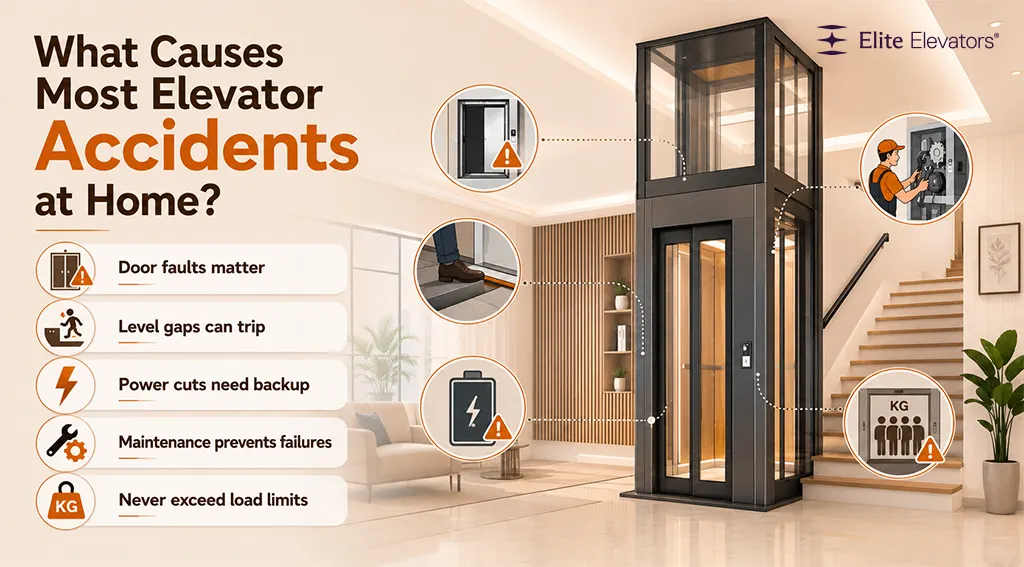
It deserves a real answer rather than reassurance. Elevators are among the safest forms of transport in daily use. You are considerably more likely to be injured on your staircase than in a properly maintained lift. But accidents do happen, and when they do, the causes are rarely mysterious. They cluster into a small number of failure modes, almost all of which are preventable through equipment choice, installation quality, and maintenance discipline.
Table of Contents
- 1. Door and gate faults, the single largest category
- 2. Mis-levelling: The Hidden Safety Risk in Home Lifts
- 3. What Happens to a Home Lift During a Power Failure?
- 4. When Maintenance Falls Short: The Safety Risks
- 5. Power Issues and Water Damage
- 6. Overloading and Improper Use
- 7. Installation and Safety Standards
- A practical checklist
- How Elite Elevators Addresses Each Safety Risk
- Why homeowners choose Elite Elevators
This guide covers the causes we see most often in Indian homes and buildings, what each one actually looks like, and how to reduce the risk in your own installation.
At Elite Elevators, safety engineering is the reason our home lifts are specified the way they are. Headquartered in Chennai and installed in thousands of homes across India, our lifts hold EU Type Examination Certificates issued by Liftinstituut, an independent European Notified Body; our E-series is to EN 81-41 for home lifts, and our X300 series is to EN 81-20 and EN 81-50, the standards written for commercial passenger elevators. We would rather explain potential failure scenarios honestly and show you how our equipment is designed to address each one, instead of asking you to simply trust our safety claims.
1. Door and gate faults, the single largest category
Contrary to what films suggest, most elevator injuries have nothing to do with falling. They happen at the doorway.
The worst offender in India is the older collapsible gate lift, still common in buildings constructed before door sensors became standard. A collapsible gate has gaps a child’s hand or foot can pass through while the car is moving. Injuries from this design are well documented and entirely avoidable; it is the main reason many state lift authorities have pushed to phase collapsible gates out of passenger service.
Modern failures are subtler. A door light curtain or safety edge that has become dusty or misaligned may stop detecting an obstruction, so the door closes on a person or a bag. An interlock fault can, in the worst case, allow the car to move with a door not fully secured.
What reduces the risk: insist on solid doors with electronic detection rather than gates. Every Elite Elevators model includes door safety sensors or light curtains that prevent movement until the doors are properly closed. Have the sensors cleaned and function-tested at every service; this is a two-minute check that is easy to skip.
2. Mis-levelling: The Hidden Safety Risk in Home Lifts
If an elevator stops two or three centimeters above or below the landing, someone will eventually catch a toe on the lip and fall. This sounds trivial. In injury statistics, it is not: trip-and-fall at the threshold is one of the most common ways people actually get hurt in lifts, and it disproportionately affects the elderly, the people a home lift is often installed for in the first place.
Mis-levelling comes from worn positioning sensors, control drift, or in hydraulic systems, slow settling as the car sits at a landing.
What reduces the risk: auto re-leveling, which detects the discrepancy and corrects it before the doors open. It is standard across the Elite range, and on the X300 series the Magnetic Driven Controls (MDR) system replaces mechanical relays with magnetic sensing specifically to improve landing accuracy. If you already own a lift of any brand, stand at each landing and look at the threshold gap. If you can see a step, call for service.
3. What Happens to a Home Lift During a Power Failure?
In India, power cuts are relatively common, so the possibility of a lift stopping during an outage deserves attention. A power failure with someone inside the lift is not inherently dangerous. The lift remains safely held in position, and there is no shortage of air inside the cabin. The greater risks come from panic, particularly for someone with a heart condition, or from attempting to force the doors open and climb out. It is this unsafe response that can turn a temporary stoppage into a serious fall hazard.
The compounding failure is a lift where nobody inside can call for help.
What reduces the risk: an automatic rescue device, which uses battery power to move the lift to the nearest landing and open the doors rather than leaving occupants waiting. Every Elite model includes battery-operated ARD or emergency lowering. Just as important is a working communication link: an in-cabin GSM phone that runs on backup power, so a call goes out even with the mains down, plus emergency cabin lighting so nobody sits in the dark.
Two honest caveats that most safety articles omit. The backup battery is a consumable. It degrades over a few years, and it fails silently; the lift works perfectly until the day the power goes out and the ARD does nothing. A GSM emergency phone needs a live SIM. If the connection has lapsed, the handset is decorated. Both belong on your annual service checklist, and you are entitled to ask your technician to demonstrate that they work.
4. When Maintenance Falls Short: The Safety Risks
Most elevator failures are maintenance failures while wearing a costume. Skipped services, ignored fault codes, and repairs by whoever was cheapest are behind a large share of incidents.
This is particularly acute for hydraulic lifts, which need periodic attention to seals, fluid, and the control unit to keep travelling smoothly. Gearless belt-driven systems like the X300 series have fewer moving parts and lower servicing demands, but “lower” is not “none”; belts wear and need monitoring. The X300 Mark II includes real-time belt tension and alignment sensors precisely so wear is caught while it is still a service item rather than a fault.
What reduces the risk: an annual maintenance contract with the manufacturer or an authorised service network and treating fault notifications as urgent rather than cosmetic. Error notification systems ENS on the X-series and AENS on the E300 exist to tell you something needs attention before it becomes a failure. They only help if someone acts on the alert.
5. Power Issues and Water Damage
Two environmental causes that matter more in Indian conditions than in the European markets, where much of this equipment is engineered. Voltage instability stresses control boards and drives. A spike can damage electronics; sustained under-voltage can cause erratic behavior. Phase voltage protection, which shuts the system down safely during over- or under-voltage rather than operating through it, is a meaningful specification; it is included on the X300 Mark II.
Water is the other one. Monsoon flooding of a pit, or rain reaching an outdoor installation that was not specified for it, corrodes components and creates electrical risk. If you are installing outdoors, confirm the weather rating explicitly, and make sure pit drainage is part of the site plan rather than an afterthought.
6. Overloading and Improper Use
Load limits are engineering limits, not suggestions. Elite’s hydraulic models are rated at 400 kg and the X300 series at 440 kg. Exceeding capacity, usually while shifting furniture rather than carrying people, stresses the drive and braking systems. Overload detection and alerts are standard, but they work best when the household knows the number.
Related: unrestricted access by children. PIN or pattern-based floor restriction is available across the smart-enabled models, and it is worth configuring rather than leaving open.
7. Installation and Safety Standards
India’s regulation of lifts sits largely with the states, several of which have their own Lifts and Escalators Acts covering registration, licensing, and inspection. Requirements and enforcement vary meaningfully by state, and home lifts in particular can fall into gaps between frameworks written mainly for commercial passenger elevators.
That gap is why the certification your equipment carries matters and why it is worth knowing exactly which certificate covers which model.
Elite Elevators lifts are certified by Liftinstituut, an independent notified body in the Netherlands, through EU type examination certificates:
| Standard | What it covers | Elite Elevators models |
| EN 81-41 | Lifting platforms for persons — the European standard for home lifts, covering fall protection, door safety, and emergency provisions | E100, E200, E300 (TK Home Solutions) |
| EN 81-40 | Stairlifts and inclined lifting platforms | E50 stairlifts |
| EN 81-20 & EN 81-50 | Construction, installation, and type-testing requirements for commercial passenger lifts | X300, X300+, X400, X400+ |
The last row is worth pausing on. EN 81-20 and EN 81-50 are the standards applied to passenger elevators in offices, hotels, and apartment towers, a more demanding regime in several respects than the home-lift standard, because commercial lifts run faster, carry more, and cycle far more often. Our X300 series is certified against that commercial benchmark rather than the residential one.
An EU Type Examination Certificate is not a self-declaration. An independent notified body examines the design and testing evidence and issues a certificate that can be requested and checked. Ask any vendor for theirs, including us.
Alongside the product certificates, Elite Elevators holds ISO certifications for environmental management and occupational health and safety. These govern how we operate our facilities and protect our workforce rather than certifying your lift, but they indicate a company that documents and manages its processes.
What reduces the risk: check your state’s requirements before you buy; use a vendor who handles registration and inspection properly, and ask for certification in writing.
A practical checklist
If you own a home lift of any make, work through this:
- Stand at each landing and check for a visible step at the threshold
- Ask your technician to demonstrate the ARD by simulating a power cut
- Confirm the in-cabin emergency phone connects to a live line
- Check that door sensors stop the doors on an obstruction
- Confirm the date of your last service and whether a contract is active
- Know your load rating and make sure the household does too
- Configure access restriction if children have unsupervised access
- Verify your installation is registered under your state’s rules if applicable
How Elite Elevators Addresses Each Safety Risk
We would rather you buy on verifiable specifications than on reassurance. Every cause listed above has a corresponding answer built into the Elite Elevators range:
| Cause | What Elite Elevators includes |
| Door and gate faults | Door safety sensors and light curtains on every model; solid doors, not collapsible gates |
| Mis-levelling | Auto re-levelling as standard; Magnetic Driven Controls (MDR) on the X300 series for landing accuracy |
| Entrapment in power cuts | Automatic Rescue Device or battery-operated emergency lowering on every model; emergency cabin lighting; in-cabin GSM phone on backup power |
| Lapsed maintenance | Error notification systems (ENS, AENS, Dynamic ENS); nationwide service network with annual contracts |
| Voltage fluctuation | Phase voltage protection on the X300 Mark II; low-voltage cabin operation across the range |
| Overloading | Overload detection and alerts as standard; 400 kg hydraulic / 440 kg gearless ratings |
| Unsupervised child access | PIN, pattern, and biometric floor restriction on smart-enabled models |
| Non-compliant installation | EU Type Examination Certificates from Liftinstituut—EN 81-41 for the E-series, EN 81-20 & EN 81-50 for the X300 series |
Why homeowners choose Elite Elevators
- Independently certified, not self-declared. EU Type Examination Certificates issued by Liftinstituut, a European Notified Body: EN 81-41 for the E-series, EN 81-40 for E50 stairlifts, and EN 81-20 & EN 81-50 for the commercial passenger lift standards for the X300 series. Certificates available on request.
- Certified management systems. ISO certifications for environmental management and occupational health and safety across our operations.
- European engineering. The E300 is built on patented gearless cogbelt technology engineered in Germany by TK Access Solutions.
- Installation without demolition. Elite Elevators home lifts need no deep pit and no separate shaft, with pit depths of 59 mm on the X300 series. Compact configurations fit footprints as small as 720 × 720 mm, which is why retrofitting into an existing home rarely means structural work.
- A range that fits the requirement. The X200 hydraulic line from ₹14.50 lakhs, the gearless X300 Mark II from ₹18.70 lakhs, the AI-equipped X300 MK II Plus from ₹20.95 lakhs, and the European E200 and E300 lines plus E50 stairlifts and full BeSpoke customisation. All prices exclude taxes.
- Support that continues after handover. A nationwide service network, annual service contracts, and on-call support because, as this article argues, maintenance is the difference between a safe lift and a lift that used to be safe.
- Rated 5/5 from 889 customer reviews.
- No elevator is risk-free, and any company telling you otherwise is selling rather than informing. What a good installation gives you is layered protection, where a single failure is caught by the next system in line and a maintenance relationship that keeps those layers working.
Talk to Elite Elevators
Book a free home lift demonstration, or visit an Elite Elevators experience centre and inspect the safety mechanisms yourself. You can take a home lift for a test drive much like a car. If you want an existing installation assessed, or you are specifying a lift for a new build, our team will walk the site with you.
Related Case Studies:
1. Elite Elevators Case Study Highlights How Product Selection
2. What Should You Do If Your Elevator Shows Signs of a Malfunction?
3. How Remote Elevator Monitoring Can Improve Safety, Maintenance and Emergency Response
4. Residential Elevator Safety Features: Sensors, Brakes, Door Systems and More
5. How Regular Elevator Maintenance Prevents Accidents
Note: * Prices listed are starting rates, exclude applicable taxes, and may vary based on customization.