Add Elite as Preferred
 Your mother uses the lift eight times a day. You live four hundred kilometers away. And the only way you find out something is wrong is if she tells you, which, if you know anything about parents, means you find out after it’s been wrong for three weeks.
That gap is the real weakness in traditional home lift ownership. Servicing is scheduled by calendar rather than by condition, so a belt that started drifting in April waits until October’s visit. Faults are reported by whoever happens to be inconvenienced, in whatever words they can manage on the phone. Emergencies depend on someone inside the cabin describing a problem they can’t see. And the technician who eventually arrives spends the first hour working out what actually happened, because the lift kept no useful record of it.
Table of Contents
Remote elevator monitoring closes that gap. By connecting the lift’s own sensors to a network and to your phone, it shifts maintenance from reactive to predictive, gives families visibility they’ve never had, and cuts emergency response from a phone call to an automatic alert. Here’s what that means in practice, and what’s actually available on residential lifts in India today.
What Is Remote Elevator Monitoring, and What Does It Watch?
A residential lift already generates a continuous stream of data. Position sensors know where the cabin is. Load cells know what it’s carrying. Belt sensors know tension and alignment. Door sensors know how many times the curtain was broken and whether closure met resistance. Controllers log every fault, every voltage irregularity, and every stuck button.
Traditionally all of that stayed inside the controller until a technician plugged in. An elevator monitoring system simply gives that data somewhere to go: to the manufacturer’s service network, to your phone, or to both.
What gets monitored on residential systems:
- Drive condition – belt tension and alignment on gearless systems; pressure and cycle behavior on hydraulic ones
- Levelling accuracy – drift from flush landing at each floor, tracked over time
- Door performance – cycle counts, obstruction events, closure resistance
- Power quality – over and under-voltage events, outage frequency, ARD activations
- Backup battery health – charge state and degradation, the most commonly missed failure point
- Fault and error history – a timestamped log rather than a verbal account
- Usage patterns – trips per day per floor, which informs a realistic service interval
The last two are quietly the most valuable. A timestamped fault log means the technician arrives knowing what happened. “Usage data” means servicing can be scheduled by actual wear rather than by the calendar.
Predictive Elevator Maintenance: Fixing Things Before They Break
Predictive elevator maintenance is the highest-value application because it changes the economics of ownership.
Consider a belt drive. Tension drifts gradually and measurably. Under a calendar-based regime, that drift is discovered at the next scheduled visit up to six months after it began. With continuous monitoring, the trend is visible from the week it starts, and a five-minute adjustment replaces a component change.
The same logic applies across the lift:
- Leveling drift trends toward a trip hazard long before anyone notices a lip at the threshold
- Door closure resistance creeping upward indicates alignment or track wear well before a curtain fails to detect an obstruction
- Battery capacity degrading toward the point where the ARD would fail invisibly under visual inspection but be obvious under monitoring
- Increasing fault frequency on a single component, which no single incident would flag
The outcomes are practical rather than abstract: fewer breakdowns, shorter visits, cheaper parts caught earlier, and, most importantly, safety systems verified continuously rather than twice a year.
There’s further efficiency. Where a lift supports remote diagnostics and software updates, a proportion of issues are resolved without anyone entering your home at all. For an owner in a different city from the lift, that’s the difference between a resolved problem and an unresolved one.
Smart Elevator Safety: What Families Actually Gain
- Smart elevator safety sounds like a marketing phrase until you map it onto specific household situations.
- Knowing a parent is safe. A cabin camera lets you check on a family member who uses the lift alone. Not surveillance reassurance for the person who’d otherwise be calling to ask, “Did you get downstairs alright?”
- Faster emergency response. A one-touch SOS that alerts both your emergency contacts and the manufacturer’s technical team simultaneously means help is dispatched even if the passenger can’t explain the situation. Compare that with dialing a number, describing a problem, and hoping.
- Automatic outage handling with notification. The Automatic Rescue Device brings the cabin to a floor and opens the doors during a power cut. Monitoring adds the part families want: a record that it happened, and an alert if it happened more often than it should.
- Access control and intrusion alerts. A PIN or biometric floor restriction stops children from riding unsupervised, and photo alerts on unauthorized use tell you if someone tried to use the lift when they shouldn’t have.
- App control of the environment. Adjusting lighting, fan speed, door timing, or announcements from a phone matters most for the household member who finds the cabin controls difficult.
A note on privacy, since cabin cameras deserve honesty: know who can access the feed, whether footage is stored and for how long, and make sure everyone in the household, including domestic staff, is told the camera exists. A camera nobody was informed about is a problem regardless of how useful it is.
Elite Elevators’ Remote Monitoring and Smart Safety Systems
Elite Elevators builds connectivity into the lift rather than bolting it on, with capability scaling across the range. Every model is ISO certified to EN 81-41 and Machinery Directive 2006/42/EC.
| Monitoring capability | X200 | X200 Plus | X300 Mark II | X300 MK II Plus | E200 | E300 |
| Fault detection & instant alerts | ✅ ENS | ✅ ENS instant alerts | ✅ | ✅ Dynamic ENS (real-time) | ✅ | ✅ AENS |
| Mobile app control & monitoring | — | ✅ Mobile App V1 | ✅ | ✅ Full app: lights, fan, doors, announcements | — | — |
| Remote diagnostics by engineers | — | via app alerts | via app alerts | via app alerts | — | ✅ CAN bus (CCT) |
| Remote software updates | — | — | — | — | — | ✅ CAN bus |
| Real-time belt tension & alignment monitoring | — | — | ✅ | ✅ | — | — |
| In-cabin camera | — | — | — | ✅ VisionLog wide-angle | — | — |
| Unauthorized access photo alerts | — | — | — | ✅ | — | — |
| One-touch SOS to contacts + support team | — | ✅ Live SOS | — | ✅ Live SOS 2.0 | — | — |
| GSM emergency calling with battery backup | ✅ | ✅ | ✅ | ✅ | ✅ Autodialer + GSM | ✅ in-cabin GSM |
| Restricted floor access | — | ✅ PIN / pattern | ✅ Password lock | ✅ PIN + biometric | — | — |
| 21″ interactive cabin display | — | ✅ Live Board | ✅ SSD V2 | ✅ Live Board + SSD V2 | — | — |
| AI usage learning & voice control | — | — | — | ✅ Elite AI | — | — |
Four systems do the heavy lifting here.
- Dynamic ENS on the X300 MK II Plus performs real-time fault detection and keeps you and our service network informed 24/7, meaning we’re often aware of a developing issue before you’ve noticed anything.
- CAN bus connection (CCT) on the E300 gives our engineers immediate remote access for diagnostics and software updates from a mobile device. Combined with AENS’ advanced error notification, it’s the most complete predictive maintenance package in the range appropriate for a lift carrying SIL 3 certification and German engineering by TK Access Solutions.
- Real-time belt monitoring on the X300 range continuously checks tension and alignment so wear is identified before it becomes an issue.
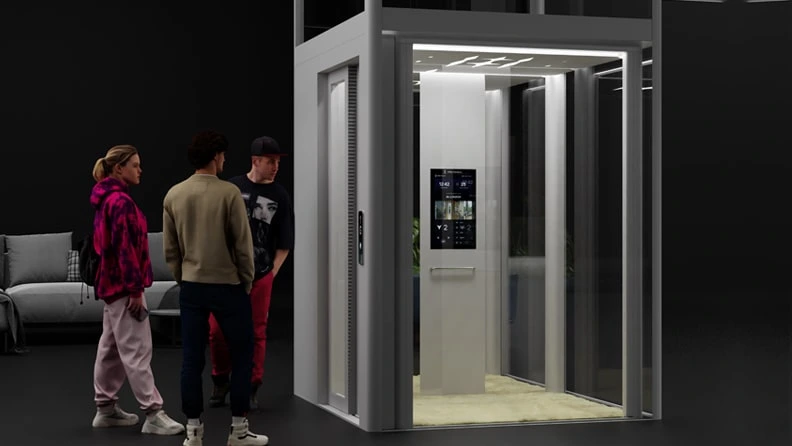
- VisionLog and Live SOS 2.0 on the X300 MK II Plus cover the human side: a discreet wide-angle cabin camera for checking on loved ones and one-touch alerting to both your emergency contacts and our technical team. Add Elite AI, which learns your household’s daily patterns and responds to voice or touch, and the X300 MK II Plus stands as India’s only AI-powered smart home lift.
Connected Home Lifts and Service Support Across India
Remote monitoring only delivers value if there’s a service network at the other end of the alert. Elite Elevators operates nationwide coverage with annual service contracts and on-call support for the life of the lift so a fault flagged by Dynamic ENS reaches a team that can act on it.
That combination is what makes remote monitoring genuinely useful for families managing a property from elsewhere. Whether you’re specifying a smart home lift in Chennai, a connected home elevator in Bangalore, or app-controlled home lifts in Hyderabad, or comparing smart elevators across Mumbai, Pune, Delhi NCR, Ahmedabad, and Kochi, the monitoring capability and the service response travel together.
You can see the systems working before you commit. At an Elite Elevators Experience Centre, you can operate the app, trigger the SOS, and view the 21″ Live Board display in person because the value of a feature like this is easier to judge in your hands than on a specification sheet.
Frequently Asked Questions
1. Can I monitor and control my home lift from my phone?
Yes, on connected models. Elite Elevators’ X200 Plus and X300 ranges offer app-based control of lighting, fan speed, door timing, and announcements, alongside fault alerts. The X300 MK II Plus adds VisionLog camera access and full app management.
2. How does remote monitoring make a lift safer?
Three ways: it verifies safety systems continuously rather than twice a year, including backup battery health, which visual inspection can’t assess; it flags developing faults before they become failures; and it speeds emergency response by alerting the service team automatically rather than waiting for a phone call.
3. What is predictive elevator maintenance?
Servicing based on the lift’s actual condition rather than a fixed calendar. Sensors track belt tension, leveling accuracy, door performance, and battery health continuously, so components are adjusted when trends show wear beginning, usually with a minor adjustment instead of a replacement.
4. Can a technician diagnose my lift without visiting?
On some models, yes. The E300’s CAN bus connection allows Elite Elevators engineers to read fault history and push software updates remotely. On app-connected X200 Plus and X300 models, fault alerts reach our service team so a technician often arrives already knowing the likely cause. Many issues are identified and some resolved without a site visit.
5. Is a camera inside the lift an invasion of privacy?
It depends entirely on how it’s used. VisionLog is designed for checking on family members and tracking usage. Before installing, confirm who can access the feed and whether footage is stored, and tell everyone in the household, including domestic staff, that the camera is there.
6. Do smart features add much to the cost?
Less than most buyers expect. The X200 Plus adds smart controls, Live Board, app connectivity, and Live SOS over the standard X200 for roughly ₹2.25 lakhs at each configuration level. Full pricing is on our All Products Price page, excluding applicable taxes.
Note: * Prices listed are starting rates, exclude applicable taxes, and may vary based on customization.