Add Elite as Preferred
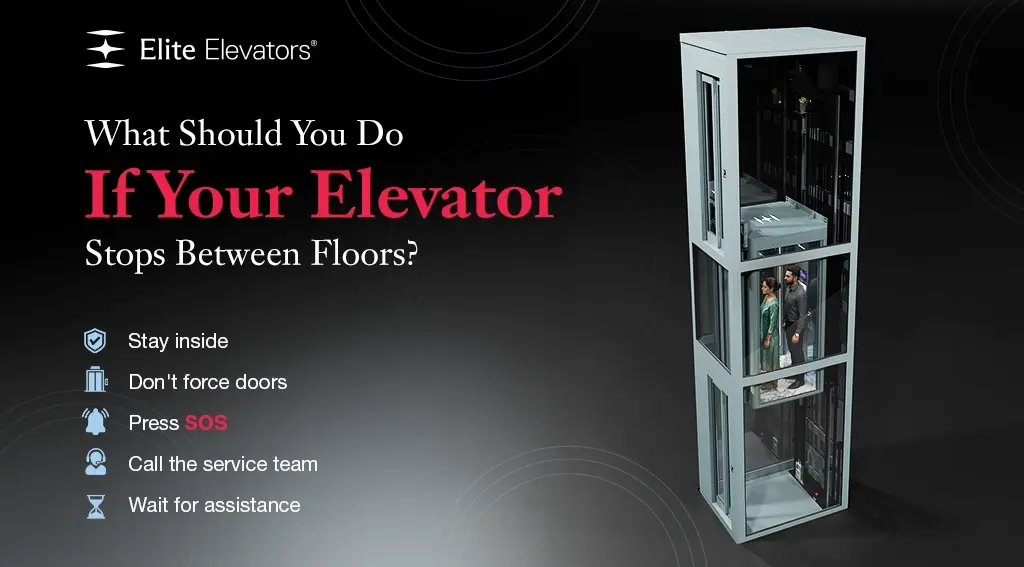
 If your lift shows signs of malfunction, stop using it and call for service. If it stops with someone inside, stay in the cabin, press the emergency call button, and wait; never force the doors. Elite Elevators lifts include an automatic rescue device and in-cabin GSM calling on battery power.
A home lift rarely fails without warning. In almost every case there is a period, sometimes weeks, where something is slightly different. A faint noise on the descent. A cabin that stops a few millimeters below the floor. Doors that hesitate before closing.
Table of Contents
- What Are the Early Signs of a Malfunctioning Elevator?
- What Should You Do Immediately If the Lift Stops With Someone Inside?
- Which Problems Can You Safely Check Yourself, and Which Need a Technician?
- Which Elevator Safety Tips Should Every Household Know?
- Who Should Read This Guide Most Closely?
- How Do Elite Elevators Detect Malfunctions Before You Do?
- How Do You Reach Elite Elevators for Elevator Maintenance Service?
- Warning signs, likely causes, and how Elite Elevators responds
Most households notice these changes and carry on using the lift because it still works. That is understandable, and it is also how a minor adjustment becomes a breakdown. Components in a residential lift degrade gradually: batteries lose capacity, sensors drift out of alignment, and belts and seals wear. The early signals are the cheapest and safest moment to act.
This guide covers how to recognize a malfunctioning elevator, what to do immediately if someone is inside, which checks are safe to make yourself, and when to call for service.
What Are the Early Signs of a Malfunctioning Elevator?
Six changes are worth acting on. None of them mean the lift is dangerous today; all of them mean it needs attention.
- New or changing noise. A grinding, clicking, or scraping sound that was not there before, particularly if it occurs at the same point in every trip.
- Uneven landings. The cabin stops above or below floor level. This is both a fault signal and an immediate trip hazard, especially for anyone unsteady on their feet or using a walking aid.
- Jerky starts or stops. Movement that used to be smooth becoming abrupt suggests a control or drive issue developing.
- Door hesitation. Doors that stall, re-open without an obstruction, or close more slowly than they used to. Door systems account for most real lift incidents, so this deserves prompt attention.
- Slower response or intermittent operation. A call button that sometimes needs pressing twice, or a lift that occasionally does not respond at all.
- Warning indicators or alerts. Any fault code on the cabin display, or an alert from the lift’s monitoring system. These exist to be acted on.
One rule covers all six: if the lift is behaving differently, stop using it and call for service. A lift that is out of use for two days costs you inconvenience. A lift used through a developing fault costs considerably more.
What Should You Do Immediately If the Lift Stops With Someone Inside?
This is the situation households most fear, and the correct response is simple enough to teach a child. Print it and put it inside a kitchen cupboard.
- Stay inside the cabin. It is the safest place. The shaft is not.
- Do not attempt to force the doors open, and do not climb out. Almost all serious lift injuries historically involve people trying to exit a stalled cabin.
- Press and hold the emergency call or SOS button. Speak when connected.
- If there is no response, use a mobile phone and call the service number. Keep it saved in every family member’s contacts.
- Sit down if anyone feels faint. Cabins are ventilated and are not airtight.
- Wait. For a residential lift, assistance is normally a matter of minutes.
Reassure anyone inside that the cabin is held by the braking system, not by power, and cannot fall. On a lift with an automatic rescue device, a power cut usually resolves itself within seconds; the cabin moves to the nearest landing on battery, and the doors open without anyone doing anything.
These are the elevator emergency tips that matter most and the only ones a household actually needs to memorise.
Which Problems Can You Safely Check Yourself, and Which Need a Technician?
Useful elevator troubleshooting at home stops at a clear boundary: check what is visible and accessible from the landing or inside the cabin, and nothing else.
Safe to check yourself:
- Whether an object, mat, or piece of clothing is obstructing the door track
- Whether the doors on every floor are fully closed: a lift will not move if one is not
- Whether the main supply to the lift is switched on at the isolator
- Whether the cabin display is showing a fault code and noting it down
- Whether the emergency light and call button work when tested
Never attempt it yourself:
- Opening the shaft, the pit, or any access panel
- Adjusting, cleaning, or lubricating guide rails or door mechanisms
- Resetting a fault repeatedly to “clear” it a fault that returns is telling you something
- Any electrical work on the lift supply
- Continuing to use the lift after two or more failed resets
Repeated resetting is the single most common mistake owners make. It suppresses the symptom while the underlying condition continues to develop.
Which Elevator Safety Tips Should Every Household Know?
A short set of elevator safety tips prevents most everyday problems.
- Do not exceed the rated load. Overload detection will stop the lift; consistently loading to the limit accelerates wear.
- Keep the door track clear. Dust, grit, and small objects cause more door faults than component failure does.
- Do not hold doors open by hand to keep the lift waiting. Use the door-open control.
- Teach children the rule: stay inside, press the button, wait, and make sure they know the lift is not a playspace.
- Never use the lift during a fire. Use the stairs.
- Keep the service number visible, not only in a phone. Stick it inside a cupboard door.
- Do not skip scheduled servicing. In most agreements it is also a condition of your warranty.
Who Should Read This Guide Most Closely?
Households where an elderly parent uses the lift alone. Uneven landings and door hesitation matter far more here than in a household of able-bodied adults.
- Families with young children, who ride lifts unsupervised and need the emergency rule taught explicitly.
- Owners of lifts over five years old, where battery capacity and sensor alignment are the most likely first faults.
- Owners of unbranded or orphaned lifts whose original supplier is unreachable and for whom the priority is finding a service provider before something fails.
- Prospective buyers, who should understand that ownership involves periodic servicing regardless of brand.
How Do Elite Elevators Detect Malfunctions Before You Do?
The strongest protection against a malfunction is a lift that reports its own condition. Elite Elevators builds fault detection into every model rather than relying on the homeowner to notice.
- Fault detection and alerting. The ENS error notification system on the X200 range identifies irregularities and reports them instantly. Dynamic ENS on the X300 MK II Plus performs real-time fault detection with 24/7 alerting. The E300 carries AENS, an advanced error notification system that continuously monitors operational performance and flags any irregularity immediately.
- Condition monitoring before failure. The X300 range includes real-time belt tension and alignment monitoring, so wear is identified while it is still an adjustment. Call button jam detection disables a stuck button rather than allowing repeated false stops. Phase voltage protection shuts the lift down safely during over- or under-voltage instead of running through it, the most common cause of control damage on Indian supplies.
- Remote diagnostics. The E300’s CAN bus (CCT) connection allows our engineers to read fault history and push software updates remotely, which means a technician frequently arrives already knowing the cause. On app-connected X200 Plus and X300 models, alerts reach our service team directly.
- Prevention by design. Greaseless rails across the range mean no oil or lubrication to degrade or attract grit. Auto re-leveling keeps the cabin flush with the floor on every model. Gearless X300 models have few moving parts and no gearbox, which is why they are designed for low maintenance; E-series hydraulic models receive periodic servicing to preserve smooth travel.
How Do You Reach Elite Elevators for Elevator Maintenance Service?
Our service team handles our own installations, not a rotating set of subcontractors through a nationwide network with annual service contracts and on-call support for the life of the lift.
We support installations across Chennai, Bangalore, Hyderabad, Mumbai, Pune, Delhi NCR, Coimbatore, Ahmedabad, and Kochi, and every city in between where our lifts are installed. Customers consistently describe the response as the deciding factor. Mohammad Azeez: “She followed up on my case with the technical team and resolved the issue. Had continuous contact with me until the issue got resolved.”
Warning signs, likely causes, and how Elite Elevators responds
| Warning sign | What it usually indicates | Elite Elevators system that detects it | Available on | What you should do |
| Cabin stops above or below floor level | Levelling or position sensing drift | Auto re-leveling, MDR magnetic position control | Auto re-leveling: all models · MDR: X300 range | Stop using; report—trip hazard |
| New grinding or clicking noise | Component wear or debris on rails | Real-time belt tension & alignment monitoring | X300 Mark II, X300 MK II Plus | Stop using; book service |
| Jerky starts or stops | Drive or control irregularity | EGSS soft start/stop, MDR | X300 range (EGSS/MDR); SSS on E200 | Report at the next service or sooner if worsening |
| Doors hesitate or reverse without cause | Obstruction or door sensor drift | Door safety curtain and obstruction sensors | All models | Check track for obstruction; then call service |
| Lift stops during a power cut | Mains failure | Automatic Rescue Device to the nearest floor | All models | Wait—the cabin should reach a landing automatically |
| Cannot contact anyone from inside | Communication failure | In-cabin GSM phone on lift’s own battery; live SOS | GSM: all models · Live SOS: X200 Plus, X300 MK II Plus | Press SOS; test monthly |
| Repeated stops with no clear cause | Stuck call button | Call button jam detection | X300 Mark II, X300 MK II Plus | Report the fault code |
| Lift trips during voltage fluctuation | Over- or under-voltage | Phase voltage protection, safe shutdown | X300 Mark II, X300 MK II Plus | Report: Check supply stability |
| Fault code on display | Any monitored irregularity | ENS · Dynamic ENS · AENS | ENS: X200 range · Dynamic ENS: X300 MK II Plus · AENS: E300 | Note the code and call service |
| Intermittent fault, hard to reproduce | Requires history, not a snapshot | CAN bus (CCT) remote diagnostics | E300 | Call service—often diagnosed remotely |
Certification for reference: the E200 and E300 hold EU Type Examination certificates to EN 81-41, issued by Liftinstituut, with the E300 built on patented cogbelt technology engineered in Germany by TK Access Solutions. The X300 range holds EU-type examination certificates to EN 81-20 and EN 81-50, the standards applied to commercial passenger lifts. E50 stairlifts are certified to EN 81-40.
Frequently Asked Questions
1. Is it safe to keep using a lift that is making a noise?
No. A new or changing noise indicates something has altered mechanically, and continuing to use the lift allows a minor adjustment to develop into a failure. Stop using it and book service. The lift being functional is not the same as the lift being right.
2. What should I do if the lift stops between floors?
Stay inside, do not force the doors, press and hold the emergency call button, and wait. The cabin is held by the braking system and cannot fall. On Elite Elevators lifts, the in-cabin GSM phone runs on the lift’s own battery, so it works even when the house has no power or internet.
3. Why does my home lift stop slightly above or below the floor?
This usually indicates levelling or position-sensing drift, and it should be corrected promptly because it creates a trip hazard at every entry and exit. Elite Elevators lifts include auto re-leveling as standard, with magnetic-driven controls (MDR) on the X300 range for precise landings.
4. How often should a home lift be serviced to prevent malfunctions?
It depends on the drive system. Gearless belt-drive models such as the X300 range are designed for low maintenance thanks to minimal moving parts; hydraulic E-series models need periodic servicing to preserve smooth travel and seal condition. Ask for the written scope and visit frequency in your annual service contract.
5. Who do I call if my home lift stops working?
For Elite Elevators installations, call our service line on +91 89259 32119 or email servicecare@eliteelevators.com. On models with remote diagnostics, our engineers can often review fault history before dispatching a technician, so the visit is faster and better prepared.
Note: * Prices listed are starting rates, exclude applicable taxes, and may vary based on customization.