Add Elite as Preferred





If you are researching 6-passenger lift prices in India and finding ranges between ₹8–20 lakhs with no explanation of what sits where and why, you are not alone. It is one of the most searched elevator topics in India and one of the least honestly answered.
Quick Summary
A 6 passenger elevator price in India starts from ₹14.50 lakhs for a certified hydraulic model. Elite Elevators offers hydraulic and gearless traction lifts engineered to international safety standards, with transparent pricing and complete cabin customisation.
The confusion is mostly created by mixing commercial and residential specifications, quoting uncertified products alongside certified ones, and presenting wide ranges without telling buyers what actually moves the price within them.
This guide fixes that. Real 6-person lift prices in India in 2026, an honest hydraulic elevators vs. traction elevators comparison, and the criteria that determine which technology is actually right for your building.
Table of Contents
- What Is a 6-Passenger Elevator?
- Hydraulic vs Traction: What Is the Real Difference?
- 1. How Does a Hydraulic 6 Passenger Elevator Work?
- 2. How Does a Traction (Gearless) 6-Passenger Elevator Work?
- Hydraulic vs. Traction 6-Passenger Lift Head-to-Head Comparison
- What Is the Traction Lift Price Premium Over Hydraulic, and Is It Worth It?
- Which 6-Passenger Elevator Is Right for Your Building?
- What Is the Elevator Installation Cost Beyond the Product Price?
What Is a 6-Passenger Elevator?
A 6-passenger lift is rated for a load capacity of approximately 400–450 kg. At an average Indian adult weight of 65–70 kg, this accommodates 6 passengers comfortably, making it the standard specification for most Indian home elevators and small commercial installations.
In the residential context, 400 kg is the practical minimum for a multi-generational family home. The elevator needs to carry two adults and an elderly parent with a walking aid, or two adults with groceries and luggage, without hitting the weight limit on a typical daily trip.
The two main drive technologies for a 6-passenger elevator in India are hydraulic and traction (gearless). Understanding what each one actually delivers, not just the specification sheet difference but the daily-use difference, is the most important part of this decision.
Hydraulic vs Traction: What Is the Real Difference?
1. How Does a Hydraulic 6 Passenger Elevator Work?
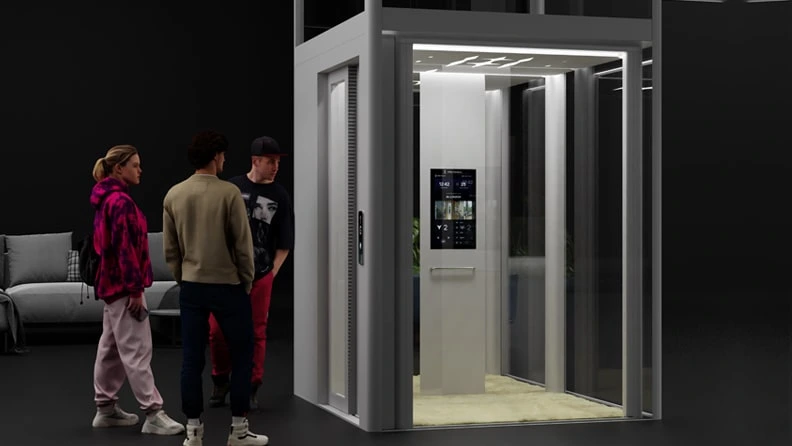
A hydraulic elevator uses a pump-driven mechanism to raise and lower the cabin. In the modern chain-drive variant used in home elevators such as the Elite Elevators X200 range, a hydraulic pump drives a chain that moves the cabin. This indirect mechanism eliminates the need for hydraulic fluid on the rails, delivers smooth, quiet movement, and operates on standard single-phase domestic power.
Modern hydraulic residential elevators have almost nothing in common with the older direct-hydraulic systems that required machine rooms, deep pits, and hydraulic fluid servicing. The chain-drive variant requires a 100 mm pit, no machine room, and single-phase power.
2. How Does a Traction (Gearless) 6-Passenger Elevator Work?
A traction elevator uses a belt or rope connected to a gearless motor to raise and lower the cabin. In modern residential applications, the Elite Elevators X300 range is a gearless belt-drive system that operates at up to 1.0 m/s with a 59 mm pit depth and no machine room.
The gearless mechanism is faster, smoother at higher speeds, and more suitable for greater travel heights (up to 21,000 mm). It also supports smarter features like AI navigation, biometric access, and smart displays that are not available on hydraulic platforms.
Hydraulic vs. Traction 6-Passenger Lift Head-to-Head Comparison
| Feature | Hydraulic (X200 Range) | Gearless Traction (X300 Range) |
| Speed | Up to 0.30 m/s | Up to 1.0 m/s |
| Load Capacity | 400 kg | 440 kg |
| Pit Depth | 100 mm | 59 mm |
| Machine Room | Not required | Not required |
| Power Supply | Single-phase | Single-phase |
| Max Floors | 4 stops | 6 stops |
| Max Travel Height | 13,100 mm | 21,000 mm |
| Smart Features | App, Live Board (X200 Plus) | AI, Biometrics, Live Board (X300 MK II Plus) |
| Safety Certification | EN 81-41 (E200) | EN 81-20 & EN 81-50 (X300 range) |
| Noise Level | Quiet | Quieter |
| Starting Price (G+1) | ₹14,50,000* | ₹18,70,000* |
What Is the Traction Lift Price Premium Over Hydraulic, and Is It Worth It?
The gearless traction X300 Mark II starts at ₹18.70 lakhs, approximately ₹4.20 lakhs more than the hydraulic X200 at G+1. Over a 15-year elevator lifespan, this premium works out to approximately ₹28,000 per year, or ₹77 per day.
What that premium delivers in daily use:
- Speed: A gearless elevator at 1.0 m/s covers a 3-floor journey in approximately 9 seconds. A hydraulic at 0.30 m/s covers the same journey in approximately 30 seconds. For a household making 15+ trips daily, the cumulative time saving over 15 years is meaningful.
- Smart features: AI navigation, biometric floor selection, 21-inch live board, and real-time belt monitoring. These features exist only on the gearless traction platform. The hydraulic X200 Plus offers app connectivity and Live SOS, but the AI and biometric capability are exclusive to the X300 range.
- Travel height: Hydraulic models support up to 4 stops and 13,100 mm travel height. Gearless models support up to 6 stops and 21,000 mm. For G+4 and G+5 homes, gearless is not a premium; it is the only option.
- Cabin size: The XL cabin (1500×1500 mm) with centre-opening panoramic doors is the most accessible configuration for wheelchair users and multi-person trips and is available only on the X300 gearless range.
For G+1 and G+2 homes with moderate usage and no requirement for AI features or XL cabin, the hydraulic X200 is the correctly specified product and the better value decision. For G+3 and above, active households, or luxury homes where design and technology both matter, the traction premium is justified by the daily delivery.
Which 6-Passenger Elevator Is Right for Your Building?
1. G+1 or G+2 home, moderate usage, budget-conscious:
Hydraulic X200: ₹14.50 lakhs. The most widely chosen 6-person lift in India for good reason. Smooth, certified, full safety suite, single-phase power. No over-specification.
2. G+2 or G+3 home, elderly residents, smart features needed:
X200 Plus: ₹16.75 lakhs. EGSS smooth ride, Live SOS, app monitoring, PIN floor access. The smart hydraulic passenger elevator that costs less than the gearless range but delivers real daily value.
3. G+3 to G+5 home, high daily usage, design-conscious household:
X300 Mark II: ₹18.70 lakhs. Gearless traction at 1.0 m/s. India’s first advanced pre-door opening. Four ride modes. The right traction lift for a serious multi-storey home.
4. Luxury villa, highest specification:
X300 MK II Plus: (AI, biometrics, live board) or E300 Cogbelt (EN 81-41 certified, Germany-engineered, quietest drive available). The 6 passenger elevators that match the finest Indian homes.
What Is the Elevator Installation Cost Beyond the Product Price?
The elevator installation cost is the total of the product price plus four additional items that most buyers do not budget for upfront:
- Shaft construction: If the shaft is not client-supplied during construction, the manufacturer’s shaft adds ₹3–18 lakhs depending on the model. The most cost-efficient approach is always to build the shaft during home construction using your own contractor.
- AMC: Annual Maintenance Contract costs vary by model and service level. Smart models with ENS real-time monitoring enable proactive maintenance that reduces the likelihood of emergency service calls between scheduled visits.
Related Posts:
✅ How Much Does a Hydraulic Elevator Cost?
✅ Top Benefits of Installing Hydraulic Lifts in Residential Buildings
✅ How Advantageous is the Hydraulic Home Elevator to Choose?
✅ Hydraulic Lifts or Gearless Lifts: Which Is Better for Indian Homes?
✅ Why Are Hydraulic Home Lifts Popular in Luxury Villas in India?