Add Elite as Preferred
 Any mechanical system in daily use will eventually develop a fault. A home elevator is no different from your elevator in this respect, and the sensible response is the same: know the warning signs, understand which faults matter, and keep to a service schedule.
What follows is a straight account of the malfunctions that occur in residential lifts including the ones that affect well-built equipment. We would rather you recognise a symptom early than discover it during a failure. Most of what follows is detectable by a homeowner paying attention, and most of it is a routine service item if caught in time.
Table of Contents
- 1. Mis-levelling: A Common Safety Risk
- 2. Door and sensor faults
- 3. Hydraulic-specific faults (X200, X200 Plus, E200)
- 4. Belt and drive faults (X300 series, E300)
- 5. Control system and electronics faults
- 6. Call button jam
- 7. The Failures That Often Go Unnoticed
- 8. Overload and load-sensing faults
- 9. Guide rail and structural issues
- A homeowner’s warning-sign summary
- Why Elite Elevators would rather tell you this
- How Elite Elevators makes faults visible early
- The Elite Elevators service commitment
Elite Elevators has installed home lifts in thousands of Indian homes and maintains them through a nationwide service network, so this list reflects what our engineers actually attend to rather than a generic checklist. Where an Elite Elevators feature addresses a specific fault, we have said so, and where a fault is simply part of owning a mechanical system, we have said that too.
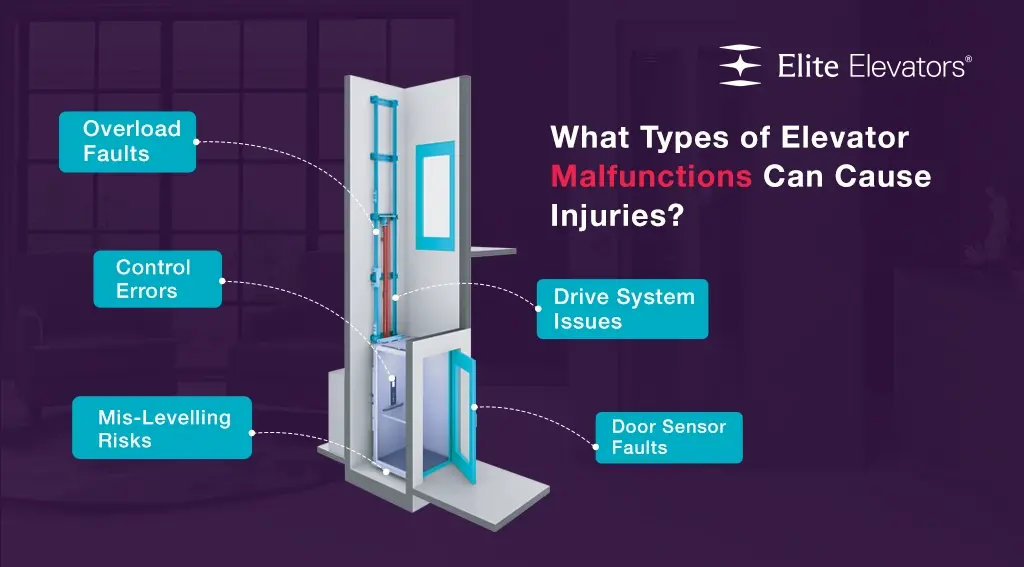
1. Mis-levelling: A Common Safety Risk
- What happens: the elevator stops slightly above or below the landing, leaving a lip at the threshold.
- Why it matters more than it sounds: this is the leading cause of actual injury in lifts. Someone catches a toe on the step and falls, and the people most affected are the elderly, the exact people a home lift is often installed to help. A two-centimetre discrepancy is easy to dismiss and entirely capable of breaking a hip.
- Causes: worn or contaminated positioning sensors, control drift, or in hydraulic systems, slow settling as the elevator sits at a landing while seals age.
- Warning signs: a visible step at any landing. An elevator that noticeably adjusts itself after stopping. Occupants habitually look down as they step out; people compensate for this unconsciously before they consciously notice it.
- What helps: auto re-leveling, standard across Elite models, detects and corrects the discrepancy before doors open. On the X300 series, Magnetic Driven Controls replace mechanical relays with magnetic sensing specifically to improve landing accuracy.
- Self-check: stand at every landing this week and look at the gap. This is the single most valuable thirty seconds of home lift maintenance available to you.
2. Door and sensor faults
- What happens: doors close on a person or object, fail to open fully, reopen repeatedly, or, in the worst case, the interlock permits movement with a door not properly secured.
- Causes: dust or grease on light curtain optics, sensor misalignment, worn interlock contacts, and debris in the door track.
- Warning signs: doors that hesitate or stutter. A door that needs a second attempt to close. Any occasion where a door closed on someone and did not immediately reverse that is not a quirk; that is a fault.
- What helps: door safety sensors and light curtains are standard on every Elite model and prevent movement until doors are properly closed. But optics get dirty, so cleaning and function-testing belong at every service.
- Self-check: hold an object in the doorway as it closes. It should stop and reverse promptly every time.
3. Hydraulic-specific faults (X200, X200 Plus, E200)
Hydraulic drives are robust and quiet, and they age in predictable ways.
- Seal wear and drift. Seals harden over years and allow slow settling. The elevator sinks a few centimetres over hours at a landing, which turns into a misleveling hazard. Not dangerous in itself; needs attention.
- Air in the fluid. Produces jerky or stuttering travel where movement has been smooth. A ride quality change is a diagnostic signal, not a cosmetic one.
- Fluid temperature. Hydraulic fluid heats with heavy use. High temperature triggers protective shutdown until it cools, inconvenient rather than dangerous, but frequent occurrences indicate a problem.
- Pump noise. A change in the sound of the power unit is often the earliest indication of trouble. Homeowners are good at noticing this because they hear the lift daily.
- Honest note: hydraulic systems need periodic servicing to maintain smooth travel and safe operation. This is a real ownership cost, and we would rather state it than let you discover it. The gearless X300 series, with a belt drive and fewer moving parts, has genuinely lower servicing demands, which is worth weighing at purchase.
4. Belt and drive faults (X300 series, E300)
- What happens: belts stretch, wear, or drift out of alignment over years of use.
- Why it is manageable: belt condition degrades gradually and measurably, which makes it well-suited to monitoring. The X300 Mark II includes real-time belt tension and alignment sensors that track condition continuously, so wear surfaces as a scheduled service item rather than a fault. This is the argument for monitored systems: the failure mode is not eliminated, it is made visible early.
- Warning signs: new noise during travel, vibration that was not there before, any change in ride feel.
- On the E300: the gearless cogbelt drive is paired with a CAN bus connection allowing remote diagnostics and software updates, so some issues can be identified without a site visit.
5. Control system and electronics faults
- What happens: erratic behaviour, calls not registering, unexpected stops, display faults, and doors misbehaving without a mechanical cause.
- Causes: in India, the most common is voltage instability. Spikes damage boards; sustained under-voltage produces unpredictable operation.
- What helps: phase voltage protection shuts the system down safely during over- or under-voltage, rather than operating through it, as included on the X300 Mark II. Error notification systems (ENS on the X-series, AENS on the E300, Dynamic ENS on the MK II Plus) flag faults as they arise.
- The catch: notification systems only work if someone acts on the notification. An alert dismissed for three months is not a safety system.
6. Call button jam
- What happens: a landing or cabin button sticks in the pressed position, causing continuous calls and unnecessary stops.
- Why it is worth naming: minor, but it degrades operation and confuses users, who then start forcing things. The X300 Mark II detects a jammed button and disables that call automatically.
7. The Failures That Often Go Unnoticed
These are the two most important items in this article, because they cannot be detected by using the lift normally. Your home elevator works flawlessly, and the safety system that is supposed to help you does nothing on the one day it is needed.
- The ARD battery. The Automatic Rescue Device runs on a battery, and batteries degrade over a few years. A dead ARD battery produces no symptoms whatsoever until a power cut, at which point the car does not move to a landing and someone sits inside waiting.
- The GSM SIM. The in-cabin emergency phone depends on an active connection. If the SIM has lapsed or the account is unpaid, the handset is a plastic ornament. Again, no symptoms until it matters.
- What to do: put both on your annual service checklist explicitly, and ask your technician to demonstrate them rather than tick a box. A simulated power cut takes a few minutes. A test call takes one. Any competent service engineer will do both without complaint, and you are entitled to ask.
8. Overload and load-sensing faults
Elite hydraulic models are rated at 400 kg and the X300 series at 440 kg. Overload detection and alerts are standard, but sensors can drift out of calibration. Overloading usually happens while moving furniture rather than carrying people, and it stresses drive and braking systems.
What to do: make sure everyone in the household knows the number and have load sensing verified at service.
9. Guide rail and structural issues
- What happens: rail misalignment from building settlement or corrosion in outdoor installations.
- Warning signs: new vibration or knocking during travel, particularly at consistent points in the shaft.
- On corrosion: this is a genuine Indian concern for outdoor installations. Monsoon exposure and pit flooding degrade components and create electrical risk. Confirm weather rating explicitly for outdoor installs and make sure pit drainage is designed in. Elite rails are greaseless, which removes lubricant contamination and slip risk, but greaseless does not mean weatherproof by itself.
A homeowner’s warning-sign summary
Call for service if you notice:
- A visible step at any landing
- Doors that hesitate, stutter, or fail to reverse on an obstruction
- Any new noise, vibration, or knocking
- A change in ride smoothness, jerking where it was smooth
- The car settling after it stops
- Calls not registering, or unexpected stops
- Any error notification, however minor it seems
- A change in the sound of the power unit
And regardless of symptoms: an annual service, with the ARD and emergency phone demonstrated rather than assumed.
Why Elite Elevators would rather tell you this
A vendor who implies their equipment never develops faults is either inexperienced or not being straight with you. Every lift in service, at every price point, needs maintenance, and the homeowners who have the best experience are the ones who recognise a symptom in week one rather than month six.
How Elite Elevators makes faults visible early
The design principle across our range is that a developing problem should announce itself while it is still a service call rather than a failure:
| Fault type | Elite Elevators feature that catches it |
| Mis-levelling | Auto re-levelling on every model; Magnetic Driven Controls (MDR) on the X300 series |
| Door obstruction | Door safety sensors and light curtains as standard |
| Belt wear | Real-time belt tension and alignment monitoring (X300 Mark II) |
| Electrical faults | Error notification systems ENS, AENS on the E300, Dynamic ENS on the MK II Plus |
| Voltage instability | Phase voltage protection (X300 Mark II) |
| Jammed call button | Automatic detection and call disabling (X300 Mark II) |
| Overload | Overload detection and alerts as standard |
| Remote diagnosis | CAN bus connection for remote diagnostics and software updates (E300) |
| Rail contamination | Greaseless rails across the range: no oil, no slip risk, less to go wrong |
Where our equipment cannot help is if the alerts go unread or the service lapses. That part is a partnership.
The Elite Elevators service commitment
Nationwide service network with annual service contracts and on-call support, covering every model we install.
- Independently certified engineering. EU Type Examination Certificates from Liftinstituut, a European Notified Body, are EN 81-41 for the E-series, EN 81-40 for E50 stairlifts, and EN 81-20 & EN 81-50 (the commercial passenger lift standards) for the X300 series. The E300’s gearless cogbelt drive is engineered in Germany by TK Access Solutions.
- Certified management systems. ISO 14001:2015 for environmental management and ISO 45001:2018 for occupational health and safety.
- Honest guidance on ownership cost. Our gearless X300 series has genuinely lower servicing demands than hydraulic drives, thanks to a belt system with fewer moving parts. If low maintenance is your priority, we will tell you which model actually delivers it rather than selling you the one with the better margin.
- Rated 5/5 from 889 customer reviews, with thousands of installations across India.
Book a service check
If anything on the warning-sign list above sounds familiar on Elite Elevators equipment or any other brand, have it looked at now rather than next month.
Related Case Studies:
1. Elite Elevators Case Study Highlights How Product Selection
2. What Should You Do If Your Elevator Shows Signs of a Malfunction?
3. How Remote Elevator Monitoring Can Improve Safety, Maintenance and Emergency Response
4. Residential Elevator Safety Features: Sensors, Brakes, Door Systems and More
5. How Regular Elevator Maintenance Prevents Accidents
Note: * Prices listed are starting rates, exclude applicable taxes, and may vary based on customization.