Add Elite as Preferred
 The power cuts out. You’re between the first and second floor, and the cabin stops. Maybe you’re alone. Maybe it’s your mother, who uses the lift six times a day, or your eight-year-old, who rides it because it’s more fun than the stairs.
This is the scenario nobody wants to picture while shopping for a home lift, which is exactly why it’s the one worth picturing hardest. In India, where extended outages are routine in many neighbourhoods and monsoon tripping is seasonal, a lift that simply stops when the grid does isn’t an inconvenience it’s a trap. And the difference between a frightening ten minutes and a genuine emergency comes down to engineering decisions made long before installation: whether the lift can move itself without mains power, whether anyone inside can call for help when the phone has no signal, and whether the company at the other end of that call actually answers.
Table of Contents
The good news is that elevator emergency features on properly certified residential lifts are now sophisticated, layered, and largely automatic. This guide explains what each one does, which ones are non-negotiable, and how they work together to keep passengers safe.
What Happens During a Power Cut and Why the Lift Shouldn’t Just Stop
A well-designed elevator emergency system treats power loss as an expected event rather than a fault. Three things should happen automatically within seconds.
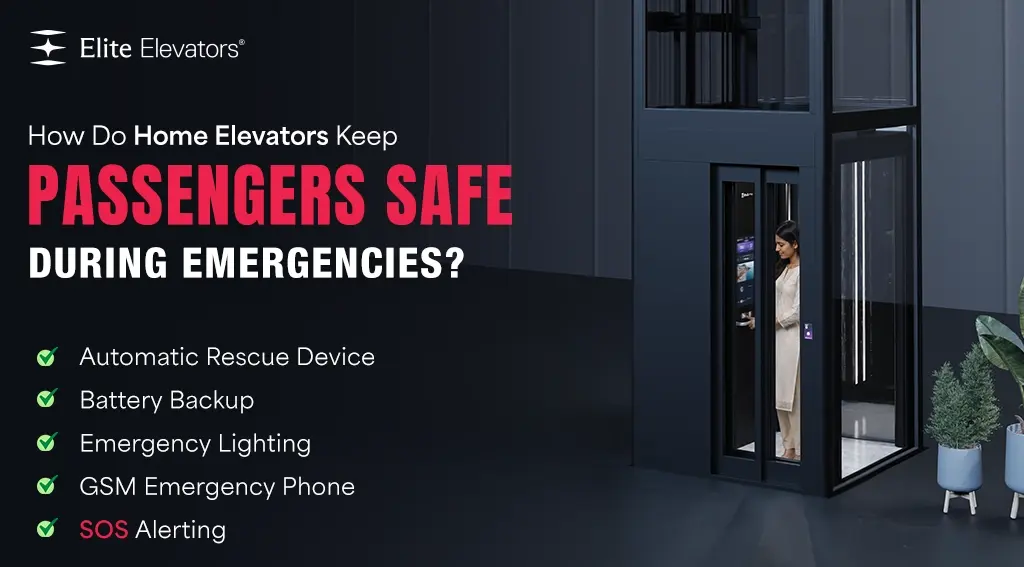
The cabin moves to safety. An Automatic Rescue Device (ARD) detects the loss of mains supply, switches to a battery, and drives the cabin at reduced speed to the nearest landing then opens the doors. Nobody presses anything. Nobody waits. This is the single most important emergency feature in a residential lift, and it’s the first thing to confirm on any quotation.
The lights stay on. Battery-backed cabin lighting matters more than it sounds. Darkness is what turns a brief stop into panic, particularly for children and elderly passengers.
Communication survives. The lift’s emergency phone must run independently of your household power and your Wi-Fi, which is why GSM-based calling has replaced the old intercom-to-the-gate arrangement in modern home lifts.
On hydraulic systems, there’s an additional inherent advantage: controlled gravity lowering. Because descent doesn’t require the pump to drive it, a hydraulic lift can be brought down safely on battery power alone with minimal energy draw.
The Core Elevator Rescue System: Devices That Do the Work for You
An elevator rescue system is a chain of components, and it’s only as strong as its weakest link.
- Automatic Rescue Device. Battery-driven controlled movement to the nearest floor, with automatic door opening. Verify the battery’s rated capacity and how often it needs replacing.
- Emergency lowering. On hydraulic and cogbelt systems, a battery-operated lowering function releases the cabin downward under control. Some models allow a technician to trigger this manually from outside the cabin.
- Trap door and emergency lighting. A code-required escape route in the cabin ceiling, plus lighting to use it. Important caveat: this exists for trained rescuers, not passengers. Never attempt to use it yourself.
- GSM emergency phone with battery backup. A cellular phone inside the cabin, powered by the lift’s own battery, connecting to a named contact or a service desk. Works during outages and doesn’t depend on your broadband.
- SOS alerting. A single button that notifies your emergency contacts and the manufacturer’s technical team simultaneously so help is dispatched even if the passenger can’t explain where they are or what happened.
- Fault notification. An error detection system that reports irregularities to the service network in real time, often before the passenger notices anything wrong.
Elevator Passenger Safety: The Protections You Never See
Emergencies aren’t only power cuts. Several features exist to prevent the more serious failures entirely, and they define elevator passenger safety in practice.
- Overspeed governors monitor cabin velocity and engage brakes if it exceeds safe limits. The better residential systems monitor both directions upward; overspeed is a real, if less discussed, failure mode.
- Dual emergency brakes provide redundancy: a second independent braking path if the first fails.
- Door interlocks and safety curtains prevent movement unless the doors are fully closed and locked, and stop closure if anything a hand, a walking stick, a pet breaks the beam.
- Overload detection refuses to move an over-capacity cabin rather than straining the drive.
- Low voltage cabin operation removes AC mains power from inside the cabin entirely, eliminating shock risk. This is a meaningful advantage in homes with children.
- Phase voltage protection shuts the lift down safely during over- or under-voltage rather than letting a fluctuating supply damage the controller, genuinely relevant on Indian residential supply.
- Underpinning all of it: certification. EN 81-41 and Machinery Directive 2006/42/EC are the European standards written specifically for lifts in private residences. Ask to see the certificates, not just the claim.
What Passengers Should Actually Do in an Emergency
Emergency features work best when passengers know the protocol. Share this with everyone in your household, including children and domestic staff.
- Stay inside the cabin. It is the safest place. A stationary cabin is not falling and is not going to.
- Don’t try to force the doors or use the trap door. Almost all serious lift injuries involve people attempting to self evacuate.
- Press the SOS or emergency call button and stay on the line.
- Wait for the ARD. In most power cut scenarios the lift will move to a landing and open the doors on its own within moments.
- If a child or elderly parent uses the lift alone, rehearse this. Knowing which button to press, once, in advance, is worth more than any feature on the specification sheet.
How Elite Elevators Builds Emergency Safety Into Every Model
Elite Elevators treats emergency protection as standard equipment rather than an upgrade tier. Every lift from the entry level X200 to the flagship X300 MK II Plus is ISO certified and built to EN 81-41 and Machinery Directive 2006/42/EC, with layered emergency systems designed for Indian conditions including frequent outages and voltage fluctuation.
| Emergency feature | X200 | X200 Plus | X300 Mark II | X300 MK II Plus | E200 | E300 |
| Automatic Rescue Device (ARD) | ✅ | ✅ | ✅ | ✅ | ✅ | ✅ |
| Battery-operated emergency lowering | ✅ | ✅ | ✅ | ✅ | ✅ | ✅ |
| Emergency cabin lighting on battery | ✅ | ✅ | ✅ | ✅ | ✅ | ✅ |
| Trap door escape access | ✅ | — | ✅ | ✅ | — | — |
| GSM emergency phone with battery backup | ✅ | ✅ | ✅ | ✅ | ✅ (Autodialer + GSM) | ✅ (in-cabin GSM) |
| Live SOS alerting to support team | — | ✅ Live SOS | — | ✅ Live SOS 2.0 | — | — |
| Fault detection & instant alerts | ✅ ENS | ✅ ENS | ✅ | ✅ Dynamic ENS | ✅ | ✅ AENS |
| Dual overspeed governors (both directions) | — | — | ✅ | ✅ | — | — |
| Dual emergency brakes | — | ✅ | — | — | — | ✅ |
| Door safety curtain / obstruction sensors | ✅ | ✅ | ✅ | ✅ | ✅ | ✅ |
| Overload detection | ✅ | ✅ | ✅ | ✅ | ✅ | ✅ |
| Low-voltage cabin (no AC power inside) | ✅ | ✅ | ✅ | ✅ | ✅ 24 V | ✅ 24 V |
| Phase voltage protection | — | — | ✅ | ✅ | — | — |
| App / remote monitoring | — | ✅ App | ✅ App | ✅ App + VisionLog | — | ✅ CAN bus diagnostics |
Beyond the hardware, three Elite Elevators features change how emergencies resolve. Live SOS 2.0 on the X300 MK II Plus alerts your emergency contacts and our technical team from a single touch. Dynamic ENS performs real time fault detection, so our service network is often aware of a developing issue before you are. And on the E300, a CAN bus connection lets engineers diagnose the lift remotely and push software updates without a site visit cutting response time when it matters.
The E200 carries 194 integrated safety parameters and EN 81-41 certification; the E300 holds SIL 3 certification, a functional safety level well above the residential baseline, with German engineering by TK Access Solutions.
Emergency Support You Can Actually Reach
Features are only half of emergency safety. The other half is whether someone answers.
Elite Elevators operates a nationwide service network with a dedicated emergency service line, annual service contracts, and on-call support for the life of the lift, not just the warranty period. Customers consistently describe this as the deciding factor: Mohammad Azeez noted our CRM team “followed up my case with the technical team and resolved the issue, had continuous contact with me until the issue got resolved.”
Whether you need home lift safety support in Chennai, elevator emergency service in Bangalore, a lift rescue system in Hyderabad, or coverage across Mumbai, Pune, Delhi NCR, Ahmedabad, and Kochi, the same service infrastructure applies. Note too that Tamil Nadu, Karnataka, Maharashtra, and Delhi operate Lift Acts requiring registration and periodic inspection of lifts in private buildings our teams handle that compliance as part of installation and servicing.
Frequently Asked Questions
1. What happens if the power goes off while I’m inside a home lift?
On any Elite Elevators lift, the Automatic Rescue Device detects the outage, switches to battery power, moves the cabin to the nearest floor, and opens the doors automatically, without you pressing anything. Cabin lighting stays on throughout via battery backup.
2. Can I get stuck in a home elevator?
It’s rare on a certified lift with a working ARD because the lift is designed to reach a landing under battery power. If the cabin does stop, stay inside, press the SOS or emergency call button, and wait. Never attempt to force the doors or use the ceiling trap door.
3. Does the emergency phone work if there’s no electricity or internet?
Yes. Elite Elevators lifts use a GSM-enabled phone powered by the lift’s own backup battery, so it operates independently of your household electricity and your Wi-Fi connection.
4. How often should emergency features be tested?
Have the ARD, backup battery, emergency lighting, and GSM phone checked at every scheduled service visit; batteries degrade with age and are the most common point of failure in an otherwise sound emergency system. An annual service contract covers this systematically.
5. Are home lifts safe for children and elderly passengers to use alone?
With the right features, yes ARD, door safety curtains, low-voltage cabin operation, and one-touch SOS are all designed for exactly this. What matters as much is rehearsal: make sure they know to stay inside and press the SOS button once.
Note: * Prices listed are starting rates, exclude applicable taxes, and may vary based on customization.