

 Add Elite as Preferred


Touchless elevator systems use biometrics, AI, and IoT to eliminate button contact and add smart home control. Elite Elevators’ X300 MK II Plus is India’s only AI-powered home elevator with biometric access and real-time fault monitoring.
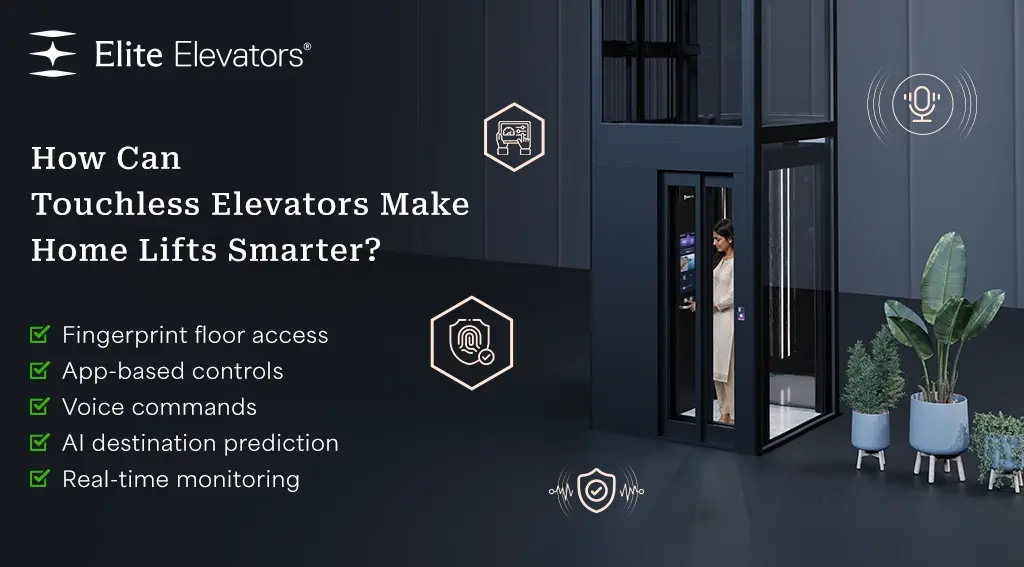
Elevator buttons are touched hundreds of times a day by different hands. In homes with elderly family members, young children, or anyone with reduced immunity, that is a genuine concern and it is one that smart elevator technology has already solved in several different ways.
This guide covers how touchless elevator systems work, which technologies are available in India today, and what actually makes a difference in daily home life versus what is simply a marketing term.
Table of Contents
- Why Touchless Matters Beyond Hygiene
- Types of Touchless and Smart Elevator Technologies Available Today
- 1. Infrared Proximity Sensors
- 2. Mobile App Floor Selection
- 3. Biometric Fingerprint Floor Selection
- 4. Voice Command Integration
- 5. AI-Powered Destination Prediction
- Touchless Technology Comparison
- What IoT Elevator Features Actually Mean in Daily Home Life
- What to Ask Before Choosing a Touchless or Smart Elevator
- How Elite Elevators Delivers Touchless and Smart Technology ?
Why Touchless Matters Beyond Hygiene
The conversation about contactless lift solutions started during the pandemic, but the reasons to want one go well beyond infection control.
For elderly users with limited dexterity or tremors, pressing small buttons precisely is a daily frustration. For users carrying bags, groceries, or mobility aids, a free hand to press a button is not always available. For parents with young children, the cabin button panel is an invitation for every floor to be pressed simultaneously.
A well-designed touchless elevator system removes all of these friction points, not just the hygiene one.
Types of Touchless and Smart Elevator Technologies Available Today
1. Infrared Proximity Sensors
The most common contactless lift solution found in commercial buildings. A sensor detects when a finger moves close to a button zone and registers the selection without physical contact. Reliable, widely deployed, and relatively simple to retrofit.
Best for: Office buildings, hospitals, high-traffic buildings.
Limitation: Still requires the user to navigate to the correct button zone; no intelligence in the system itself.
2. Mobile App Floor Selection
IoT elevator features that allow passengers to select their floor from a smartphone before or during boarding. The elevator is called, the floor is selected, and the cabin arrives all without the user touching a single panel.
Best for: Premium residential homes, smart buildings.
What it delivers: Complete hands-free operation for every family member with a smartphone.
3. Biometric Fingerprint Floor Selection
The most advanced contactless lift solution currently available for residential homes. The passenger places their finger on a biometric sensor not a button panel, and the elevator automatically selects the correct floor based on their registered profile.
This is not just touchless in the hygienic sense. It removes visible controls from the cabin interior entirely, creating a seamless, uncluttered surface. It also restricts floor access to authorised users so children cannot access certain floors and visitors cannot reach restricted areas.
Best for: Premium homes, villas, homes with elderly users who benefit from simplified controls.
4. Voice Command Integration
Emerging in premium smart home installations, voice-activated floor selection allows passengers to simply state their destination. The system responds without any physical or proximity interaction.
Best for: Smart homes with integrated home automation systems.
5. AI-Powered Destination Prediction
AI-powered elevators take the concept furthest. Instead of requiring any input at all, the system learns the household’s daily movement patterns over time—who goes where at what time of day—and begins predicting and pre-selecting destinations before the passenger has to do anything.
Best for: Active multi-generational households where usage patterns are consistent and daily convenience is the priority.
Touchless Technology Comparison
| Technology | Input Required | Best For | Complexity |
| Infrared Sensor | Proximity gesture | Commercial, hospital | Low |
| Mobile App | Smartphone tap | Premium residential | Medium |
| Biometric Fingerprint | Finger on sensor | Home, villa | Medium |
| Voice Command | Voice | Smart homes | High |
| AI Prediction | None | Active households | High |
What IoT Elevator Features Actually Mean in Daily Home Life
- IoT elevator features in a home lift are not about technology for its own sake. They solve real, daily problems.
- Real-time fault monitoring means the system detects and reports irregularities automatically before they become breakdowns. The maintenance team knows there is an issue before the family does.
- Remote monitoring via app means family members can check cabin status, usage history, and fault alerts from their phone providing genuine peace of mind when an elderly family member uses the lift independently.
- Over-the-air software updates mean the elevator’s performance can be improved and updated without a technician visit the same principle that keeps smartphones current without hardware replacement.
- Restricted floor access via app or biometric means specific floors can be locked to specific users protecting home offices, storage areas, or children’s rooms from unrestricted access.
What to Ask Before Choosing a Touchless or Smart Elevator
Not every product that claims to be “smart” or “touchless” is genuinely useful in daily home life. Before choosing, ask:
- Does the touchless feature work reliably every time, or does it require multiple attempts?
- Is the app available on both iOS and Android?
- Does biometric recognition work for every family member including elderly users with less distinct fingerprints?
- What happens during a power failure does the touchless system have a manual backup?
- Is the smart monitoring system proactive (detects issues before failure) or reactive (alerts you after the fault appears)?
How Elite Elevators Delivers Touchless and Smart Technology ?
Elite Elevators’ X300 MK II Plus is India’s only home elevator with AI-powered floor prediction learning household patterns and anticipating destinations before the passenger selects them. Biometric fingerprint floor selection eliminates the control panel from the cabin interior entirely. Mobile App Connectivity gives every family member remote control and real-time monitoring from their phone. ENS real-time fault monitoring keeps the lift proactively maintained between service visits.
The X300 Mark II adds app connectivity and smart floor restriction. The X200 Plus adds Live SOS alerts and basic app integration. Every model across the range includes safety communication as standard.
Frequently Asked Questions
1. What is a touchless elevator system?
A touchless elevator system allows passengers to select floors and operate the lift without physically pressing buttons using technologies like infrared sensors, mobile apps, biometric fingerprints, voice commands, or AI prediction.
2. Are touchless elevators available for homes in India?
Yes. Biometric floor selection and mobile app connectivity are available on premium home elevators in India today, including the Elite Elevators X300 range. AI-powered destination prediction is available on the X300 MK II Plus.
3. What is the difference between a contactless lift and a smart elevator?
A contactless lift eliminates physical button contact. A smart elevator adds intelligence learning patterns, monitoring performance in real time, and connecting to other home systems via IoT. The best systems offer both.
4. What are IoT elevator features?
IoT features in a home elevator include real-time fault monitoring, mobile app control and notifications, remote diagnostics, over-the-air software updates, and usage history tracking all accessible from a smartphone.
5. Are AI powered elevators available in India?
Yes. The Elite Elevators X300 MK II Plus is India’s only AI-powered home elevator, with Elite AI that learns household movement patterns and predicts floor destinations over time.
Note: * Prices listed are starting rates, exclude applicable taxes, and may vary based on customization.



Vikrant Tomar
This was a very informative guide on how touchless elevator technology is changing the way people think about home mobility. I especially liked the explanation of biometric access, mobile connectivity, and AI-based features. A touchless elevator can offer both convenience and better control while also supporting modern safety expectations for families.
Shreya Kulkarni
This article gives a clear overview of the evolution from traditional elevator buttons to more advanced contactless solutions. I liked how each technology was explained according to its actual use case and limitations. A modern elevator with biometric or app-based controls can provide a cleaner, more convenient experience without compromising the importance of safety systems.
Anmol Bhat
Very informative content for homeowners researching touchless elevators for safety and convenience. The explanation of biometric fingerprint selection was particularly interesting because it combines simple operation with controlled floor access. It shows how a touchless elevator can be more than a hygiene solution and can also contribute to accessibility, privacy, and easier everyday movement.
Kiran
A well-structured guide that explains modern elevator technology in an easy-to-follow manner. The comparison table is useful for understanding the different levels of interaction required by infrared, smartphone, biometric, voice, and AI systems. Anyone planning a modern elevator installation can use these points to decide which features actually provide value for their household.
Aarti Chatterjee
This is a valuable resource for anyone looking into convenient elevator solutions for a residential property. I found the explanation of mobile app connectivity and floor restrictions especially relevant because these features can provide both flexibility and control. Modern elevator systems are clearly moving toward connected operation, and this article explains that transition very well.
Shubham Yogi
Excellent overview of how touchless and smart technologies are improving residential elevator experiences. The article covers hygiene, accessibility, security, monitoring, and convenience without losing focus on practical use. The biggest takeaway for me is that a modern elevator should combine advanced features with dependable safety systems, making touchless elevator technology genuinely useful for everyday family life.