

 Add Elite as Preferred
 IoT and smart technology help elevator maintenance companies shift from reactive repairs to predictive service, detecting faults before they cause failures. Elite Elevators builds this intelligence into every model, from ENS real-time alerts to CAN Bus remote diagnostics on the E300.
Picture this. It is a Tuesday evening. Your home elevator stops between floors. You press the emergency button, wait, and wonder how long it will take for someone to show up. A technician arrives hours later, diagnoses the problem, orders a part, and schedules a return visit for next week. Two trips. Four days of disruption. A completely avoidable situation.
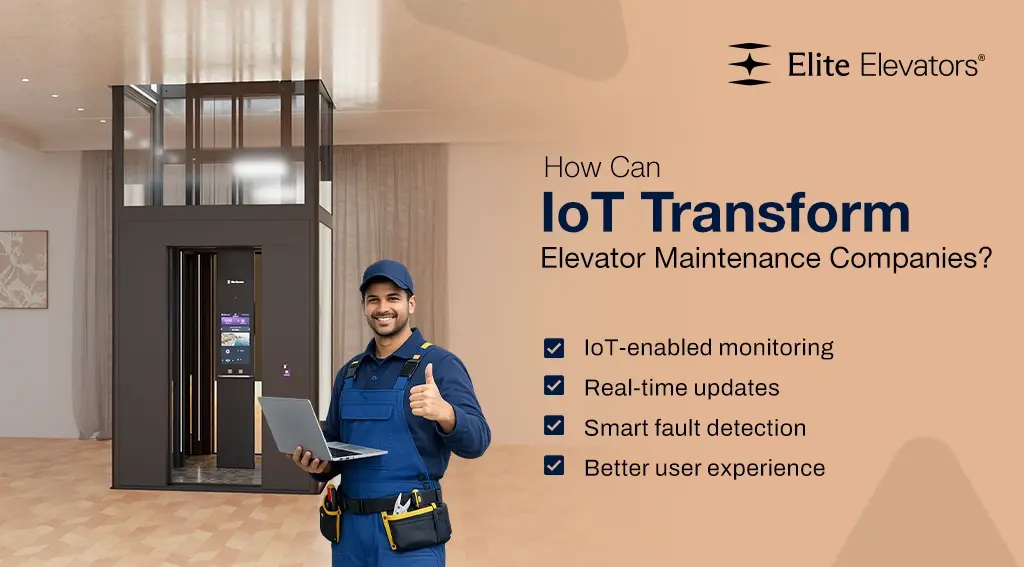
Table of Contents
Now picture the alternative. Your elevator’s internal sensors detect an irregularity in the belt tension at 3 AM on Monday. Before you wake up, the system has already flagged the issue, logged the fault code, and sent an alert to your elevator maintenance company. A technician calls you Tuesday morning to schedule a fifteen-minute fix before the elevator ever stops working. You never even knew there was a problem.
That is the difference IoT and smart technology are making to how elevator maintenance companies operate and why choosing a company that has embraced these tools is one of the most important decisions a home elevator owner can make in 2026.
What Is IoT in the Context of Elevator Maintenance?
IoT the Internet of Things, refers to the network of sensors, processors, and communication systems embedded in physical devices that allow them to collect, share, and act on data in real time. In a smart elevator service context, this means your elevator is no longer a mechanical box that either works or breaks. It becomes a connected system that monitors its own performance continuously, communicates with a service platform, and enables remote diagnosis and intervention.
The sensors involved in modern IoT elevator maintenance monitor a remarkable range of variables: motor temperature, door cycle counts, belt tension, leveling accuracy, vibration patterns, power consumption, and cabin weight distribution, among others. Any deviation from normal parameters triggers an alert long before it becomes a failure. The result is a fundamental shift from reactive maintenance fixing it when it breaks to predictive maintenance preventing it from breaking in the first place.
How Smart Technology Changes What Elevator Maintenance Companies Can Do
Traditional elevator maintenance companies operated on fixed schedules. A technician visited every three or six months, performed a standard checklist inspection, and left. The problem with this model is that elevators do not fail on schedule. A belt that develops unusual tension in week two of a six-month cycle goes undetected for months, and the first sign of the problem is a complete failure.
IoT changes this model entirely. Here is what smart-equipped maintenance operations can now deliver:
- Remote fault detection: Sensors flag irregularities the moment they appear. Technicians review the data remotely and determine whether an in-person visit is required, what part is needed, and how urgent the repair is before the first call is made.
- Predictive part replacement: Usage data shows when components approach end-of-life based on actual cycle counts and load history, not calendar dates. Parts are ordered and replaced proactively, not reactively.
- Over-the-air software updates: On smart home lift platforms like the Elite Elevators CAN Bus system on the E300 Cogbelt, firmware and performance parameters can be updated remotely. No site visit required.
- Usage analytics: Data on trip frequency, peak usage times, and load patterns allows maintenance schedules to be calibrated to actual use rather than generic intervals.
- Faster emergency response: When a fault does occur, the maintenance team already has full diagnostic data before the technician departs. First-visit resolution rates improve dramatically.
Why This Matters More for Home Elevators Than Commercial Ones
Commercial elevators in office buildings and hotels have full-time facilities management teams. Home elevators do not. The homeowner is the only person monitoring performance, and most homeowners have no way to assess whether an elevator is performing optimally or quietly degrading. IoT elevator maintenance bridges this knowledge gap, giving home elevator owners the same level of proactive monitoring that large commercial operations have always had.
For families with elderly members or mobility-challenged users who depend on the elevator daily, this is not a convenience feature; it is a safety imperative. An elevator that fails unpredictably in a home with a senior resident is a genuine emergency. An elevator monitored by smart sensors with a proactive maintenance team behind it is one that effectively never fails unexpectedly.
What to Look for in a Smart Elevator Service Provider
Not every elevator maintenance company has made an investment in IoT infrastructure. When evaluating a service provider, ask these specific questions:
- Does the elevator model support remote diagnostics via CAN Bus or equivalent connectivity?
- Can the maintenance team access real-time fault logs without a site visit?
- Is predictive maintenance part of the AMC or only reactive repair?
- Are software and firmware updates delivered over the air or only by technician visits?
- What is the average first-visit resolution rate for fault calls?
A maintenance company that cannot answer these questions confidently is still operating on the old model, which means your elevator gets attention only when something goes wrong.
The Role of Smart Home Integration
The most advanced smart technology elevators in 2026 do not operate in isolation from the rest of the home. Mobile app connectivity, real-time status monitoring, usage history, and remote control are standard features on the latest residential elevator platforms. This integration means the homeowner and the maintenance company are looking at the same live data simultaneously, creating a genuinely collaborative relationship between the user, the elevator, and the service team.
When your elevator maintenance company can see what your elevator sees, proactive service becomes genuinely possible. That is the standard that forward-thinking home lift manufacturers are building toward and the standard you should expect from any company maintaining your lift.
The Right Models for Smart Maintenance
Not all elevators are built for IoT integration. Here are the Elite Elevators models designed with smart connectivity at their core and the features that make proactive maintenance possible:
- X300 MK II Plus — Elite AI, Dynamic ENS real-time fault detection, mobile app integration, and VisionLog cabin camera. The most connected home elevator in India.
- X300 Mark II—Real-Time Belt Monitoring, Smart App Connectivity, Dynamic ENS, Call Button Jam Detection.
- X200 Plus — ENS Instant Alerts, Live SOS V1, Mobile App V1 connectivity.
- X200 — ENS fault detection and reporting, ARD, GSM emergency backup.
- E300 Cogbelt — CAN Bus Connection for remote diagnostics and software updates. The only home elevator in India with SIL 3 certification and over-the-air update capability.
- E200 Hydraulic — 194 integrated safety parameters, automatic platform control, battery-operated emergency lowering.
- E50 Stairlift — Battery-powered with continuous charging, obstruction detection, and smooth ASL technology.
Frequently Asked Questions
1. What does IoT mean for elevator maintenance companies?
IoT allows maintenance companies to monitor elevator performance in real time through embedded sensors detecting faults, predicting failures, and resolving issues remotely before they affect the user. It shifts the model from reactive repair to proactive prevention, which is particularly valuable for home elevators where no dedicated facilities team is present.
2. How does smart technology reduce elevator downtime?
Smart sensors continuously monitor components like belts, motors, and door mechanisms. Anomalies are detected and flagged early, often before the fault becomes a failure. Combined with remote diagnostics, this means most issues are resolved in a single visit with the right part already in hand, dramatically reducing the time the elevator is out of service.
3. Which home elevators in India support IoT and remote diagnostics?
The Elite Elevators E300 Cogbelt supports CAN Bus remote diagnostics and over-the-air updates. The X300 MK II Plus includes Dynamic ENS real-time fault detection and full mobile app connectivity. The X300 Mark II features real-time belt monitoring and smart app integration. The X200 Plus includes ENS Instant Alerts and Live SOS connectivity.
4. Is smart elevator service more expensive than traditional maintenance?
Predictive maintenance typically reduces the total cost of ownership over time. By catching component wear early, it prevents expensive emergency repairs and minimises downtime. The upfront investment in a connected elevator platform pays back through fewer reactive call-outs, longer component life, and more efficient scheduled service visits.
5. Can existing home elevators be upgraded for IoT connectivity?
Some retrofitting is possible depending on the elevator’s existing control architecture. However, the most comprehensive smart maintenance capabilities are built into the elevator’s core systems at the manufacturing stage, which is why choosing a smart-ready model from the outset delivers the best long-term value.
Note: * Prices listed are starting rates, exclude applicable taxes, and may vary based on customization.



Poonam Gupta
This blog was genuinely helpful and explained how IoT in elevators is changing the way modern lifts are maintained. I never realized that predictive monitoring could prevent unexpected breakdowns before they happen. Anyone comparing elevator maintenance companies should definitely read this before making a decision. Great insights and easy to understand.
Dheeraj Varma
I was searching for reliable information about elevator maintenance services, and this article answered many of my questions. The explanation about remote diagnostics and smart monitoring made the topic very easy to understand. It is useful for anyone planning to choose a trusted lift service provider for long-term reliability.
Hemalatha Raj
Excellent article with practical information about smart elevator technology. The comparison between traditional servicing and predictive maintenance clearly shows why connected elevators are the future. This blog helped me understand what questions to ask elevator service companies before purchasing a home elevator.
Ramesh Kumar
I found this blog while looking for elevator maintenance, and it was worth reading from start to finish. The examples made it easy to understand how smart sensors reduce downtime. It is good to see such detailed information shared for homeowners who want reliable and safer elevator performance.
Akshaya Nair
This was one of the most informative blogs I have read about IoT in elevators. The explanation of predictive maintenance and real-time fault alerts was simple yet detailed. Anyone searching for elevator companies near me should first understand these technologies because they make a huge difference in long-term service quality.
Sasi Kumar
Great blog with valuable information about modern elevator maintenance services. The content explains how connected systems help technicians identify issues before they become serious problems. This gives homeowners much more confidence in the performance and safety of their elevators over time.
Varalakshmi Devi
This article is very informative and written in a simple language that anyone can understand. The details about IoT in elevators and preventive servicing show how technology is improving home elevators. Definitely recommended for anyone researching elevator maintenance before investing in a lift.
Praveen Kumar
I appreciate the effort that went into writing this blog. It explains why modern elevator service companies are moving toward predictive maintenance instead of waiting for breakdowns. The content helped me understand how connected elevators improve reliability, safety, and overall customer experience.