

 Add Elite as Preferred


Smart home lifts are transforming how Indian families experience vertical mobility. This guide explores IoT-enabled features, AI-powered controls, and how providers like Elite Elevators are building genuinely smart residential lifts in 2026.
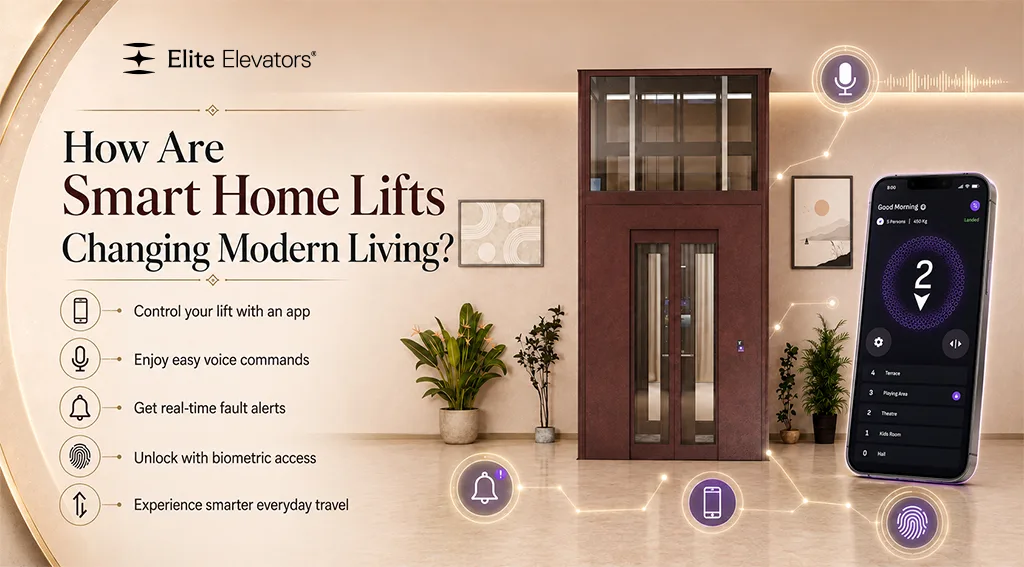
Home elevators used to be simple machines press a button, wait, get where you’re going. That’s changing quickly. Smart home lifts India-wide are now arriving with app controls, voice commands, and sensors that quietly monitor performance in the background. It’s a genuine shift in how homeowners interact with a lift, not just a marketing buzzword slapped onto an old product.
Table of Contents
This guide looks at what “smart” actually means in the context of a home elevator, what’s worth paying attention to before choosing one, and how providers like Elite Elevators are approaching this shift.
What Does “Smart” Actually Mean for a Home Lift?
The term gets used loosely, so it helps to break down what genuinely smart features look like in practice.
- Remote control via app: Adjusting lighting, fan speed, or door timing from a phone, without needing to be inside the cabin or at the landing panel.
- Predictive usage patterns: Some AI powered home elevators learn daily usage habits over time recognising, for instance, that a particular floor is requested most often in the mornings, and adjusting accordingly. Elite Elevators’ own take on this, built into its premium models, learns a household’s habits well enough to respond to voice commands and predict likely destinations without manual input every time.
- Real-time fault detection: Sensors that flag irregularities immediately, rather than waiting for a scheduled maintenance visit to catch a developing issue.
- Voice and biometric access: Fingerprint-based floor selection or voice commands that remove the need for physical buttons altogether a fingerprint touch that automatically selects the right floor without anyone needing to press anything.
None of these change how the lift physically moves they change how you interact with it day to day, and how quickly issues get caught before they become real problems.
Why IoT-Enabled Elevators Are Gaining Traction in India
The rise of IoT enabled elevators in Indian homes isn’t really about novelty it’s about two practical benefits: convenience and early problem detection.
Convenience is the obvious one. Controlling lighting, fan speed, or door timing from an app, or having custom voice announcements recorded for each floor, makes daily use noticeably smoother, especially in larger households where different family members might prefer different settings.
Early detection matters more than most homeowners initially realise. A connected lift can flag unusual belt tension, irregular movement, or a sensor fault well before it becomes a breakdown meaning fewer surprise repair calls and a longer effective lifespan for the equipment. Some premium systems take this further with remote diagnostic connectivity, where technicians can access performance data and push software updates without needing an in-person visit for every check-up. This kind of real-time diagnostic monitoring is where smart residential lifts have genuinely moved past being a gimmick.
How AI Is Changing the Way Home Elevators Operate
AI’s role in home elevators is still fairly new in India, but it’s moving quickly beyond gimmick territory. A handful of genuinely useful applications are already showing up:
- Learning which floors are used most often at particular times of day, and responding to voice or touch accordingly
- Adjusting ride speed and door timing based on stored user preferences
- Flagging maintenance needs based on usage patterns rather than fixed schedules
- Enabling voice-based floor selection without needing to touch a panel
- Sending photo-based alerts if someone attempts to use the lift without authorisation
These features matter most in households with elderly residents or young children, where reducing the number of physical interactions with buttons or panels genuinely improves ease of use. Elite Elevators has leaned into this with an in-house AI system that responds to both voice and touch, alongside a wide-angle in-cabin camera that lets families keep an eye on usage or check in on loved ones remotely useful for peace of mind rather than just convenience.
What a Genuinely Smart Cabin Experience Looks Like
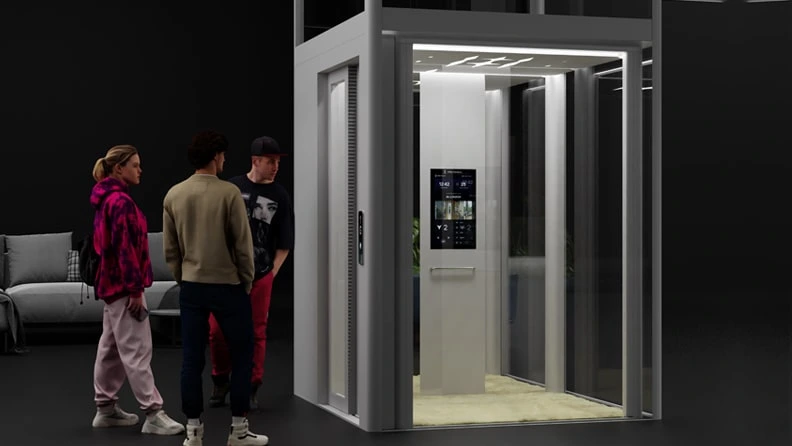
Beyond the back-end intelligence, a lot of the “smart” experience shows up directly inside the cabin. A large interactive touch display, for example, can go well beyond just selecting a floor, showing real-time weather, the clock, or even letting kids draw or play games during the ride. Some systems let users personalise this display entirely, right down to uploading their own wallpaper or a short video.
Magnetic-driven controls are another quieter but meaningful upgrade replacing older mechanical relays with magnetic sensors for smoother, more precise floor levelling every time, so the cabin lines up exactly with the floor rather than needing a small step up or down. Paired with gentle acceleration technology that removes jerky starts and stops, the ride itself becomes part of the “smart” experience, not just the controls around it.
What to Look for in a Smart Residential Lift
Not every “smart” lift on the market delivers the same depth of features. A few things worth checking before choosing one:
- Does the app actually work reliably? A smart feature that’s clunky or frequently disconnects defeats the purpose. Ask for a live demonstration rather than relying on marketing claims.
- Is the smart functionality built in, or bolted on? Some systems retrofit basic connectivity onto older mechanical designs, while others are engineered from the ground up with smart features in mind. The latter tends to be more reliable long-term. Elite Elevators, for instance, builds its app-based controls, biometric access, and cabin display directly into the electronics from the start, rather than adding them as a separate afterthought layer.
- What happens if the internet connection drops? A genuinely well-designed smart residential lift should still operate normally on manual controls even without connectivity smart features should be an enhancement, not a dependency.
- Is fault detection proactive or just reactive? Ask specifically whether the system flags issues before they cause a breakdown, or only logs problems after something’s already gone wrong. Look for an active error-notification system that reports irregularities as they happen, rather than one that only surfaces problems during scheduled servicing.
- Is access control genuinely secure? Beyond convenience, check whether the system supports layered access PIN codes alongside biometric restriction on specific floors so you can control exactly who uses the lift and when, which matters in larger households or homes with domestic staff.
Balancing Smart Features With Everyday Reliability
It’s easy to get drawn in by an impressive feature list, but the fundamentals still matter most a smart lift that’s occasionally unreliable isn’t actually an upgrade over a simple, dependable one. The best approach is choosing a provider that treats smart features as an addition to solid mechanical engineering, not a replacement for it.
This is exactly the balance Elite Elevators tends to strike pairing precision-engineered drive systems and gentle ride technology with smart features layered on top, rather than leading with technology at the expense of core reliability. It’s a useful benchmark to keep in mind while comparing providers: does the smart layer genuinely add value to a dependable lift, or is it covering for a weaker underlying system?
Is a Smart Home Lift Worth the Extra Cost?
Smart features typically add a modest premium over a standard lift, mainly for the sensors, connectivity hardware, and app development involved. Whether it’s worth it depends on your household’s priorities families with elderly members often find the fault-detection, camera monitoring, and voice-access features genuinely valuable, while others may prioritise simpler controls and lower upfront cost.
There’s no universally right answer here. It comes down to how much daily value the smart layer actually adds to your specific household’s routine, and whether the provider you’re considering treats these features as genuinely functional rather than purely decorative.
Frequently Asked Questions
1. Are AI-powered elevators more expensive to maintain?
Not necessarily in fact, early fault detection often reduces long-term maintenance costs. Catching issues before they become breakdowns typically saves money over time. The main added cost is usually at the point of installation.
2. Can smart features be added to an existing home lift?
It depends on the original system’s design, but some retrofitting is possible in certain cases. Systems built with smart functionality from the start, including app control and biometric access, tend to offer more reliable integration. A provider can assess this during a site visit.
3. What’s the main benefit of an IoT-enabled elevator?
The biggest practical benefit is early fault detection combined with everyday convenience features like app control and voice announcements. This reduces the chances of unexpected breakdowns. It also makes daily use noticeably smoother for larger households.
4. Is voice control reliable in a home elevator?
Yes, when properly implemented, voice control works reliably for floor selection and basic settings adjustments. It’s particularly useful for elderly users or anyone with limited mobility. Manual controls remain available as a backup regardless.
5. Do smart lifts require more technical knowledge to operate?
Not really most smart features are designed to simplify usage, not complicate it. App interfaces are generally straightforward, and manual controls still work exactly as they would on a standard lift. Most users adapt within the first few uses.
Note: * Prices listed are starting rates, exclude applicable taxes, and may vary based on customization.



Rahima Begum
This blog gave me a much clearer understanding of what smart residential lifts actually offer. The discussion around IoT connectivity, predictive maintenance, voice control, and biometric access was particularly useful. Instead of simply listing features, the article explains how they can improve everyday convenience and reliability. It is a useful starting point for anyone comparing smart lifts for a modern home.
Divya Raj
The article provides a balanced view of smart home lifts rather than treating every new feature as essential. I particularly liked the points about checking app reliability, built-in technology, access control, and proactive fault detection. For homeowners considering smart elevators, understanding these differences can make it easier to separate useful technology from features that are mainly included for marketing purposes.
Priyadarshini
A very useful guide for understanding how smart lifts are changing modern homes. The explanation of app-based controls, personalised cabin settings, interactive displays, and remote monitoring helped me understand the technology from a homeowner’s perspective. The article also makes an important point that convenience should not come at the expense of reliability, safety, or proper maintenance.
Rajdeep Sarkar
This guide helped me understand that smart home lifts are much more than elevators with an app. The combination of AI, sensors, biometric access, voice controls, and remote diagnostics can change how a family interacts with its home elevator. I also appreciate the article’s focus on maintaining manual operation as a backup, because smart technology should make a lift easier to use rather than create another dependency.