Add Elite as Preferred
 You have decided to put a lift in your home. Then the quotations arrive: one at a serious price, another at nearly half, and every brochure promises “world-class safety.” Nothing tells you which claims are backed by a standard and which are pure marketing. This is the exact moment most Indian families make an expensive mistake, because the elevator safety standards India applies to residential elevators are almost never explained in plain language during a sales conversation.
What follows is predictable. The homeowner picks the cheapest unit, then learns after the slab is cast that the pit is too shallow for a compliant buffer, or that there is no overspeed protection, or that the state licensing authority won’t clear the installation. Retrofitting safety into a finished shaft costs far more than specifying it correctly at drawing stage, and a non-compliant lift is close to unsellable when the house changes hands, plus a nightmare in any insurance claim.
Table of Contents
Elite Elevators approaches this differently: the compliance conversation happens before your civil work, in writing, with drawings. This guide covers the codes that apply to home lifts in India, the physical provisions your building must make, how Elite Elevators handles each requirement, and twelve questions that expose any supplier cutting corners.
Who Should Read This
Homeowners 3–12 months from installation, architects and civil contractors specifying lifts, families retrofitting a lift into an existing house, and buyers installing for wheelchair access or aging parents. No engineering background needed.
The Codes and Regulations That Govern Home Lifts in India
Three layers apply, and any credible supplier, Elite Elevators included, should speak comfortably about all three.
- National Building Code of India (NBC 2016), Part 8 — Building Services. The umbrella code covers installation of lifts in buildings: shaft construction, machine spaces, ventilation, fire considerations and clearances. Most municipal building approvals reference the NBC.
- Indian Standards from BIS. The IS 14665 series is the principal set of elevator installation standards in India, covering outline dimensions, code of practice for installation, operation and maintenance, and inspection requirements. Ask which specific parts a supplier’s equipment and installation practice is assessed against.
- State lifts and escalators legislation. The layer homeowners most often miss. Lifts are regulated at the state level, and states including Maharashtra, Tamil Nadu, Karnataka, Delhi, Gujarat, and West Bengal have their own Acts and Rules requiring permission to erect, registration or a licence to operate, and periodic inspection by the electrical inspectorate or a designated lift inspector for private residences too, not only commercial buildings. Requirements and fees differ by state, so confirm your city’s current position before ordering equipment.
Alongside these, imported home lifts and lifting platforms are commonly designed and certified to EN 81-series European standards, including the standard for lifting platforms for persons with impaired mobility and the accessibility standard for lift usability, plus CE marking and ISO quality certification for the manufacturer. These are not a substitute for Indian statutory approval; they are evidence of the engineering behind the product. Elite Elevators supplies home elevators engineered to international home-lift safety standards and provides customers with the certificate and test-report pack rather than asking them to take a brochure claim on faith.
What Elevator Installation Safety Requires at Your Site
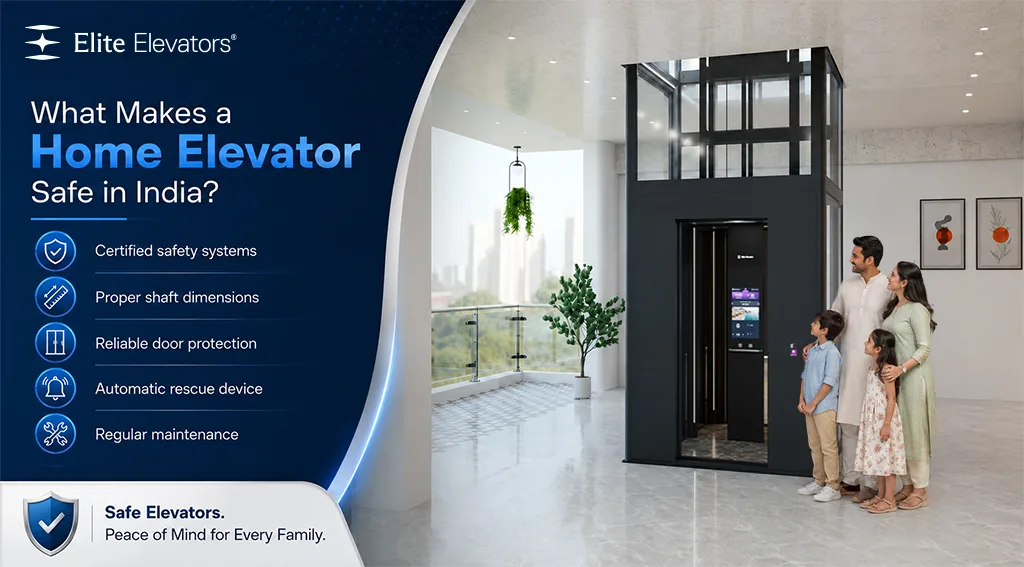
Lift safety regulations in India applies translate into physical provisions in your building. Elite Elevators issues these as a written specification before construction because every one of them is cheap to plan and expensive to retrofit:
- Pit depth: space below the lowest landing for buffers and safe maintenance access
- Headroom: clearance above the top landing so the elevator cannot strike the ceiling and a technician has refuge space
- Shaft dimensions and plumbness: an out-of-plumb shaft causes lifelong guide-rail wear and ride-quality problems
- Structural capacity: shaft walls or self-supporting structure must take rail reaction and impact loads, certified by your structural consultant
- Machine space: Elite Elevators home lifts are machine-room-less, but drive and controller locations still need ventilation, access, and water protection
- Electrical provisioning: dedicated circuit with correct rating, separate earthing, protection devices, and provision for the rescue-device battery
- Waterproofing and drainage: critical in Chennai, Mumbai, Kochi, Kolkata, and any stilt or basement pit
- Fire and egress: the lift must not compromise escape routes, and shaft materials must satisfy code
- Ventilation and lighting: in shaft, elevator, and pit
House elevator standards also govern what happens inside the elevator: rated load clearly marked, emergency alarm and two-way communication; emergency lighting, handrail, anti-slip flooring, full-opening door protection, and controls at a height a seated user can reach. Where accessibility is the reason for the lift, Elite Elevators specifies car dimensions and clear door width for wheelchair use explicitly in the order, not left to interpretation on site.
How Elite Elevators Handles Compliance for You
Three things separate a compliance-led supplier from a box-mover, and they are worth asking every brand about:
- Pre-construction specification. Elite Elevators reviews your architectural drawings and returns model-specific pit, headroom, shaft, structural, and electrical requirements in writing before your slab is cast.
- Approval support. Because state lift rules vary, Elite Elevators guides customers on the permission, registration, and periodic inspection requirements applicable in their city.
- Documented commissioning. Load, brake, safety-gear, door-protection, and levelling tests plus a live rescue-device demonstration are handed over with the report, drawings, O&M manual, and warranty.
12 Questions to Ask Before You Sign Including Us
Take this to every supplier meeting. Vague answers are the answer.
- Which standards is this lift designed, manufactured, and tested to see certificates?
- Will you support state licensing-authority permission and registration, or is that entirely on me?
- What pit depth, headroom, shaft size, and structural loads do you need, in writing?
- Is an automatic rescue device included? Walk me through a power cut, step by step.
- What is the overspeed and free-fall protection mechanism?
- Full-opening light curtain, or edge sensors only?
- Is installation by your own trained team or subcontracted?
- Which commissioning tests are performed, and do I get the report?
- AMC scope, visit frequency, emergency response time, and coverage in my city?
- Genuine parts and for how many years is availability guaranteed?
- What exactly does the warranty exclude?
- Can I speak to two of your customers in my city?
Elite Elevators is happy to answer all twelve in writing. Any supplier who won’t have told you something important.
Where Homeowners Most Often Go Wrong
Three patterns cause most regret. Buying on price alone: the gap between a compliant imported home lift and a locally fabricated unit is almost entirely safety systems, engineering, and service infrastructure. Deciding late, calling the lift company after the staircase and slab are done, forcing compromises on the pit, headroom, or shaft. Skipping the AMC saves an annual fee, which voids the assumption every safety standard rests on: that the equipment is maintained. Elite Elevators pushes customers to engage at the drawing stage precisely to avoid the first two.
Frequently Asked Questions
1. Do I need government permission to install a home lift in India?
In many states, yes, permission to erect, plus a licence or registration to operate and periodic inspection, including for private residences, usually administered by the electrical inspectorate or a designated lift inspector. Confirm your state’s current requirement before ordering, and ask your Elite Elevators consultant what applies in your city.
2. What is the minimum space required for an Elite Elevators home elevator?
It depends on model, capacity, and drive type. Machine-room-less home lifts work in compact footprints with shallow pits and modest headroom, which is why they suit retrofits into stairwells and courtyards. Elite Elevators provides model-specific pit, headroom, and shaft figures in writing before civil work begins.
3. Are EN 81 standards valid in India?
EN 81-series certification shows the product was designed and tested to recognised European lift safety standards and is widely used for imported home lifts, including those Elite Elevators supplies. It does not replace Indian statutory requirements; you still satisfy the NBC, applicable Indian Standards, and your state’s lift rules.
4. Is a home lift safe during a power failure?
With an automatic rescue device and battery backup standard on Elite Elevators home lifts, the car travels to the nearest landing and opens its doors. Without one, passengers wait for trained manual rescue. Treat the rescue device as non-negotiable, not an upgrade.
5. How do I verify a lift company is genuinely certified?
Ask for certificates and test reports as documents, then check certificate numbers and issuing bodies. Ask for a commissioning report from a recent installation and speak to two customers in your own city. Elite Elevators provides all three on request.
Related Case Studies:
1. Elite Elevators Case Study Highlights How Product Selection
2. What Should You Do If Your Elevator Shows Signs of a Malfunction?
3. How Remote Elevator Monitoring Can Improve Safety, Maintenance and Emergency Response
4. Residential Elevator Safety Features: Sensors, Brakes, Door Systems and More
5. How Regular Elevator Maintenance Prevents Accidents
Note: * Prices listed are starting rates, exclude applicable taxes, and may vary based on customization.