Add Elite as Preferred
 A lift jolts to a stop between the first and second floors. Someone is inside. In the next ten minutes, a family will make decisions that determine whether this becomes a manageable incident or a serious injury, and in the days after, whether the paperwork protects them or exposes them. Yet almost nobody knows the correct sequence of elevator accident reporting in India until they are standing in a lobby, phone in hand, guessing.
That gap is where the real damage happens. Well-meaning neighbours pry doors open and cause falls. The home lift is quietly restarted the same evening “because it seems fine now.” Nobody photographs the scene, saves the controller fault code, or informs the licensing authority, so when an insurance claim or a legal notice lands months later, there is no record of what happened or what was fixed. Meanwhile, the underlying fault, uninvestigated, is still sitting there waiting.
Table of Contents
Elite Elevators exists on the other side of that phone call. Along with a 24×7 emergency response line, Elite Elevators runs a documented post-incident process: trained rescue, root-cause investigation, written inspection report, corrective action, and formal return to service so owners are not improvising at the worst possible moment. This guide walks through each stage as it applies to Indian homes and residential buildings and shows where Elite Elevators takes the load off you.
Stage 1: The First 30 Minutes — Safe Rescue
Priorities in order: the passenger’s condition, then containment, then the equipment.
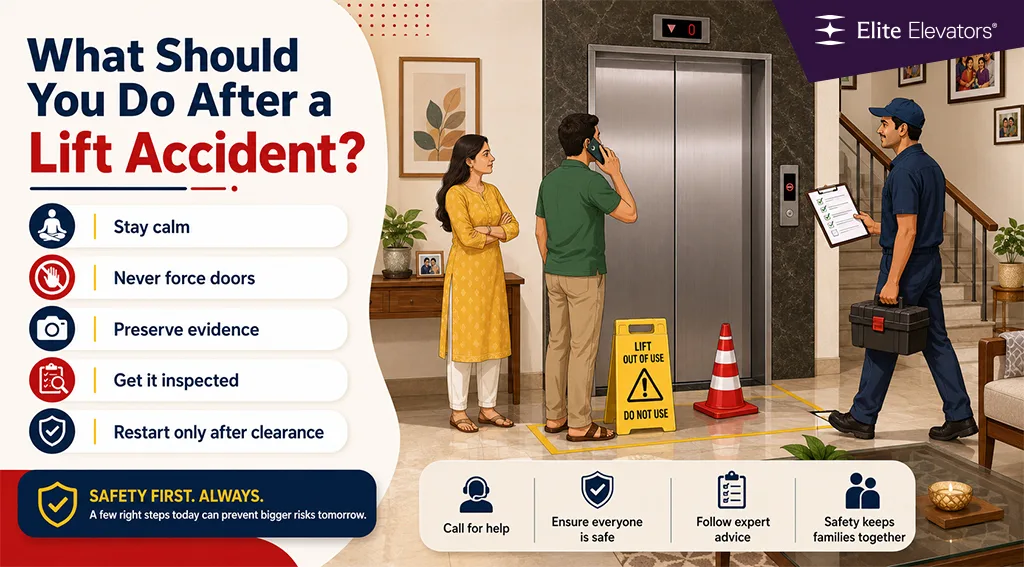
- Talk to the passenger through the intercom or door. Reassurance is a safety intervention; panic is what makes people force doors and attempt climbs.
- Call emergency services on 112 (or 108 for an ambulance in most states) if anyone is injured, breathless, diabetic, pregnant, or elderly and unwell.
- Call the Elite Elevators 24×7 emergency helpline, not a local electrician. Manual rescue means releasing a brake and hand-winding an elevator in a controlled way; done wrong, the elevator drops. Elite Elevators technicians are trained specifically for this procedure.
- Do not force the doors. A car stopped between floors leaves an open shaft below the door line. Most severe lift injuries in India happen during untrained rescue attempts, not during the original fault.
- Isolate the lift at the main switch once the passenger is out, and lock out landing calls so nobody re-enters.
- Inform the police in the event of death or grievous injury, and leave the site undisturbed.
Every Elite Elevator’s handover includes a walkthrough of exactly this sequence with the household, including elderly members and domestic staff, plus the helpline number displayed inside the car, because the right response has to be known before it is needed.
Stage 2: Notification and Preserving the Scene
Before anything is tidied up, capture the state of the installation. This becomes the factual backbone of the elevator accident investigation, the insurance assessment, and any statutory review. Elite Elevators service engineers document these on arrival, but the first few minutes are usually yours:
- Date, time, car position, and door status
- Names of passengers, witnesses, and anyone who assisted
- Photographs and video of the car, landing, doorway, pit and machine area
- The controller fault code or error log, captured before power is cycled where possible
- The maintenance logbook, last service report, and any pending complaints
- Site conditions: heavy rain, power surge, ongoing construction
Notify in parallel: Elite Elevators (or your maintenance contractor) in writing, not just by phone; the building owner or association; and your insurer’s intimation desk. A timestamped written notification matters more than most owners expect.
Stage 3: Statutory Elevator Accident Reporting in India
Elevator safety regulations in India are largely state-administered rather than centrally licensed. States including Maharashtra, Tamil Nadu, Karnataka, Delhi, Gujarat, and West Bengal regulate lifts through dedicated acts and rules, with the electrical inspectorate or a designated lift inspector responsible for permissions, periodic inspection, and accident reporting. Technical requirements draw on the National Building Code of India (Part 8) and the IS 14665 series of Indian Standards, with EN 81-series standards commonly applied to imported home elevators and lifting platforms.
Practically, three things follow for owners:
- Reporting duties depend on your state. Where a Lifts Act applies, an accident generally must be reported to the licensing authority within a prescribed period, and the lift may not return to service until examined and cleared. Confirm the form, timeframe, and authority for your city.
- Commercial and workplace premises attract additional duties under labour and factory legislation.
- Documentation is compliance. Registration or licence copies, inspection certificates, the AMC agreement, service reports, and the incident file must all be retrievable. Missing paperwork is the most common reason owners lose an insurance claim.
Elite Elevators supports customers with the documentation side of this service history, commissioning records, inspection reports, and post-incident findings assembled in a form authorities and insurers accept.
Stage 4: The Elite Elevators Post-Incident Safety Inspection
A credible investigation looks for the mechanism of failure, not a culprit. An elevator safety inspection India owners can rely on, and the structure Elite Elevators follows after an incident covers the following:
- Timeline reconstruction with passengers and witnesses
- Controller and drive diagnostics — fault history, drive parameters, encoder, and levelling data
- Door system testing — interlocks, light curtain, rollers, alignment, closing force, reopening response
- Safety chain verification — overspeed governor, safety gear, limit and final limit switches, buffers, emergency stop
- Brake and suspension examination — brake torque and lining, ropes/belts/chains and terminations
- Electrical integrity — earthing, insulation resistance, protection devices, supply quality
- Shaft and pit condition — water ingress, debris, corrosion, structural fixings
- Load, leveling, and full rescue-device testing at rated and reduced load
- Maintenance history review — were intervals met, prior complaints closed, genuine parts used
The output is a written report naming root cause, contributing factors, corrective actions, parts replaced, retest results, and a clear statement on fitness for service. Insist on a copy from Elite Elevators or any provider. Verbal all-clears are worth nothing six months later.
Stage 5: Corrective Action and Return to Service
The lift goes back into use only after corrective work is complete, retests pass, and where your state requires it, the licensing authority or competent inspector has cleared it. Elite Elevators closes the loop with the people who actually use the lift: a short refresher for the household or residents on the emergency alarm, the intercom, what not to do during an entrapment, and where the helpline number is displayed.
Elite Elevators provides this end-to-end support for emergency rescue, documented elevator accident procedures, root-cause reporting, genuine spare parts, and re-certification assistance across Chennai, Bengaluru, Hyderabad, Mumbai, Pune, Delhi NCR, Ahmedabad, Kochi, and Coimbatore.
Frequently Asked Questions
1. Who do you report a lift accident to in India?
In states with lift and escalator legislation, the licensing authority, usually the electrical inspectorate or designated lift inspector, must be informed, along with your manufacturer or maintenance provider and your insurer. Police must be informed in case of death or grievous injury. Elite Elevators customers can ask their service engineer which authority and timeframe applies in their city.
2. Can the lift be used again immediately after an accident?
No. It should be isolated and kept out of service until inspected, repaired, retested, and, where state rules require it to be formally cleared. Elite Elevators does not return a lift to service on a verbal all-clear; a written fitness statement is part of the process.
3. What should you never do when someone is trapped in a lift?
Never pry the doors, never let the passenger climb out or through the ceiling, and never let an untrained person release the brake or hand-wind the car. Keep talking to the passenger and wait for the trained Elite Elevators rescue team.
4. How long does a post-accident elevator inspection take?
A focused inspection of a residential elevator typically takes a few hours. If components must be replaced or a statutory inspection scheduled, expect several days. Elite Elevators gives an expected timeline in writing once the initial inspection is done.
5. Does home insurance cover a lift accident?
It depends on the policy cover may sit under home insurance, an equipment policy, or public liability cover for a shared building. Intimate the insurer immediately, preserve evidence, and keep the inspection report; claims are most often disputed over late intimation and missing maintenance records, which is exactly what an Elite Elevators AMC file provides.
Related Case Studies:
1. Elevator Safety Standards in India: What Should Homeowners Know Before Installing a Lift?
2. 8 Common Causes of Home Elevator Accidents and How Elite Elevators Helps
3. What Safety Measures Should Premium Elevator Companies Follow to Reduce Accident Risks?
4. Elite Elevators Customer Cases: Understanding Concerns, Support and Resolutions
5. Elevator Accidents During Installation: Common Risks and Safety Precautions
6. What Should You Do If Your Elevator Shows Signs of a Malfunction?
Note: * Prices listed are starting rates, exclude applicable taxes, and may vary based on customization.