

 Add Elite as Preferred
 Choosing between ramps and elevators depends on space and mobility needs; for compact homes and effortless access, Elite Elevators deliver space-saving, reliable entryway mobility.
If you have a home that is no longer accessible because of stairs, this guide will help you decide which option is best suited to your needs. When comparing Home elevators vs ramps for entryway accessibility, homeowners often evaluate space, convenience, and long-term usability. While ramps offer basic access to your home, contemporary residential elevators by Elite Elevators provide compact, easy-to-use solutions designed with safety features for users who require long-term accessibility.
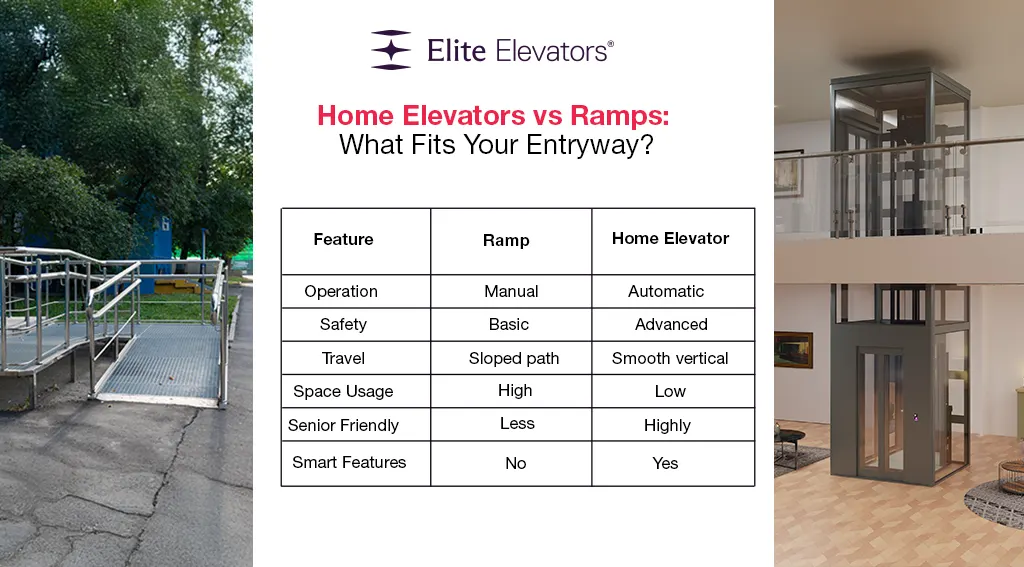
Table of Contents
- Introduction: The Entryway Accessibility Problem
- What Is the Difference Between a Ramp and an Elevator for Entryways?
- Features of a ramp:
- Elevator Features:
- Why Do Many Homeowners Compare Wheelchair Ramp vs Elevator Options?
- When Is a Wheelchair Ramp a Good Option?
- Where Do Home Elevators Offer Better Entryway Accessibility?
- Who Benefits the Most from Elevators Instead of Ramps?
- How Do Home Elevators Solve the Limitations of Ramps?
- Ramp vs Elevator Entryway: Quick Comparison
- Why Elite Elevators Is the Smart Entryway Solution
- Conclusion
- FAQs
Introduction: The Entryway Accessibility Problem
Many homeowners are asking how to make the front door/entryway easy to access for senior citizens, users of wheelchairs or individuals with limited mobility. One of the toughest parts of accessing the front door/entryway may be climbing stairs every day!
There are two solutions that work well in most cases:
- Build a wheelchair ramp.
- Install a home elevator or lift, often considered when comparing home elevators vs ramp solutions.
Ramps appear fairly basic but require plenty of space and slope restrictions. It must be used with the help of physical strength. As a result, many homeowners are choosing a home elevator instead of installing a ramp when evaluating wheelchair ramp vs elevator options.
Elite Elevators models are designed specifically for use at home, require minimal construction and include the latest cutting-edge safety features in residential installations. It meets all EN-81 European Safety Standards plus ISO certified engineering, which means you can trust it to be safe for the whole family.
With knowledge of the differences between Home elevators vs ramps, you can now choose which one is best suited for the Home elevators vs ramps entryway decision at your home entrance.
What Is the Difference Between a Ramp and an Elevator for Entryways?
A wheelchair ramp is an incline used by wheelchairs to go from one level to another without using stairs. A home elevator is a type of vertical mobility device that is used to carry people from one floor to another by a mechanical lifting system.
Features of a ramp:
- A ramp uses an inclined slope.
- Requires a large horizontal space.
- Manually driven.
- Suitable for short-distance rises only.
Elevator Features:
- Lifts vertically
- Takes up little space on the floor
- Runs by itself
- Access to more than one floor with frequent use each day
For example, Elite Elevators’ home lift models have a capacity up to 440 kg and will travel height-wise between 12,600 mm and 21,000 mm. Elite Elevators’ home lifts can also be designed to take into account multiple floors of a home.
In simple terms:
| Solution | Movement Type | Space Needed | Convenience |
| Ramp | Inclined path | Large | Manual |
| Elevator | Vertical lift | Compact | Automatic |
This makes elevators more practical for modern homes when analysing ramps vs elevators for accessibility.
Why Do Many Homeowners Compare Wheelchair Ramp vs Elevator Options?
A homeowner may consider ramps and elevators when building accessible homes for
- Seniors
- Wheelchair users
- Post-surgery recovery
- Multi-generational use.
The primary reason for comparing these options, including wheelchair ramp vs elevator solutions, is to determine how much space and physical effort they will require.
Ramp Limitations
- According to ADA ramp requirements:
- The maximum slope must be a 1:12 residential ramp slope
- That means 1 inch of height requires 12 inches of ramp length.
Example:
| Height Difference | Ramp Length Required |
| 12 inches | 12 foot ramp |
| 24 inches | 24 foot ramp |
| 36 inches | 36 foot ramp |
As a result, a small step at a home’s entry point may result in the installation of long ramps that could extend the length of the home and potentially into the driveway or the garden.
Ramps must also provide:
- Minimum of 36 inches wide
- Level landing areas
- Handrails on rises greater than 6 inches
Due to these ADA ramp requirements, ramps become impractical for many homes.
When Is a Wheelchair Ramp a Good Option?
A wheelchair ramp can work well in specific situations.
Ideal scenarios for ramps
- Small height difference at the entrance
- Temporary accessibility needs
- Large outdoor space available
- Budget-limited projects
Typical residential ramp specifications
Common ADA ramp requirements include:
- Maximum slope: 1:12 residential ramp slope
- Minimum width: 36 inches
- Landings are required every 30 feet
- Non-slip surface for safety
However, ramps become difficult when:
- Height difference increases
- Entryway space is limited
- The user cannot push the wheelchair independently
In such cases, ramps can actually create more effort than accessibility.
Where Do Home Elevators Offer Better Entryway Accessibility?
Elevators for residential use make access easier when ramps are impractical, which is why many homeowners evaluate ramp vs elevator entryway solutions before building accessibility features. The home elevator machine is an ideal location for home use (due to ramp issues) and/or individuals who have difficulty utilising the stairs.
Ideal home elevator Location:
- Duplex Homes
- Villas/Bungalows
- Multi-Storey Homes
- Homes with Elderly Residents
- Wheelchair Accessible Homes
Elite Elevators, a manufacturer of elevators specifically for home use, requires minimal structural change or a small installation space.
Some models provide features such as:
- Load capacity: up to 440 kg
- Speed: Up to 1.0 m/s
- Stops: up to 6 floors
- Pit requirement: approx. 100 mm (with shaft)
- Environment: Indoor & Outdoor
- Mobile App Integration
- PIN + Biometric Floor restriction
- 21-inch Interactive Touch Display
These technical specifications make elevators suitable even for existing homes.
Who Benefits the Most from Elevators Instead of Ramps?
Many people benefit from home elevators rather than ramps. The following groups receive significant advantages from them:
- Older Adults: Using an elevator helps remove the physical effort required to move about and provides independence.
- Wheelchair Users: Pushing someone up a ramp or climbing a ramp is often tiring, which is why wheelchair ramp vs elevator comparisons frequently favour elevators.
- Families with Mobility Challenges: When using an elevator to help carers, the carer does not create any extra strain on themselves.
- Long-term accessibility for homeowners: Elevators enhance property value and long-term sustainability.
Elite Elevators supplies gearless, hydraulic, and stairlifts for residences, including villas, bungalows, and all residential areas. Each of these products uses an innovative, technology-based approach to provide stability, security, and style as permanent accessibility enhancements.
How Do Home Elevators Solve the Limitations of Ramps?
Modern elevators solve many problems that ramps do not solve.
1. Space Efficiency
Ramps take a long, horizontal distance to get between levels, while elevators can be located vertically, thus taking less space.
2. Comfort
A ramp requires that the user exert physical effort to climb it. An elevator uses an automatic system and has a control panel.
3. Multi-floor Access
Ramps only allow two levels to connect close to one another. Elevators can service many more levels, up to 6 levels (depending on the model), approximately 18,000 mm or 18 metres (60 feet) high.
4. Safety
Elite Elevators have safety features, such as:
- Emergency Cabin Light & Trap Doors
- Automatic Rescue Device
- Overload Detectors
- GSM Connect + Battery Backup
- Live SOS 2.0
- European compliance with EN 81-41 standards for Safety
5. Modern Design
Unlike ramps, which change the look of the outside of the building, elevators are part of the building’s interior and architecture.
Ramp vs Elevator Entryway: Quick Comparison
| Feature | Wheelchair Ramp | Home Elevator |
| Movement | Inclined slope | Vertical lift |
| Space requirement | Very large | Compact |
| Effort required | Manual | Automatic |
| Suitable floors | Single level | Multiple floors |
| Installation | Simple but large | Compact residential system |
| Accessibility | Limited | Universal access |
In most homes, elevators provide a long-term accessibility solution when evaluating ramp vs elevator entryway accessibility choices.
Why Elite Elevators Is the Smart Entryway Solution
When selecting a lift system, engineering and safety should be the main considerations.
Elite Elevators are the industry leaders based on the following reasons:
- Purpose-built for residential buildings
- Comply with European safety standards (EN 81)
- Provide both hydraulic and gearless drive systems
- Small installation sizes (new or retrofit)
- Smooth, quiet lift operation and attractive modern appearance.
Higher-end products like the X Series gearless residential elevators have:
- An estimated weight capacity of 440kg
- Unlimited capacity; can go through up to 6 levels
- Doesn’t require a deep pit or machine room
The unique combination of safety, technology and design makes Elite Elevators the accessibility choice of many.
Conclusion
The choice between ramps and elevators will be determined by both the layout of your space and how accessible you want your home to be. Ramps are typically a good solution for a small number of height variations. However, they can take up large amounts of floor area and require a decent amount of physical energy to navigate.
Home elevators have many benefits, including:
- Ease of use
- Compact installation
- Multi-level access
- Safety features
For homeowners who want to build an accessible home that is ready for the future, installing an Elite Elevators’ residential lift is the best way to create a comfortable and secure entranceway.
FAQs
1. What’s the difference between a ramp and an elevator for wheelchair accessibility?
A ramp uses an angled slope to get you between different levels, while a lift utilises an electric motor to move you vertically between levels. Elevators take up much less area than ramps and typically make it easier to get around.
2. Why do people look at wheelchair ramps vs elevators when looking at their homes?
Homeowners compare them to see which will be the best and most practical way to access their home. Ramps require a lot of space and effort to use, while lifts are much more compact and allow effortless access to your home.
3. How much space will a ramp use at the home?
A ramp typically requires 1 foot of ramp for each inch of rise, based on ADA ramp requirements and residential ramp slope guidelines. For example, if you have a 24-inch rise, you will need a 24-foot ramp.
4. Which is better for homes, wheelchair ramps or elevators?
If you need to move between two or more floors, elevators are the best choice, as they allow more effortless access and fit much better into a smaller space than ramps do.
5. How do Elite Elevators improve a home’s accessibility for people in wheelchairs?
Elite Elevators provides lifts for residential use with the following features: Maximum weight capacity of 440 kg. Features high-level safety, minimal structural changes, and hassle-free access for seniors or persons using a wheelchair.
Note: * Prices listed are starting rates, exclude applicable taxes, and may vary based on customization.




Suraj Malhotra
This blog clearly explains home elevators vs ramps in a very practical way. I never realized how much space a ramp actually needs until reading this. The comparison helped me understand why a space-saving home elevator vs ramp is often the better choice for long-term accessibility.
Vani Ramesh
I found this article extremely helpful while comparing wheelchair ramp vs elevator cost and usability. The breakdown of space and convenience really simplifies decision-making. It’s clear that elevators offer better long-term value in most modern homes.
Lalita Kumari
Great insights on home elevators vs ramps! The way you explained the limitations of ramps and benefits of elevators makes it easy to understand. For people planning future-ready homes, a home elevator for seniors seems like the right investment.
Tarakeshwar Rao
Helpful and detailed post about home elevator for seniors. The points about comfort and independence really stand out. Elevators seem like a much better option than ramps for daily use.
Deepali Bansode
Very informative blog on space saving home elevator vs ramp. The space comparison is especially useful for modern homes where every square foot matters. Elevators definitely win in this aspect.
Omprakash Meena
A very well-explained guide on space-saving home elevator vs ramp. The practical examples and comparisons make it easy to understand. Elevators definitely seem more suitable for modern living.