

 Add Elite as Preferred


Thinking about installing a stair lift at home, but unsure what the process involves? This complete step-by-step guide walks you through every stage from site assessment to first ride so you know exactly what to expect.
Why Understanding Installation Matters Before You Buy
Most stair lift buyers in India focus entirely on the product and the price, and overlook the installation process entirely. That is a critical mistake. The quality of a stair lift installation determines whether your lift performs perfectly and safely for a decade or becomes a source of intermittent faults and expensive service calls. A stair lift installed on an incorrectly fabricated rail, without proper calibration, or with inadequate safety testing, is not just unreliable; it is dangerous. Understanding the correct installation process gives you the knowledge to choose the right installer, ask the right questions, and ensure your lift is set up correctly from the very first day.
Table of Contents
- Why Understanding Installation Matters Before You Buy
- Step 1: Site Feasibility Check and Needs Assessment
- Step 2: Custom Rail Manufacturing (For Curved Staircases)
- Step 3: Preparing Your Home Before Installation Day
- Step 4: Rail and Carriage Installation
- Step 5: Safety Checks and Full Calibration
- Step 6: User Training and Handover
- After Installation, Maintenance, and Long-Term Support
- Frequently Asked Questions
Step 1: Site Feasibility Check and Needs Assessment
The installation process begins before a single component arrives at your home. An Elite Elevators installation specialist visits to conduct a comprehensive site survey. This is not a sales visit; it is a technical assessment that determines exactly what your home needs. The surveyor measures the staircase precisely: total length, width, angle, number of landings, and any structural features or obstacles such as walls, support posts, or doorways that affect the rail path. The staircase type is identified as straight, curved, spiral, or multi-landing, as this determines whether standard or custom-fabricated rail sections are required.
The structural condition of the staircase is verified because the E50’s rail mounts on the staircase treads, not on the wall, and the staircase must be sound. The surveyor also evaluates the user’s specific mobility needs: whether a seated or platform lift is more appropriate, what control type suits them best (joystick or remote), and whether any optional features like a powered swivel seat or powered footrest are advisable. The electrical supply is checked. A standard 230V socket near the top or bottom of the staircase is all that is needed.
Step 2: Custom Rail Manufacturing (For Curved Staircases)
For straight staircases, standard rail sections are stocked, and installation can proceed quickly after the site survey, often within days. For curved, spiral, or multi-landing staircases, this step is where the real engineering happens. Elite Elevators’ technical team uses the precise measurements from the site survey, along with computer-aided design tools, to create a rail that follows the exact three-dimensional path of your staircase, every curve, every turn, every angle. This is not a generic curved rail adjusted on-site. It is a precision component manufactured specifically for your staircase. The quality of this fabrication is the single most important factor in the E50’s performance on complex staircases.
Custom rail manufacturing typically takes 2–3 weeks. This is the period between your site survey and your installation date for curved staircase projects. It is worth every day of the wait a perfectly fabricated rail is the foundation of smooth, reliable, long-term stair lift performance.
Step 3: Preparing Your Home Before Installation Day
While the rail is being fabricated (or for straight installations, while delivery is arranged), a few simple preparations ensure installation day runs smoothly:
- Clear the staircase completely; remove shoes, decorative objects, runners, and any items stored on or near the steps.
- Confirm that a 230V electrical socket is accessible near the top or bottom landing. If one needs to be installed, arrange this with your electrician before the installation date.
- Ensure clear access for a two-person installation team to work on both the staircase and the landing areas at each end.
- If any banister sections need to be temporarily removed for rail installation, your Elite Elevators installer will advise you in advance this is uncommon but occasionally necessary on very narrow staircases.
- Have the primary user and any family members who will assist with operation present during installation, as they will receive a full training session at handover.
Step 4: Rail and Carriage Installation
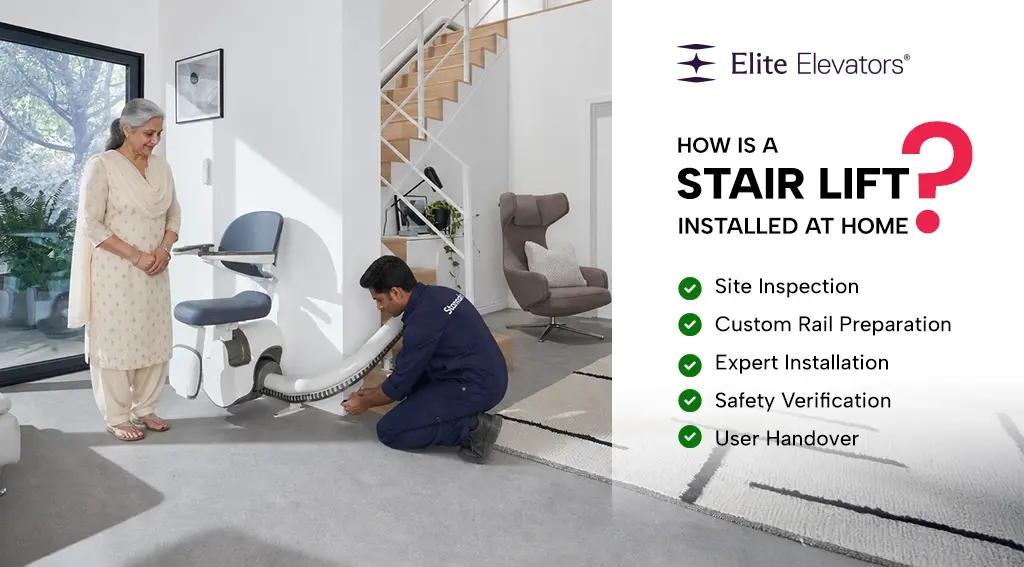
Installation day begins with the team bringing in the rail sections, carriage assembly, and chair unit. The first and most important task is mounting the rail system on the staircase treads; this is the critical technical step that defines the ride quality of the entire installation. Each mounting bracket is positioned precisely on the staircase tread, ensuring the rail follows a perfectly smooth path with no wobble, flex, or misalignment. For curved stair lifts, the custom-fabricated rail arrives in sections that are joined on-site.
Once the rail is secured, the carriage assembly is attached and run along the rail to verify smooth, friction-free travel. The chair unit is mounted on the carriage, armrests and footrest are attached, and the wiring is routed neatly along the rail housing to the charging point. The E50’s slim rail profile is designed specifically to minimise visual bulk on the staircase. The installation is noticeably less intrusive than older-generation stair lifts.
Step 5: Safety Checks and Full Calibration
This is the most critical phase and the phase that most clearly separates a professional installation from an amateur one. Elite Elevators’ certified installation team performs an exhaustive safety check protocol before any family member is permitted to use the lift. Every safety system is tested individually and then as an integrated system.
- Obstruction sensor testing: An object is deliberately placed below the footrest, and the lift is activated. The lift must stop immediately and not restart until the obstruction is cleared.
- Speed calibration: The lift is run at full length multiple times to verify it travels at exactly 0.15 m/s and decelerates smoothly to a complete stop at both ends.
- ASL system verification (E50): On curved staircases, the Advanced Swivel and Levelling system is tested at every turn and landing to confirm the chair maintains the correct orientation and travels smoothly through all geometries.
- Seatbelt and safety restraint check: All restraints are tested for correct locking and release under both normal and simulated emergency conditions.
- Battery backup test: Mains power is disconnected, and the lift is operated on battery only for multiple test runs to confirm battery capacity and performance.
- End stop verification: The lift is run to both extreme ends of the rail to confirm the end stops engage correctly and prevent overtravel.
- Remote control function test: All remote control commands are verified at multiple distances and positions on the staircase.
Step 6: User Training and Handover
Before the installation team leaves your home, a full training session is conducted with the primary user and any family members who will assist with or independently operate the lift. This session covers: boarding the lift safely, including the correct seated position and seatbelt use; operating the joystick for upward and downward travel; using the remote call and send functions to bring the chair to whichever landing you are on; operating the powered swivel (if fitted) for safe boarding and alighting; folding and unfolding the seat, footrest, and armrests when the staircase is needed by others; what to do in the event of a power cut (the battery continues to operate the lift normally); and how to contact Elite Elevators’ service team if any issue arises.
After Installation, Maintenance, and Long-Term Support
The E50 stair lift is designed for reliable, low-maintenance operation over many years. Elite Elevators recommends an Annual Maintenance Contract (AMC) to ensure the lift is professionally inspected and serviced at regular intervals, typically once per year. During an AMC service, the technician checks all safety systems, recalibrates speed and braking where needed, cleans the rail and drive mechanism, and tests the battery capacity. With 500+ trained technicians across India and experience centres in 35+ locations, Elite Elevators’ post-installation support is one of the strongest in the industry. You are not left to manage your lift alone after the installation team drives away.
Frequently Asked Questions
Q1. Does stair lift installation require civil work or wall drilling?
No, stair lifts are mounted directly on the staircase treads, not on the wall. No civil work, no drilling into walls, and no structural modifications to your home are required. This is one of the most significant practical advantages of a stair lift over a traditional home elevator.
Q2. How long does stair lift installation take in India?
For straight staircases, installation typically takes half a day to a full working day with a two-person team. Curved or complex staircases require custom rail fabrication and installation, which typically takes around 2–3 weeks. The stair lift is ready to use immediately after installation and safety testing.
Q3. What electrical supply is needed for a stair lift?
A standard 230V single-phase household socket near the top or bottom of the staircase is all that is required. The E50 charges continuously from this socket and runs on battery power during operation, including during mains power failures.
Q4. Can a stair lift be installed on a curved staircase in India?
Yes, the Elite E50 works on all staircase types, including curved, spiral, half-turn, and multi-landing configurations. The rail is custom-fabricated to exactly match the three-dimensional geometry of your staircase; no adjustments or compromises at the site.
Q5. What happens if the stair lift malfunctions?
The E50 includes multiple integrated safety features that prevent unsafe operation. If a fault is detected, the system alerts the user and stops safely. Elite Elevators’ service team can be contacted immediately and can often diagnose issues remotely via the fault notification system. The battery backup ensures the user can always reach a landing safely even if a fault occurs mid-travel.
Ready to elevate your home? Book a Free Site Survey with Elite Elevators today.
Note: * Prices listed are starting rates, exclude applicable taxes, and may vary based on customization.


Ashwin Ravi
This blog provided a very clear explanation of stair lift installation from start to finish. I was searching for information on how to install a stair lift and most articles only covered product features. The detailed breakdown of site surveys, rail fitting, safety checks, and user training makes the entire home stair lift installation process much easier to understand. Very informative and practical.
Swathi Reddy
Excellent article for anyone considering a stair lift for home use. I especially liked how the guide explained each installation stage in simple language. The section on custom rail manufacturing for curved staircases was particularly useful. This is one of the most detailed resources I have read about stair chair lift installation and long-term maintenance support.
Vinod Kumar
Thank you for sharing such a comprehensive guide on stair lift setup at home. Many people focus only on pricing, but this blog highlights why professional installation is equally important. The explanation of safety testing and calibration helped me understand what to expect during a quality indoor stair lift installation process.
Yamini Krishnan
I found this article very helpful because it explains every stage of stair lift installation in a logical way. The pre-installation checklist and home preparation tips are especially useful for first-time buyers. Anyone researching how to install a stair lift should read this guide before making a purchase decision.
Rajesh Verma
Great blog with valuable information for homeowners and caregivers. I appreciated the detailed explanation of the site feasibility check because many articles skip that step entirely. Learning about the complete stair chair lift installation process helped me understand the importance of proper measurements and professional installation.
Hema Lakshmi
Very informative content. The article explains stair lift installation in a way that is easy to understand even for someone with no technical background. I found the section about safety checks particularly reassuring. It clearly shows why choosing experienced professionals for home stair lift installation is so important.