

 Add Elite as Preferred
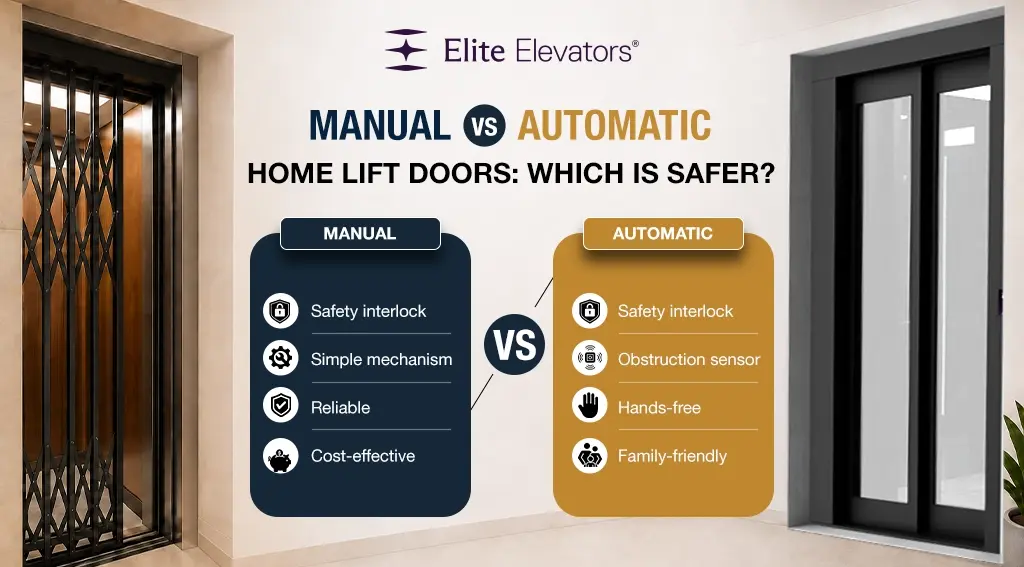
 Manual and automatic home lift doors are both safe when properly certified, but automatic doors offer added protection for elderly users and children. Elite Elevators offers both options with full safety interlocks and obstruction sensors standard, ensuring superior home elevator door safety for every household.
What Are the Door Options for a Home Lift?
One of the most overlooked decisions when choosing a home elevator is the door type. Most homeowners spend weeks comparing cabin size, drive technology, and price and then decide on the door almost as an afterthought. That is a mistake, because the door is the part of the lift your family interacts with the most, and it plays a direct role in everyday safety.
Table of Contents
- What Are the Door Options for a Home Lift?
- How Do Manual Home Lift Doors Work?
Home elevators in India are available with two main home lift door types: manual swing doors and automatic sliding doors. Both are used widely, and both are safe when properly engineered, but they behave very differently in daily use. This guide breaks down exactly how each works, what the real safety difference is, and which one is right for your home.
How Do Manual Home Lift Doors Work?
A manual home lift door is a swing-style door that the passenger opens and closes by hand, similar to a regular room door. The lift will not move until the door is fully closed and securely latched; this is a standard safety interlock on every certified home elevator, manual or automatic, and a critical component of home elevator door safety.
Manual doors are simple mechanically, which makes them slightly more affordable and very low-maintenance. They are widely used on entry-level and mid-range hydraulic home elevators across India.
How Do Automatic Home Lift Doors Work?
- Automatic lift doors for home use are sliding or telescopic doors that open and close on their own, triggered by a sensor or button press. The passenger does not need to physically push or pull the door; it opens automatically when the cabin arrives and closes automatically once the passenger has boarded or exited.
- Automatic lift doors for home include sensor-based obstruction detection, meaning the door will not close on a person, a bag, or a mobility aid in the doorway. They are more commonly found on premium gearless elevators and are increasingly the preferred choice for homes with elderly family members or young children.
Manual vs Automatic Home Lift Doors — Comparison
| Factor | Manual Doors | Automatic Doors |
| Operation | Passenger opens and closes by hand | Opens and closes automatically |
| Obstruction Detection | Limited or none | Sensor-based, prevents closing on obstruction |
| Ease of Use | Requires physical effort | Effortless, hands-free |
| Best Suited For | Active adults, budget-conscious buyers | Elderly users, children, wheelchair users |
| Maintenance | Lower, fewer moving parts | Slightly higher, sensor calibration needed |
| Typical Cost | Lower | Higher |
Which Is Safer: Manual or Automatic Home Elevator Doors?
This is the question most homeowners actually want answered, and the honest answer is it depends on who is using the lift. For active adults without mobility limitations, a well-made manual door is genuinely safe. The lift will not move unless the door is fully closed, and the simple mechanism means there is very little that can go wrong.
For elderly family members, young children, or anyone with reduced grip strength or mobility, automatic doors are the safer choice. A manual door requires the user to pull it shut firmly every time; if it is not closed properly, the lift simply will not move, which can be frustrating or confusing for an elderly user who does not understand why. Automatic doors remove this entirely. They also prevent the door from closing on a hand, walking aid, or pet a real risk with manual swing doors if someone is distracted while boarding.
For most Indian homes with a mixed-age household, which is the majority, home elevator door safety is meaningfully better with an automatic door, simply because it removes a step that depends on the user doing it correctly every single time.
What to Look for in Home Lift Door Safety Features
Regardless of which home lift door types you choose, these safety features should be standard:
- Door interlock: The lift must not move unless the door is fully closed and locked non-negotiable for home elevator door safety on any certified home elevator.
- Obstruction sensors (automatic lift doors for home): The door should automatically reverse if it detects anything in its path while closing.
- Visible door status indicator: Cabin and landing displays should clearly show whether the door is open, closed, or in motion.
- Smooth, jerk-free closing: Whether manual or automatic, the door mechanism should never slam or move abruptly; this is especially important for households with elderly users.
- Backup power for automatic doors: Automatic doors should be able to open manually or via battery backup during a power failure, so no one is ever trapped.
Which Door Type Should You Choose for Your Home?
If your household is mostly active adults and budget is a primary consideration, a manual swing door on a well-certified hydraulic elevator is a perfectly safe and practical choice.
If your home includes elderly parents, young children, or anyone with mobility limitations, or if you simply want the most effortless daily experience, automatic doors are worth the additional cost. The difference is not dramatic on paper, but it is meaningful in daily use, particularly for the family members who benefit from a home elevator the most.
Why Choose Elite Elevators for Door Safety
Elite Elevators offers both manual swing doors and automatic centre-opening doors across its range, so the choice depends on your home and your family, not on what a single product line offers. The X200 and X200 Plus feature panoramic manual swing doors with full safety interlocks as standard. The X300 Mark II and X300 MK II Plus feature automatic center-opening doors with sensor-based obstruction detection, giving maximum effective entry width for elderly users, children, and wheelchair access.
Every model, manual or automatic, includes door safety sensors, ARD for power failures, and the full certified safety suite as standard, not as an optional upgrade. A free site survey can help you decide which door type genuinely fits your household’s needs, based on who will be using the lift most often.
Frequently Asked Questions
1. Are automatic home lift doors safer than manual doors?
For households with elderly family members, young children, or anyone with reduced mobility, automatic doors are generally safer because they include sensor-based obstruction detection and remove the need for the user to manually close the door correctly every time. For active adults, manual doors are also safe when properly certified.
2. What is the price difference between manual and automatic home lift doors?
Automatic doors typically cost more than manual swing doors due to the additional sensors, motors, and control systems involved. The exact price difference depends on the specific model and is confirmed during a quote.
3. Can automatic lift doors open during a power cut?
Yes, on certified home elevators. Automatic doors are designed to be openable manually or via battery backup during a power failure, ensuring no one is ever trapped inside the cabin.
4. Which home lift door type is best for elderly users?
Automatic sliding or centre-opening doors are generally the better choice among different home lift door types for elderly users, as they require no physical effort to operate and include obstruction sensors that prevent the door from closing on a person or walking aid.
5. Do manual home lift doors have any safety risks?
Manual doors are safe when the lift includes a proper door interlock, meaning it will not move unless the door is fully closed and locked. The main consideration is that the user must close the door correctly every time, which can be a minor inconvenience for some users but does not compromise safety when the interlock is functioning correctly.
Conclusion
Both manual and automatic home lift doors are safe when installed on a properly certified elevator with the right safety interlocks. The real difference comes down to who is using the lift daily. Active adults are well served by a manual door. Households with elderly members, young children, or anyone with mobility limitations are better served by automatic lift doors for the home with sensor-based obstruction detection.
Elite Elevators offers both home lift and door types across its product range, with full safety features standard on every model, helping you choose the right fit for your specific household rather than a one-size-fits-all answer.
Note: * Prices listed are starting rates, exclude applicable taxes, and may vary based on customization.



Tanvi Gupta
A useful and easy-to-understand article for anyone planning a home elevator. I liked how it clearly explains the difference between manual home lift doors and automatic home lift doors without making the topic complicated. The section on home lift door safety is particularly valuable for families with elderly parents or children who may use the lift regularly.
Rohit Sharma
I found the comparison of automatic vs manual lift doors quite practical. Many people focus only on cabin size and cost while choosing a lift, but the door is an important part of everyday safety. The article explains home elevator doors, obstruction detection, and door interlocks in a simple way. Definitely helpful information before making a purchase decision.
Pooja Singh
Very informative content for homeowners who are confused between different home elevator door types. The explanation of how manual and automatic doors operate makes the decision much easier. I especially liked the point that automatic home lift doors can detect obstructions and reverse their movement. These practical details are important when considering home elevator safety for the whole family.
Vishal Mehta
This is a genuinely useful guide for families planning to install a residential elevator. The article explains why home lift doors deserve more attention during the selection process. I particularly liked the discussion around elderly users, mobility limitations, and children. Understanding these factors makes it easier to decide whether manual or automatic doors will provide the most suitable combination of convenience and home elevator door safety.