

 Add Elite as Preferred


Indoor home lifts range from basic hydraulic to AI-powered gearless, and lighting defines the cabin experience. Elite Elevators’ range, from X200 to E300, offers smart app-controlled, DRL, and ambient lighting options built for modern Indian homes.
Indoor home lifts in 2026 are not what they were ten years ago. The mechanical box that once required a dedicated machine room, a deep pit, and a week of construction disruption has been replaced by a generation of compact, intelligent, architecturally integrated residential lifts that fit into Indian homes of every size without demanding structural sacrifice.
Table of Contents
If you have been researching indoor elevators for home use and finding more confusion than clarity, this guide resolves it. Types, benefits, costs, and installation: everything you need to make a confident decision.
What Types of Indoor Home Lifts Are Available in India?
Understanding home lift types is the first and most important step. The technology you choose determines the ride quality, noise level, space requirement, and total cost of ownership over the elevator’s life.
- Hydraulic chain-drive indoor lifts use a hydraulic pump and chain mechanism to move the cabin. Quiet, smooth, and cost-effective for up to 4 floors. Load capacity of 400 kg. Single-phase power. No machine room. The most widely installed indoor home lift type in India, the Elite X200 and X200 Plus, are the benchmarks in this category.
- Gearless belt-drive indoor lifts replace the hydraulic system with a gearless belt mechanism, delivering higher speeds (up to 1.0 m/s), smarter features, and a more refined ride at a higher price point. The X300 Mark II and X300 MK II Plus are the leaders in this category. The X300 MK II Plus is India’s only AI-powered indoor home lift.
- European Cogbelt indoor lifts represent the pinnacle of residential indoor lift engineering. The E300 Cogbelt uses a patented mechanism that delivers the quietest ride available at any price point and holds SIL 3 certification, the highest safety standard globally. For Indian homes where silence and certified safety are non-negotiable, this is the category.
- European Hydraulic Indoor Lifts (E200) deliver EN 81-41 certification, 194 integrated safety parameters, and clean, quiet hydraulic performance in a machine-room-less, shallow-pit configuration that suits retrofit installations.
- Indoor stairlifts (E50) are not cabin elevators; they run along the existing staircase. But for homes where shaft installation is not feasible, the E50 is the most practical indoor mobility solution available. Zero civil work. All staircase types. World-first ASL technology.
Benefits of Installing an Indoor Home Lift
The benefits of a residential indoor lift extend across every dimension of multi-storey home life:
- Full floor accessibility for seniors: children, and mobility-challenged family members every day
- Stair fall risk eliminated: the leading preventable domestic injury among Indian seniors
- Property value increase: certified indoor home lifts consistently add to resale appeal
- Design enhancement: modern indoor elevators are architectural features, not functional afterthoughts
- Future-proofing accessibility: built-in now costs a fraction of what retrofitting costs in fifteen years
Indoor Home Lift Costs in India — 2026
1. Hydraulic indoor lifts:
- X200 from ₹14.50 lakhs (G+1).
- X200 Plus from ₹16.75 lakhs.
- E200 from ₹26.81 lakhs.
2. Gearless indoor lifts:
- X300 Mark II from ₹18.70 lakhs.
- X300 MK II Plus from ₹20.95 lakhs.
3. Cogbelt indoor lift:
- E300 from ₹48.24 lakhs (client masonry shaft, G+1).
4. Indoor stairlift:
- E50 from ₹13.41 lakhs.
Indoor Home Lift Installation — What to Expect
Installation of an indoor home lift in India follows four stages. First, the site survey is a technical assessment of shaft dimensions, pit feasibility, door count, and electrical requirements. Second, manufacturing the cabin and components custom-built to your home’s exact specifications. Third, installation typically takes 2 to 3 weeks for cabin models once the shaft is prepared. Fourth, training every family member on how to operate the lift, with AMC beginning from day one.
The E50 Stairlift deviates from this process; it installs in a single day with no shaft preparation required.
Key installation requirements for compact indoor home elevators: pit depth of 59 mm (X300 range) to 120 mm (E200 hydraulic lifts), no machine room, standard ceiling height, and a dedicated electrical circuit. Most Indian homes meet all four without structural modification.
Design Considerations for Indoor Home Lifts
An indoor elevator for home use will be seen every day. The design choices of wall finish, ceiling style, colour, and door configuration determine whether it feels like a natural part of the home or an installation that was accommodated.
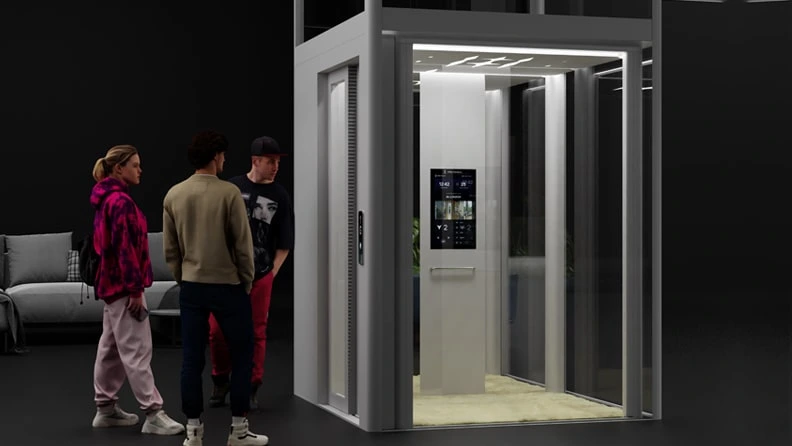
Glass cabin walls are the most popular choice for indoor home lifts in India. They create visual openness, allow natural light to pass through the shaft, and make any cabin size feel larger than it is. The starlit ceiling paired with glass walls is the most requested combination across Elite Elevators’ installations. Color-matched X-shaft framing in one of 16 RAL options ties the installation into the home’s existing palette.
How Lighting Transforms the Indoor Home Lift Experience
Most buyers finalize cabin size, wall finish, and flooring and treat lighting as an afterthought. This is the single most common design regret among residential elevator owners. Lighting defines the experience inside the cabin on every trip. It determines whether the space feels expansive or enclosed, premium or functional, designed or installed.
Elite Elevators offers four lighting configurations that produce completely different cabin atmospheres. DRL arrival lighting on the X300 MK II Plus activates a signature glow as the cabin approaches each landing, a detail guests mention first, every time, without being told to notice it. Ambient Corner Glow on the X300 Mark II integrates soft, adjustable light into all four cabin corners colour and brightness controlled via the SSD V2 display or mobile app, warm for evenings and bright for daytime. Smart app lighting control on the X300 range and X200 Plus allows the entire cabin atmosphere to be set remotely before boarding. Standard LED across all models provides clean, consistent illumination that sets the baseline every other configuration improves upon.
For indoor home lifts where the cabin is a space the family occupies multiple times daily, lighting is not a detail. It is the quality of the experience, repeated 10,000 times over ten years.
Elite Elevators Indoor Home Lift Range
- X300 MK II Plus — AI, biometrics, Live Board, DRL. India’s finest
- X300 Mark II — Gearless, Pre-Door Opening, SSD V2
- X200 Plus — Smart hydraulic. LiveBoard, app
- X200 — Entry indoor lift. From ₹14.50 lakhs
- E300 Cogbelt — SIL 3 certified. Quietest indoor lift
- E200 Hydraulic — EN 81-41. 194 safety parameters
- E50 Stairlift — Staircase-mounted. Zero civil work
FAQ — Indoor Home Lifts in India
1. What are the types of indoor home lifts available in India?
India’s residential indoor lift market covers hydraulic chain-drive (X200, E200), gearless belt-drive (X300 range), European cogbelt (E300), and stairlifts (E50). Each type suits a different combination of floor count, budget, performance requirement, and available space.
2. What is the cost of an indoor home lift in India in 2026?
Indoor home lift prices in India start from ₹13.41 lakhs for the E50 Stairlift and ₹14.50 lakhs for the X200 cabin model at G+1. Smart gearless models start from ₹18.70 lakhs. European certified models from ₹26.81 lakhs.
3. How much space does an indoor home lift require?
The X300 range operates with a 59 mm pit depth and requires approximately 1400×1400 mm floor area per landing under 2 square metres. The X200 requires 100 mm pit depth. No machine room is required for any Elite Elevators model. The E50 Stairlift requires no additional floor space.
4. How long does indoor home lift installation take?
For homes with a prepared shaft, cabin model installations typically complete just 2 to 3 weeks. The E50 Stairlift installs in a single day with no shaft preparation. All timelines are confirmed during the site survey.
5. Can an indoor home lift be installed in an existing home?
Yes all Elite Elevators models are designed for retrofit installation. Shallow pit requirements, no machine room, and compact footprints make existing-home installation practical across most Indian layouts without major structural disruption.
Note: * Prices listed are starting rates, exclude applicable taxes, and may vary based on customization.



Neha Sharma
A very informative guide for homeowners who are exploring indoor home elevators. The explanation of different lift technologies makes it easier to understand which option may suit a particular house. I also found the details about indoor elevator price and installation requirements helpful. The section on lighting is a great addition because it covers an aspect many buyers may overlook.
Saurabh Mehta
This is a well-structured guide for anyone researching indoor house lifts. The article explains the different technologies without making the topic unnecessarily complicated. The pricing examples also provide a useful starting point for understanding indoor elevator for home cost. I particularly appreciated the explanation of shallow pits and machine-room-less designs for existing homes.
Ritu Singh
I really liked how this guide explains that modern indoor home lifts can be integrated into a house without always requiring major structural changes. The information about pit depth, machine-room requirements, and installation stages is especially valuable. Anyone comparing indoor elevator price and features would benefit from reading this article before making a final decision.
Karan Kapoor
The explanation of indoor home lifts in this article is easy to follow and quite practical. I especially liked that it discusses both conventional cabin lifts and stairlift solutions. The information about indoor lifts for disabled users and older family members highlights an important benefit of residential elevators. The installation section also answers several common questions that buyers usually have.
Kritika Gupta
This was a helpful read for understanding the different choices available when selecting an indoor elevator for home use. The article clearly explains the differences between hydraulic, gearless, and cogbelt systems. I also liked the inclusion of the E50 stairlift as an alternative where a conventional lift may not be practical. The information gives homeowners several options to consider.
Manish Sharma
A very informative article about indoor lifts cost, installation, and design. I liked the fact that the guide explains why choosing the right technology matters rather than treating every residential lift as the same. The points about machine-room-less systems and shallow pits are especially relevant for existing houses where space is limited and major construction work may not be desirable.
Priya Gupta
This was a very helpful guide for understanding indoor home lifts in 2026. I liked how the article explains hydraulic, gearless, Cogbelt, and stairlift options along with their practical applications. The details about installation, space requirements, and safety make it easier for homeowners to compare indoor home elevators before making an investment.
Rajesh Verma
A very informative post about the growing popularity of indoor house lifts. I liked the emphasis on accessibility, comfort, and future-proofing a home rather than treating an elevator as a luxury alone. The details about indoor lifts cost, installation duration, and available designs are practical and should help homeowners decide what type of indoor home elevator fits their lifestyle.