Add Elite as Preferred
 You live in a beautiful home. Three floors, thoughtfully designed, every inch used well except for one problem. The staircase is tight, there is no large shaft to spare, and the contractor you spoke to last year told you a home lift would require tearing down walls. So you shelved the idea.
Quick Summary
Limited square footage should never limit your quality of life. This guide reveals the best compact home elevators for small Indian houses in 2026, comparing dimensions, installation needs, and smart features to help you choose wisely without compromising on style or safety.
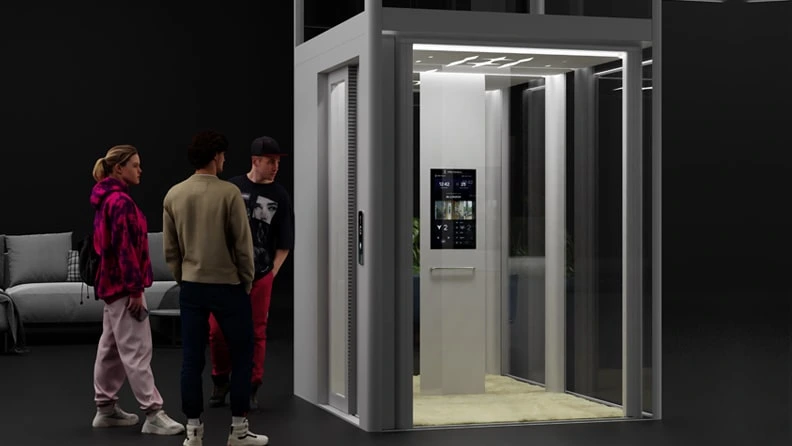
Here is what that contractor did not tell you: residential small home elevators in India are specifically engineered for exactly this situation. They need as little as 100 mm of pit depth, fit into a 1200×1200 mm footprint, and can be installed without structural modifications to your home. In 2026, compact home lifts are not a compromise; they are a category of their own, and they are better than ever.
What Makes a Home Elevator ‘Compact’?
In the context of Indian residential construction, a compact-footprint home elevator is defined by three parameters: cabin footprint, pit requirement, and installation impact. Here is what to look for:
Table of Contents
- What Makes a Home Elevator ‘Compact’?
- The Biggest Mistake Homeowners Make When Choosing a Compact Lift
- Key Features to Prioritise in a Small Home Elevator
- Single-Phase Power: Why It Matters for Small Homes
- Which Lift Fits Which Home Type?
- Urban Row House or Independent Home (G+1 or G+2)
- Duplex or Small Villa (G+2 or G+3)
- Home Without a Shaft, Staircase Only
- Elite Elevators’ Complete Range for Compact Homes
- Cabin size: Standard compact cabins start at 1200×1200 mm, large enough for one wheelchair user or two adults.
- Pit depth: Shallow pit models require as little as 59–140 mm, meaning a simple floor cut rather than deep excavation.
- Headroom: A headroom of 2,300–2,600 mm means the lift can be installed in homes without unusually high ceilings.
- Shaft requirement: Some compact models operate without a traditional shaft, using a self-supporting structure instead.
- Installation impact: The best compact lifts require zero structural wall modifications.
When a lift scores well on all five parameters, it is genuinely suited to the kind of tight layouts that define most Indian independent homes, row houses, and urban apartments.
The Biggest Mistake Homeowners Make When Choosing a Compact Lift
Most people search for the smallest possible lift and assume that means the cheapest or the simplest. This is the wrong approach. A compact lift still needs to be safe, smooth, and reliable, because you will use it dozens of times a day, every day. The cost of choosing poorly is not just money. It is years of jerky rides, noisy operation, expensive repairs, and a product that does not age well with your home.
The right question is not, ‘What is the smallest lift I can buy?’ ‘What is the best lift that fits my space?’ That distinction makes all the difference.
Key Features to Prioritise in a Small Home Elevator
For compact Indian homes, these features have the most practical impact:
- EGSS Technology (Extra Gentle Soft Start and Stop): Prevents jerky movement, critical in smaller, lighter cabins where vibration is more noticeable.
- Auto Re-levelling: Ensures the cabin stops exactly flush with each floor, important for safe entry and exit in tight spaces.
- Greaseless, grease-free rails: No mess, no maintenance, no grease stains, ideal for compact installations near living spaces.
- Zero visible screws: Keeps the aesthetic clean in a home where the lift is visible from multiple angles.
- Glass integrated doors: Make a compact shaft feel open and spacious rather than enclosed.
- Low pit, low headroom: Minimises civil work and makes the lift achievable in almost any existing layout.
Single-Phase Power: Why It Matters for Small Homes
Many Indian compact homes run on single-phase electricity. The good news: Elite Elevators’ hydraulic models, including the X200, X200 Plus, and E200, are all designed to operate on single-phase power. This means no need to upgrade your home’s electrical supply just to install a lift. It is a practical advantage that most competitor brochures quietly gloss over.
Discover Elegant Small Home Lift Elevator Designed for Tight Indian Layouts
✔ Space-Saving Modern Designs
✔ Quiet Performance with Advanced Safety
✔ Perfect for Families & Senior Accessibility
✔ Smooth, Silent & Safe Everyday Travel
Which Lift Fits Which Home Type?
Different compact homes have different constraints. Here is how to match the right product to your situation:
Urban Row House or Independent Home (G+1 or G+2)
For the classic Indian independent home with a 100–150 sq ft staircase area and 2–3 floors, the Elite X200 or X200 Plus is the ideal fit. The X200 starts at Rs 14.50 lakhs, needs only 100 mm of pit, and delivers a 1400×1200 mm cabin, spacious enough for most families and compact enough for most homes. The panoramic glass swing doors give it a premium aesthetic without demanding premium square footage.
Duplex or Small Villa (G+2 or G+3)
For a 3–4-floor duplex or compact villa, the X200 Plus adds smart features, a 21-inch Live Board display, mobile app connectivity, and Live SOS- while keeping the same compact footprint. The E200 Hydraulic is also excellent at this tier, offering EN 81-41 European certification and a no-machine-room installation that is quick, clean, and non-invasive.
Home Without a Shaft, Staircase Only
If your home simply has no room for a shaft elevator, the E50 Stairlift is the answer. It runs directly on your staircase, straight, curved, spiral, or half-turn, with zero civil work and no wall modifications. With a capacity of 125 kg and with ASL (Advanced Swivel and Leveling) technology, it is the world’s most capable stairlift for complex staircase types.
Elite Elevators’ Complete Range for Compact Homes
Every model in the Elite Elevators range has been engineered with Indian home dimensions in mind:
- X200: 100 mm pit, 1400×1200 mm cabin, panoramic glass doors. The most space-efficient lift in the lineup. From Rs 14.50 lakhs.
- X200 Plus: Same compact footprint as the X200 with added smart features, Live Board, app control, and Live SOS.
- X300 Mark II: 1200×1200 mm standard cabin, 59 mm pit. Gearless, panoramic, and smart. For compact homes that want a premium upgrade.
- X300 MK II Plus: AI-powered, biometric, 21″ live board. Same compact cabin options as the X300, but with India’s most advanced technology inside.
- E200 Hydraulic: No pit (with ramp), no machine room, single-phase, the most installation-friendly European lift for compact homes.
- E300 Cogbelt: For compact homes that want world-class safety. SIL 3 certified, cogbelt-driven, and remote-diagnosable.
- E50 Stairlift: For homes with no shaft space. Fits staircases as narrow as 610 mm. Zero civil work required.
Book a free home survey. We Will Tell You Exactly Which Lift Fits Your Space.
Related Posts:
✅ How to Choose the Best Small Home Lifts for Duplex or Villa
✅ How Much Does a Wheelchair-Accessible Lift Cost in 2026?
✅ Top 3 Popular Space-Saving Small Elevators for Homes in 2026
✅ How Much Does a G+1, G+2, or G+3 Home Elevator Cost in India?
✅ How Much Does a Hydraulic Elevator Cost?
✅ 12 Reasons Small Home Lifts Are Worth Installing in 2026
✅ How Home Elevators Improve the Quality of Life for Wheelchair Users