Add Elite as Preferred
 You have decided you want a home elevator. You have done the research, the budget conversation, and the family discussion. And then someone asks: “How much space do you actually need?” The room goes quiet. Nobody has a clear answer. The contractor shrugs. The elevator brochure lists dimensions without context. And you are left trying to figure out whether your corridor is wide enough, whether the pit depth is achievable, and whether the cabin size you are imagining will actually fit the people who need to use it.
Quick Summary
Home elevator sizes directly shape installation costs, shaft space, and daily comfort. Elite Elevators offers cabin options from the compact 1200×1200 mm standard to the spacious 1500×1500 mm XL with custom dimensions available on the E300 and E200 for homes with unique layouts.
This is one of the most consistently underserved topics in Chennai home elevator buying, and it is one of the decisions that matters most, because getting it wrong in either direction costs real money. Too small and the elevator is uncomfortable, inaccessible for your senior parent’s walker, or impractical for daily use. Too large and you have consumed floor space that the rest of your home needs. This guide gives you the clear, practical framework for thinking about home elevator sizes before a single wall is touched.
Why Cabin Size Is the First Decision, Not the Last
Most homeowners approach elevator sizing the wrong way: they decide on a model first and then discover the dimensions. The correct sequence is the reverse. Cabin size should be the first decision, because it determines:
Table of Contents
- The minimum shaft dimensions required
- The structural footprint on each floor
- The pit depth and headroom requirements
- Which door configurations are feasible
- The comfort and accessibility of every trip for the next twenty years
Getting this sequence right saves both money and regret. Getting it wrong means either expensive retrofitting or living with a cabin that never quite works for everyone in the home.
Standard Home Elevator Dimensions in India
Home elevator dimensions in the Indian residential market fall into a few clear categories. Understanding what each means in practice is the starting point for any space planning conversation.
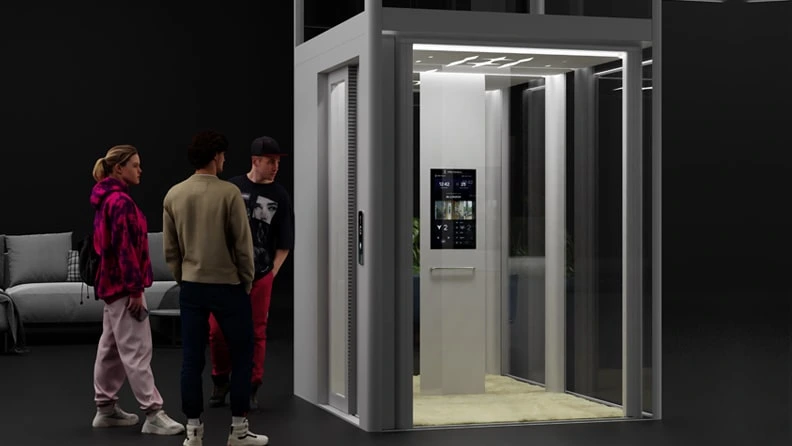
The most common standard cabin size in the Indian market is 1200×1200 mm. This is the default across the Elite Elevators X300 and X200 range and is appropriate for most single-person and two-person trips in a standard family home. It is the minimum size recommended for general residential use, comfortable for daily trips, adequate for most adults, and manageable for the majority of Indian home layouts.
The next step up is the 1400×1200 mm cabin, which is the standard on the Elite Elevators X200 Plus. The additional 200 mm in one dimension makes a meaningful difference to the boarding experience, particularly for adults with luggage, families traveling together, or households where the elevator regularly carries larger items between floors.
The premium option is the 1500×1500 mm XL cabin, available on the X300 MK II Plus and X300 Mark II. At this size, the cabin is genuinely spacious, the walls feel further away, turning inside is comfortable, and wheelchair access is practical. For homes with seniors or mobility-challenged users, this is the dimension that makes the elevator genuinely accessible rather than merely functional.
Find the Perfect Home Elevator Size for Your Space
✔ Standard & Custom Cabin Dimensions Explained
✔ Space-Saving Solutions for Every Home
✔ Accessibility Without Compromising Design
✔ Expert Planning Before Construction Begins
What Is the Smallest Elevator Size Available for Home Use?
The smallest elevator size suitable for genuine residential use in India is a 1200×1200 mm cabin available on the X200, X300, and E300/E200. However, there are smaller platform configurations available for very constrained spaces, and the E50 Stairlift eliminates the cabin dimension question entirely, as it requires only the width of the existing staircase and is functional on staircases as narrow as 610 mm.
For homeowners asking whether a smaller cabin is possible: technically yes, custom dimensions can be manufactured. But going below 1200×1200 mm for a standard cabin creates real accessibility challenges: boarding with bags, traveling with another person, and future-proofing for reduced mobility all become harder. The 1200×1200 mm standard exists because it is the practical minimum for daily family use, not an arbitrary industry convention.
How Cabin Size Affects Installation Cost
This is where the practical consequences become financial. Home elevator size for modern home planning must account for cost implications across several dimensions.
- Shaft construction: A larger cabin requires a larger shaft. If you are building the shaft as part of new construction, this cost is absorbed into the broader build. If you are retrofitting, a larger shaft means more civil work, and civil work is where costs escalate quickly. Every additional 100 mm in shaft dimension can add ₹30,000–₹80,000 in civil costs depending on materials and local contractor rates.
- Pit excavation: Larger cabins on certain drive systems require slightly deeper pits. The X300 range at standard cabin size needs just 59 mm without a shaft, one of the shallowest requirements in the market. Moving to an XL cabin does not change the pit requirement, but changing to a hydraulic system with a larger cabin can affect the configuration.
- Door width and configuration: Center-opening panoramic doors (available on the X300 range) provide maximum effective entry width for any given cabin size, and they cost more than manual swing doors. For wheelchair users or seniors, the wider effective opening of center-opening doors is worth the premium. For a standard family, manual swing doors on the X200 range are fully adequate.
- Landing door count: More stops = more door openings = higher cost. This is independent of cabin size but worth factoring into overall budget planning when choosing cabin dimensions alongside floor count.
Space Planning for Small-Size Lifts for Home Use
For homeowners working with compact urban plots, row houses, or tight floor plans, the small-size lift for home question is about far more than the cabin dimensions alone. The full space footprint of a home elevator installation includes:
- The cabin itself
- The shaft walls (if using a manufactured shaft), typically adding 100–150 mm on each side
- The landing door swing path (for manual swing doors) or recess (for sliding doors)
- The approach zone: the minimum clear floor area in front of the door at each landing
- The headroom above the top landing
The total footprint of a 1200×1200 mm cabin with a manufactured shaft is typically in the range of 1400×1400 mm to 1500×1500 mm. For homes where this is genuinely not available, the E50 Stairlift removes the shaft question entirely, operating along the existing staircase with no additional floor space consumed.
Practical Size Recommendations by Home Type
Rather than abstract dimensions, here is how cabin size decisions map to real Chennai, Bangalore, and Vijayawada home types:
- Compact G+1 row house or urban plot: 1200×1200 mm standard cabin with manual swing doors. X200 or X200 Plus. Minimal civil requirement, fits most tight layouts.
- Standard G+2 independent home: 1200×1200 mm standard or 1400×1200 mm (X200 Plus). Center-opening doors if the corridor allows. Comfortable for full family daily use.
- G+3 or larger villa with seniors: 1500×1500 mm XL cabin (X300 range) with center-opening panoramic glass doors. The accessibility upgrade that makes every floor genuinely usable by every family member.
- Heritage or retrofit home with constrained shaft: E300 or E200 with custom dimensions. European modular engineering allows fabrication to unusual shaft geometries that standard models cannot accommodate.
- No shaft possible: E50 Stairlift. Zero civil work, zero additional floor space, zero structural modification.
Elite Elevators Range Sizes at a Glance
- X300 MK II Plus — 1200×1200 mm std / 1500×1500 mm XL. Gearless. Up to 21,000 mm travel.
- X300 Mark II — 1200×1200 mm std / 1500×1500 mm XL. Gearless. Centre-opening panoramic doors.
- X200 Plus — 1400×1200 mm std. Hydraulic 100 mm pit.
- X200 — Standard cabin. Hydraulic 100 mm pit. From ₹14.50 lakhs.
- E300 Cogbelt — Custom dimensions. Gearless cogbelt. SIL 3 certified.
- E200 Hydraulic — Custom dimensions. EN 81-41. No machine room.
- E50 Stairlift — No cabin. Staircase-mounted. Width from 610 mm.
The Dimension Conversation to Have Before Any Other
Before choosing a model, before requesting a quote, and before discussing finishes, have the dimension conversation with a qualified installer. A free site survey is not a sales call. It is a technical assessment of your specific home’s constraints and the size options that genuinely fit within them. Elite Elevators’ installation team visits your home, measures every relevant dimension, and presents the size options that work, including the ones that would not work and why.
That conversation, held early, saves significant money, avoids the expensive mistake of building a shaft for the wrong cabin size, and ensures the elevator you install is the one your family will actually use comfortably for the next two decades.
Related Posts:
✅ Prices for 2-Floor, 3-Floor, and 4-Floor Home Elevators in India
✅India’s Best 400kg, 440kg 2–6 Person Elevator: Affordable House Elevator Cost
✅ How Much Does a G+1, G+2, or G+3 Home Elevator Cost in India?
✅ How Can You Match a Home Elevator with Your Interior Design?
✅ How to Choose the Right Hydraulic Lift for Your Home
✅ What Is the Cost of Installing a Home Elevator in India in 2026?
✅ Step-by-Step Guide: How to Install a Home Elevator in Your Existing Home
✅ How Do Home Elevator Sizes Differ by Elevator Type?
✅ How Do You Choose the Perfect Home Elevator / Lift Cabin Design for Your Home?