

 Add Elite as Preferred
 Hydraulic home elevators offer smooth rides, no machine room, low noise, and affordable pricing from ₹14.50 lakhs. Their limitations include slower speeds (up to 0.30 m/s) and availability only up to G+3 in entry-level models. Elite Elevators’ hydraulic range is EN 81-41 certified with full safety equipment.
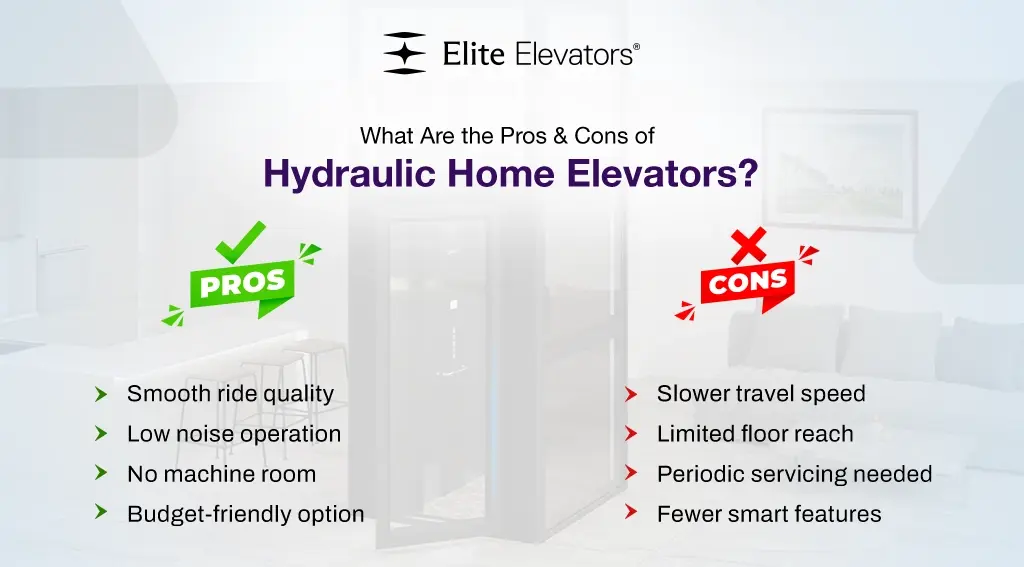
Hydraulic home elevators have a strong reputation in India’s residential lift market and for good reason. But no technology is perfect for every situation. And in a market where misinformation is common and sales conversations are often one-sided, families deserve an honest picture of both the strengths and the limitations.
The challenge is finding that honest picture. Most content either oversells hydraulic technology or dismisses it unfairly in favor of newer alternatives. Neither serves the homeowner trying to make the right decision for a G+2 villa or a multi-generational family home.
This guide gives you the complete, balanced view of the hydraulic lift advantages and the genuine hydraulic elevator disadvantages based entirely on Elite Elevators’ real products and real-world performance.
The Pros of Hydraulic Home Elevators
1. Smooth, fluid ride quality
This is the most consistently cited advantage of hydraulic technology, and it’s real. Hydraulic systems produce an inherently smooth, fluid movement driven by pressure rather than mechanical tension. The acceleration and deceleration curves are gentle and controlled, creating a ride that many users describe as the most natural-feeling elevator experience.
Elite Elevators’ hydraulic models, the X200 series and the E200, are engineered to enhance this natural smoothness further. The E200 features a Soft Start and Stop (SSS) device and 194 integrated safety parameters that produce a jerk-free ride from the first movement to the landing.
2. No machine room, no deep pit
Unlike traditional traction elevators, hydraulic home lifts do not require an overhead machine room or a deep pit. Elite Elevators’ X200 series requires only a 100 mm shallow pit and no separate machine room. The E200 requires 120 mm. This makes hydraulic lifts compatible with a much wider range of existing homes, particularly older constructions where structural modification is either impractical or undesirable.
3. Quiet, non-disruptive operation
Hydraulic systems operate quietly; the fluid mechanism produces significantly less noise than mechanical alternatives. Elite Elevators’ hydraulic models use grease-free guide rails that eliminate the metal-on-metal sounds associated with older lift systems. For families in homes where noise matters, young children, elderly members, and home offices, this is a meaningful advantage.
4. Accessible entry price
The Elite Elevators X200 starts at ₹14.50 lakhs for a G+1 home, the most accessible price point in their range and among the most competitive for a full-featured residential lift in India. All-inclusive pricing with no hidden charges makes budgeting straightforward.
5. European safety certification on premium models
The E200 is certified to EN 81-41 European safety standards, one of the most rigorous residential elevator safety frameworks globally. With 194 integrated safety parameters, battery-operated emergency lowering, a dedicated GSM autodialer, and automatic door locking mechanisms, it provides comprehensive protection at every ride.
6. Versatile installation environments
Both the X200 series and E200 are suitable for indoor and outdoor installation. The single-phase power supply requirement is compatible with standard residential electrical infrastructure across India, keeping installation preparation simple and cost-effective.
The Cons of Hydraulic Home Elevators
1. Lower speed compared to gearless systems
Hydraulic home lifts operate at up to 0.30 m/s — compared to up to 1.0 m/s for Elite Elevators’ gearless X300 series. For families with frequent daily elevator use across multiple floors, this speed difference is noticeable. The X300 series’ Sport Mode, for instance, offers high-speed travel with automatic doors that are simply not available on hydraulic models.
2. Floor coverage limitation on entry models
The X200 series is available up to G+3. Homes with G+4 or G+5 requirements need to step up to the E200 hydraulic lifts (available up to G+4) or move to the X300 gearless series (available up to G+5). For families building taller homes, this is a relevant planning consideration.
3. Periodic hydraulic unit servicing
While Elite Elevators’ hydraulic models are designed for reliability, hydraulic systems require periodic professional servicing of the hydraulic unit to maintain optimal performance. Gearless belt drive systems have fewer moving parts and tend to have longer service intervals. Elite Elevators’ nationwide service network manages this efficiently, but it is a recurring maintenance commitment.
4. Smart feature limitations on entry models
The X200 base model does not include the advanced smart features available on the X300 series. AI navigation, biometric floor selection, VisionLog cabin camera, and four ride modes are exclusive to the gearless range. The X200 Plus adds smart features, including a 21″ live board, a mobile app, and Live SOS, but the full AI and biometric package remains with the X300 MK II Plus.
Home Elevator Pros and Cons: Summary
| Features | Hydraulic (X200 / E200) | Gearless (X300) |
| Ride smoothness | Excellent | Excellent |
| Speed | Up to 0.30 m/s | Up to 1.0 m/s |
| Max floors | G+3 (X200) / G+4 (E200) | G+5 |
| Entry price | From ₹14.50L | From ₹18.70L |
| Smart features | Limited (Plus models) | Full AI + biometric |
| Maintenance | Periodic hydraulic service | Lower frequency |
| Machine room | Not required | Not required |
| Pit depth | 100–120 mm | 59 mm |
Frequently Asked Questions
1. What are the main advantages of hydraulic home elevators in India?
The main advantages are smooth, fluid ride quality; no machine room or deep pit required; quiet operation; accessible entry pricing from ₹14.50 lakhs; and European safety certification on the E200 model. They are ideal for G+1 to G+3 homes where ride comfort and affordability are priorities.
2. What are the disadvantages of hydraulic home elevators?
The main limitations are lower speed (up to 0.30 m/s vs 1.0 m/s for gearless), floor coverage limited to G+3 on entry models, periodic hydraulic unit servicing requirements, and fewer advanced smart features compared to gearless models.
3. Are hydraulic home elevators safe in India?
Yes. Elite Elevators’ hydraulic models include ARD emergency rescue, dual emergency brakes, door safety sensors, GSM emergency communication, and low-voltage cabin operation. The E200 is certified to EN 81-41 European safety standards with 194 integrated safety parameters.
4. Which is better for a G+2 home hydraulic or gearless?
Both are suitable for G+2. The X200 at ₹16.50 lakhs offers excellent value with reliable hydraulic performance. The X300 MK II at ₹20.70 lakhs adds higher speed and lower long-term maintenance costs. If smart features and AI are priorities, the X300 MK II Plus at ₹22.95 lakhs is the clear choice.
5. How long do hydraulic home lifts last in India?
With proper maintenance, Elite Elevators’ hydraulic lifts are built for lifetime durability. European-engineered components, grease-free rails, and smart fault detection systems contribute to long-term reliability. Elite Elevators provides comprehensive warranty coverage and annual service contracts.
Make the Right Choice for Your Home
Elite Elevators offers free home assessments where their engineers visit your property, assess your space, and recommend the right hydraulic or gearless model for your specific requirements. No sales pressure. No guesswork. Just a clear recommendation backed by 10+ years of residential lift expertise.
Note: * Prices listed are starting rates, exclude applicable taxes, and may vary based on customization.



Ajay Kumar
I have been researching a hydraulic elevator for home for quite some time, and this article answered many of my doubts. The comparison between ride comfort, maintenance, speed, and safety was explained in a simple way. A very informative blog that gives readers confidence before making an investment.
Aparna Menon
One of the best articles I have found about hydraulic home elevator price and performance. Most websites only highlight benefits, but this blog also explained the limitations honestly. That balance makes the information more trustworthy for homeowners who are comparing different lift technologies.
Gokul Raj
Great explanation of the hydraulic lift advantages with real technical details instead of generic information. I especially liked the points about smooth ride quality, low noise, and minimal structural changes. This guide is useful for anyone exploring residential elevator options for their house.
Nandhini Ravi
I was searching for reliable information on hydraulic home elevator India, and this blog covered almost everything I wanted to know. The safety certifications, pricing details, and installation requirements were explained very clearly. Thanks for sharing such practical and well-organized content.
Sandeep Kumar
Excellent article for anyone considering a hydraulic elevator for home. I found the comparison between hydraulic and gearless systems especially useful because it makes choosing the right option much easier. The language is simple, informative, and easy for homeowners to understand.
Rekha Sharma
This is one of the most detailed blogs I have read about a hydraulic lift for house. Instead of using complicated technical terms, the article explains everything in a way that even first-time buyers can understand. The pros and cons section was particularly valuable.
Manikandan S
Very informative content about hydraulic home elevators. I was confused by different opinions online, but this article presents both the strengths and weaknesses in a balanced manner. It helped me understand which type of lift would be more suitable depending on individual home requirements.