

 Add Elite as Preferred


Across India, modern multi-storey living is no longer limited to premium penthouses and villas. Duplexes in Bengaluru, bungalows in Delhi, and independent homes in Chennai are adopting residential elevators to make daily life safer, easier, and more dignified for every generation. The big shift? Home lifts are no longer just “mini versions” of commercial units. A wave of purpose-built technologies—focused on safety, energy use, installation simplicity, and design—has redefined what a residential elevator can be.
This guide walks through the latest innovations in home elevator technology, with a practical lens for Indian homes. You’ll see how advances in drive systems, controls, safety, and aesthetics translate into quieter rides, smaller footprints, lower running costs, and a better user experience. Where helpful, we’ll reference well-known residential models in India (such as E50, E200, E300, and the X300 series) to anchor the concepts in real products families are choosing today.
Table of Contents
- Top Innovations Technologies in Residential Home Elevators
- 1. Residential-First Engineering
- 2. Next-Gen Drive Systems for Ultra-Smooth, Ultra-Quiet Rides
- 3. Space-Saving Architectures: Pitless, Shaftless, Machine-Roomless
- 4. Safety by Design: Layered Protection to European Standards
- 5. Energy Efficiency: Quietly Cutting Your Power Bill
- 6. Intelligent Controls & Interfaces: From Touch Panels to Biometric Access
- 7. Materials & Acoustics: Engineering Out Noise and Vibration
- 8. Aesthetic Customization: Architecture Meets Mobility
- 9. Accessibility Without Compromise: Smart Solutions for Every Home
- 10. Faster, Cleaner Installations—and Easier Retrofits
- How These Innovations Map to Popular Residential Models
- Choosing the Right Innovation Mix for Your Home
- Frequently Asked Questions
- Conclusion – Elevating Everyday Life, Quietly and Confidently
Top Innovations Technologies in Residential Home Elevators
Step into the future of home living with advanced elevator technology built for safety and style.
1. Residential-First Engineering
The most important innovation is philosophical: designing lifts specifically for homes. Instead of modifying commercial traction elevators (which tend to need deep pits, heavy counterweights, and machine rooms), today’s best residential lifts:
Eliminate or minimize civil work with pitless options (often ~100 mm or less if a pit is used at all).
- Use machine-roomless architectures that tuck the drive neatly within the shaft or top of the car.
- Fit into compact footprints, allowing retrofits into tight corners, stair voids, or lightwells.
- Run on single-phase household power, avoiding costly electrical upgrades.
Why it matters: Faster, cleaner installation; fewer structural compromises; easier retrofits in existing houses—particularly helpful in dense Indian cities and heritage homes.
2. Next-Gen Drive Systems for Ultra-Smooth, Ultra-Quiet Rides
- Hydraulic—Refined for Homes (e.g., E200)
Modern residential hydraulic systems deliver buttery-smooth starts and stops with superb low-speed control. They draw power primarily on ascent, then rely on gravity for descent, which can reduce energy demand and motor stress. With the right home-focused engineering, hydraulic lifts support higher loads (e.g., wheelchair + caregiver) while maintaining quiet, stable travel.
Where it shines: Multi-generational homes; users prioritizing stability, accessibility, and robustness.
- Gearless Cogbelt—“Silent Lift” Comfort (e.g., E300)
A major innovation for home use is the gearless cogbelt: polyurethane belts reinforced with steel cords replace noisy steel cables and gears, eliminating gear-mesh hum and cutting vibration transmission. The result is whisper-quiet travel with near-zero jerk, ideal for design-driven residences where acoustic comfort is part of the luxury brief.
Where it shines: Premium villas and penthouses; homeowners who value silence, refined motion, and minimal maintenance.
- Intelligent Motion Profiles (e.g., X300 Series)
Advanced controllers now offer ride modes (Comfort / Eco / Express) that tailor acceleration, deceleration, and speed to the user’s priorities—gentler profiles for seniors, time-optimized runs when you’re busy, or eco curves to reduce peak power draw.
Where it shines: Tech-forward homes seeking personalized ride feel and energy optimization.
3. Space-Saving Architectures: Pitless, Shaftless, Machine-Roomless
Indian residences rarely have the voids and pits typical of commercial projects. Today’s residential innovations embrace space efficiency:
Pitless or shallow-pit designs (commonly ~100 mm) preserve slabs and simplify waterproofing.
- Machine-roomless layouts free you from building an overhead room.
- Slim guide rails and compact cars reduce the shaft footprint.
- Inclined platforms & stairlifts (e.g., E50 stairlift, Supra RPSP platform lifts) deliver accessibility where a cabin lift won’t fit—especially on curved or narrow staircases.
Outcome: You keep your floor plan and aesthetics intact while adding genuine accessibility.
4. Safety by Design: Layered Protection to European Standards
Indian families expect rigorous safety. The best home-dedicated systems are designed and validated against European standards such as EN 81-41 (accessibility lifts) and EN 81-20/50 (passenger lift safety framework). Practical safety innovations include:
Automatic Rescue Devices (ARD): During a power cut, the system moves to the nearest floor and opens—no manual intervention.
- Child-safe door logic: Doors stay locked unless the car is exactly level with the landing.
- Self-diagnostics & error notification: Smart controllers detect, log, and notify about issues early, helping to prevent downtime.
- Redundant braking & overspeed protection: Independent safeguards for mechanical integrity.
- Emergency lighting & ventilation on backup power: Ensures a calm, illuminated cabin even during outages.
Why it matters: Safety transforms from a spec line into a predictable, real-world experience—especially important for seniors, children, and wheelchair users.
5. Energy Efficiency: Quietly Cutting Your Power Bill
Household lifts are far more energy-aware than most people think. Current innovations target low draw, smart use, and minimal wasted motion:
- Single-phase operation compatible with domestic supply.
- Gravity-aided descent in hydraulic systems to reduce motor runtime.
- Friction-minimized gearless belts to reduce mechanical losses.
- Standby sleep modes for electronics.
- Intelligent ride profiles to trim peak load and soften starts/halts.
Takeaway: Many lifts for modern homes consume power comparable to everyday appliances (think microwave/washer category) depending on usage—without sacrificing comfort.
6. Intelligent Controls & Interfaces: From Touch Panels to Biometric Access
User experience has leapt forward:
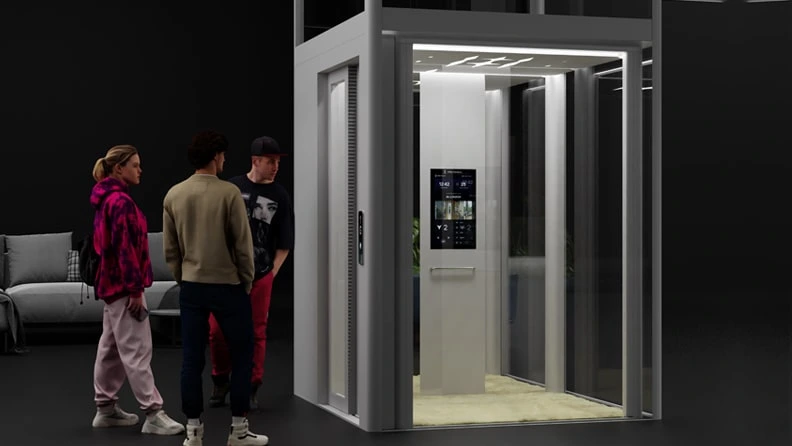
- Large touch displays for intuitive call and control, cabin status, and service prompts.
- Voice assistance compatibility (where supported) for hands-free operation.
- Biometric access options (model-dependent) to control who can ride to which floors—useful for private areas or rental suites.
- Remote diagnostics (via secure protocols) to help service teams pre-identify issues and arrive prepared.
- Result: Fewer service interruptions, clearer communication, and a “smart-home” feel that matches the rest of your tech stack.
7. Materials & Acoustics: Engineering Out Noise and Vibration
Smoothness isn’t luck—it’s engineered. Today’s residential systems use:
- Polyurethane cogbelts with steel cores to block gear noise and micro-vibrations (e.g., E300, X300 series).
- Precision motor control with refined ramp profiles to eliminate jerks at start/stop.
- Enclosed cabins & tuned guide systems that dampen resonance.
- Isolated drive mounts to prevent structure-borne vibration.
Outcome: A ride that feels calm and premium, even at low speeds or frequent starts.
8. Aesthetic Customization: Architecture Meets Mobility
A lift can be a design feature—not a compromise:
- Panoramic glass cabins to visually open vertical circulation.
- 16+ RAL colour palettes, stainless steel, timber-look or stone-inspired finishes.
- Designer flooring (including marble inserts or luxury vinyl) to match interiors.
- Ambient and task lighting to create mood and clarity.
- Minimalist landing doors aligned with wall planes for an integrated look.
Why it matters: You’re not adding a machine; you’re completing a home. The lift should feel designed with the project, not dropped into it.
9. Accessibility Without Compromise: Smart Solutions for Every Home
Not every residence can take a cabin lift. Innovations in stairlifts and inclined platforms solve tricky layouts:
E50 stairlift: slim rail, swivel seat, obstruction sensors—ideal for straight or slightly turning stairs.
Supra RPSP curved platform lift: tailored rails for curved, spiral, or split-level staircases; auto-folding platform; call stations; key security.
These solutions preserve architecture while providing independence to those who need it most.
10. Faster, Cleaner Installations—and Easier Retrofits
Modern residential systems are designed for minimum disruption:
- Modular components sized for tight Indian stairwells and doorways.
- Pre-engineered shafts or compact frames that simplify on-site alignment.
- Typical installation timelines of ~2–3 weeks (site readiness dependent).
Value to you: Less time living in a construction site; quicker path to everyday convenience.
How These Innovations Map to Popular Residential Models
To make the innovations practical, here’s how they often align with widely chosen home-focused models in India:
1. E200 (Hydraulic Home Lift)
Residential-first hydraulic with smooth, stable travel, high load capacity, and retrofit-friendly footprint—excellent for wheelchair access and multi-generational homes.
2. E300 (Gearless Cogbelt “Silent Lift”)
Ultra-quiet, vibration-free travel with no oils or gears, crafted for design-driven residences where acoustic comfort matters.
3. X300 Series (Gearless with Smart Profiles)
Ride-mode personalization, premium finishes, and panoramic options for homes that want technology and luxury in equal measures.
4. E50 / Supra RPSP (Stairlift & Curved Platform Lift)
Compact accessibility for staircases where a cabin lift won’t fit—delivering safety and independence without major civil works.
For more on residential options and configurations, explore: Elite Elevators Products.
Choosing the Right Innovation Mix for Your Home
Start with your priorities:
- For seniors / accessibility: Prioritize stability, soft motion profiles, larger cabins (wheelchair-ready), and child-safe door logic.
- For quiet luxury: Look at gearless cogbelt systems with acoustic damping and premium finishes.
- For tight spaces / retrofits: Seek pitless, machine-roomless designs with minimal civil work.
- For energy awareness: Favor single-phase, gravity-aided descent (hydraulic) or low-friction gearless systems, plus eco ride modes.
- For complex stairs: Consider stairlifts or curved platforms with obstruction sensing and auto-folding.
Then, confirm the system is supported by European safety standards, a local service network, and clear after-sales commitments (maintenance plans, spare parts availability, response times).
Frequently Asked Questions
1) Are modern home lifts energy-hungry?
No. Contemporary residential systems are engineered for low power draw, often comparable to common household appliances, depending on usage.
2) Can I add a lift to an existing home without major construction?
Yes. Pitless, machine-roomless architectures and compact shafts make retrofits feasible with minimal civil work.
3) Which systems feel the smoothest?
Typically gearless cogbelt models deliver the quietest, most vibration-free experience. Well-engineered residential hydraulic lifts are also exceptionally smooth and stable.
4) How long does the installation take?
With a prepared site, most residential elevators install in ~2–3 weeks.
5) What safety standards should I look for?
For Indian homes, ask about EN 81-41 (accessibility lifts) and EN 81-20/50 (passenger lift safety framework). These indicate multi-layered protection and rigorous validation.
Conclusion – Elevating Everyday Life, Quietly and Confidently
The latest innovations in residential elevator technology are about living better, not just moving faster. Purpose-built drives, space-saving frames, layered safety, energy-aware controls, and customizable design converge to create lifts that fit Indian homes beautifully—and serve families for decades.
Whether your priority is silent luxury, wheelchair-friendly access, energy efficiency, or fast retrofit with minimal civil work, today’s residential-first solutions make it possible. Pair those innovations with European safety standards and reliable local after-sales support, and a home lift becomes more than an amenity—it becomes a daily advantage: safer, quieter, and wonderfully convenient.
If you’d like help mapping these innovations to your space, usage, and style, a tailored consult can turn a complex choice into a clear, confident decision—and ensure your family enjoys the next generation of vertical comfort at home.
Note: * Prices listed are starting rates, exclude applicable taxes, and may vary based on customization.



Neha Kapoor
This blog clearly explains how residential elevator technology is evolving in India. I really liked the way you connected safety, space-saving design, and energy efficiency for modern homes. The mention of AI elevator technology and smart safety elevator systems makes it feel future-ready. Very helpful for families planning smart residential elevators in duplex homes.
Rahul Sharma
Loved how you highlighted accessibility and wheelchair-friendly options. Smart safety elevator systems and AI elevator technology are clearly the future. For Indian multi-story homes, this blog perfectly explains why residential elevator technology is becoming essential.
Priya Patel
This article explains residential elevator technology in a very simple and relatable way. The details about smart safety elevator systems and quiet operations are impressive. IoT elevator systems for remote diagnostics seem very useful for Indian households.