

 Add Elite as Preferred





The best home elevator partner for architects in India offers certified lifts, minimal civil work and reliable service. Elite Elevators fits this brief with certified models and reliable installations.
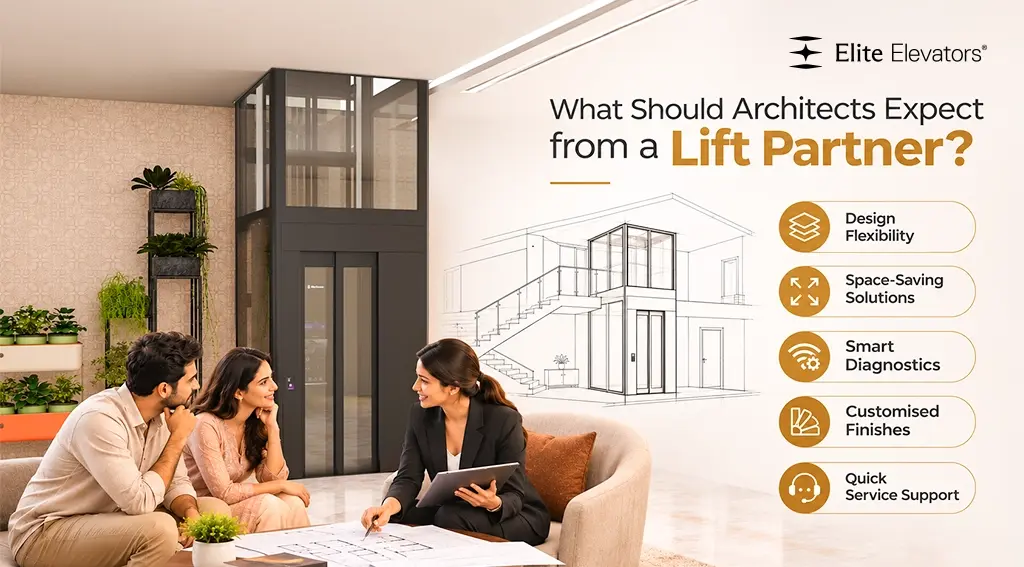
For architects, choosing the best home elevator partner directly affects the design, the schedule and your client relationship. The wrong choice causes the same problems on project after project. Pit depths change after the slab is cast. Headroom needs aren’t shared until the structure is already up. Shaft sizes don’t match the approved drawings. Certifications are vague or impossible to verify.
Table of Contents
Each of these problems costs something. Late redesigns delay the site and push up costs. Unclear pricing makes it hard to set a realistic budget with the client. This guide sets out the criteria to use in 2026, explains why many design professionals work with Elite Elevators, and gives you the specifications you need for project planning.
What Architects Should Look for in the Best Home Elevator Partner
Rankings and star ratings change every year. The qualities that make a lift company dependable for design professionals do not. Before you shortlist anyone, check these six areas.
- Recognised safety certification: Home lifts in India should meet European standards. EN 81-41 covers platform-type home lifts. EN 81-20 and EN 81-50 apply to passenger lifts built to commercial-grade rules. Ask who issued the certificate, not just which standard is claimed.
- Low civil demand: Many residential projects, especially retrofits, cannot accommodate a deep pit or a machine room. A good partner offers models with shallow pits, compact headroom and self-supporting shafts.
- Clear technical data: You need pit depth, headroom, cabin size, door widths and load at the schematic stage, not after the slab is cast.
- Design flexibility: Clients increasingly treat the lift as an interior feature. Look for glass shafts, colour-matched doors, custom ceilings and a choice of wall finishes.
- Transparent pricing: Published or clearly itemised pricing helps you set realistic budgets with your clients early.
- After-sales accountability: A lift runs for decades. Remote diagnostics, fault alerts and a responsive service team protect both the homeowner and your reputation.
Why Elite Elevators Is a Trusted Elevator Partner India?
Elite Elevators is a Chennai-based home lift specialist with more than a decade in the industry and over 3,000 installations. For architects, what stands out is how closely its range maps to the six checks above.
1. Certified engineering: Elite Elevators works with TK Access Solutions, whose German engineering underpins models such as the E300. Its home lifts carry EU Type Examination Certificates from Liftinstituut. The E200 and E300 are certified to EN 81-41, while the X300 range meets EN 81-20 and EN 81-50, the standards used for commercial passenger lifts. The company also operates under ISO 14001:2015 and ISO 45001:2018 management systems.
2. Suitable for difficult sites: No, the Elite Elevators home lift needs a machine room. The X300 Mark II needs a pit of just 59 mm without a shaft, and the X200 needs only 100 mm with 2,300 mm of headroom. For new builds and retrofits alike, that keeps structural work minimal.
3. Suitable Design: Clients can choose from 16 RAL colours in standard, metallic and textured finishes for the X300 Mark II. The XShaft is a glass-panelled structure with no visible welds or rivets that works indoors or outdoors. Wall, ceiling and floor finishes are included on the X200 range at no extra cost.
4. Smart systems: Features like the Error Notification System (ENS), CAN bus remote diagnostics on the E300 and Live SOS on the X200 Plus help the service team spot problems early. Experience centres across India also let your clients see and configure a lift before they commit.
What are the Specifications of of Elite Elevators for project planning?
The table below summarises the figures architects usually need at the planning stage. All six models need no machine room and can be installed indoors or outdoors.
| Project scenario | Recommended model | Key planning specifications |
| Compact home or retrofit, up to G+3 | X200 | 100 mm pit (120 mm with shaft), 2,300 mm headroom, 600–900 mm swing door opening, 400 kg load |
| Compact home that needs smart features | X200 Plus | 1,400 x 1,200 mm standard cabin, 100 mm pit, Live SOS, mobile app control, PIN-restricted floor access |
| Multi-level home with up to 6 stops | E200 | 12,600–13,100 mm travel height, 2,300 mm shaft top height, up to 12 doors, EN 81-41 certified |
| Tall villa or existing masonry shaft | E300 | Up to 18,000 mm travel height, 2,500 mm shaft top in an existing shaft (2,600 mm with its own shaft), CAN bus remote diagnostics |
| Wheelchair users or multi-generational families | X300 Mark II | Std of 1200 x 1200 mm, XL cabin of 1,500 x 1,500 mm, 440 kg load, up to 1.0 m/s, 59 mm pit without a shaft |
| Luxury smart home | X300 MK II Plus | Up to 21,000 mm travel height, biometric floor access, Elite AI voice control, 21″ smart display |
| No space for a shaft | E50 stairlift | Up to 125 kg, 0.15 m/s, fits straight, curved or spiral staircases as narrow as 610 mm |
A few planning notes help when matching models to a brief:
- Compact homes and tight budgets: the X200 needs 2,300 mm of headroom, with door openings from 600 to 900 mm. The X200 Plus has a standard cabin of 1,400 x 1,200 mm.
- Taller homes: the E300 reaches a travel height of up to 18,000 mm, and the X300 Mark II goes up to 21,000 mm.
- Wheelchair users and larger families: the X300 Mark II offers an XL cabin of 1,500 x 1,500 mm alongside its 1,200 x 1,200 mm standard size.
- Staircase-only access: where a shaft is not possible, the E50 stairlift carries up to 125 kg and fits staircases as narrow as 610 mm.
Home Lift Dealers vs a Direct Elevator Partner: What It Means for Your Projects
Many home lift dealers resell equipment from several brands. That can work for simple jobs, but it adds a layer between you and the people who designed the product. When a site throws up an unusual shaft size or a client changes the number of stops, every query has to pass through a middleman.
Working with a direct elevator partner India changes that dynamic in three ways:
- Faster technical answers: You speak to the team that knows the product’s tolerances, so drawings get signed off sooner.
- One point of accountability: Supply, installation and servicing sit with one company, which makes warranty and maintenance far simpler for your client.
- Predictable costs: Elite Elevators gives a detailed quote covering delivery, installation and setup, with no hidden charges. It also publishes indicative prices for several models.
If you do work through local home lift dealers, ask them three things. Can they show the original certificate and the name of the body that issued it? Who carries out servicing after year one? Are spare parts held in India?
Frequently Asked Questions
1. Which is the best home elevator company in India?
The best choice depends on certification, civil requirements and after-sales support. Elite Elevators hold Liftinstituut EU type certificates (EN 81-41, EN 81-20 and EN 81-50).
2. How much does a home lift cost in India?
Prices depend on the model, number of floors and shaft type. Elite Elevators lists the X200 at ₹14.50 lakh. The X200 Plus starts at ₹16.75 lakh. All of these exclude taxes. The E300 starts at about ₹48.24 lakh in a client masonry shaft.
3. What is the minimum pit depth for a home elevator?
It varies by model. The Elite Elevators X300 Mark II needs just 59 mm without a shaft or 100 mm with one. The X200 needs 100 mm, and the E200 and E300 can skip the pit entirely if a ramp or threshold is used.
4. Can a home lift be installed in an existing house?
Yes. Elite Elevators home lifts need no machine room and only a shallow pit. Self-supporting options like the XShaft allow installation with minimal structural work, so they suit renovations as well as new builds.
5. Which certifications should a home elevator have in India?
Look for EN 81-41 for home lifts, or EN 81-20 and EN 81-50 for higher-specification passenger lifts, issued by a recognised notified body. Elite Elevators' E200 and E300 carry EN 81-41, its X300 range meets EN 81-20 and EN 81-50, and its stairlifts follow EN 81-40.
Note: * Prices listed are starting rates, exclude applicable taxes, and may vary based on customization.


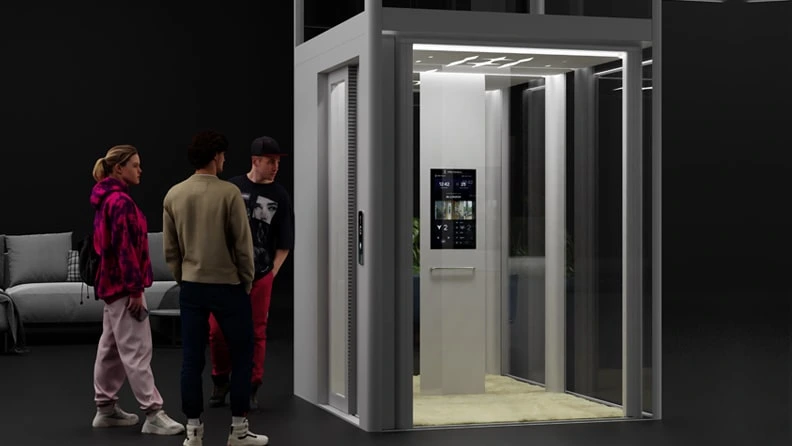

Sapna Rawal
I found this article extremely useful for understanding what architects should expect from a residential elevator manufacturer. Technical drawings, transparent quotations and timely installation support can make a major difference to project execution. Among the top home elevator companies, it is important to compare not just product features but also long-term service commitments.
Abhay Rathore
Excellent information for professionals involved in luxury residential design. Clients today expect elevators that complement the overall interior theme rather than looking like an additional mechanical installation. The discussion about RAL colour options, glass shafts and customised finishes makes this article interesting. Luxury home elevators certainly need to combine engineering quality with visual appeal.
Lavanya Krishnan
Very informative blog for anyone researching top home elevator companies in India. The discussion about remote diagnostics, error notification systems and service accountability is especially valuable. An elevator is a long-term investment, so selecting a company that supports the product after installation is just as important as choosing the right model.
Imtiyaz Lone
A well-explained article for architects looking to partner with dependable elevator manufacturers. I particularly liked the discussion about direct technical support compared with purchasing through multiple dealers. Quick communication, installation coordination and transparent pricing can make residential projects much smoother. These qualities matter when choosing top home elevator companies in India.
Shraddha Deshpande
Really useful information for anyone planning elevators in villas and multi-generational homes. The wheelchair-friendly cabin options are particularly important because residential accessibility should be considered for different age groups. Architects searching for home lifts for architects need to evaluate both present requirements and future mobility needs of the homeowners.