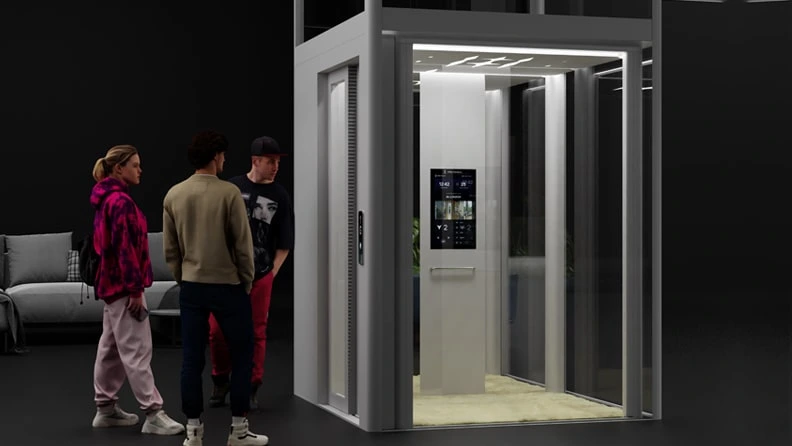
Standard home elevator dimensions range from 900 mm to 1500 mm cabin width, supporting 2–6 passengers with 400–440 kg capacity. With Elite Elevators, models like X200 and X300 ensure compact design, minimal space usage, and efficient installation for residential homes.
Understanding home elevator dimensions is a critical first step for homeowners planning to enhance accessibility and property value. Standard home elevator dimensions typically range from 900 mm to 1500 mm in cabin width, accommodating 2 to 6 passengers with load capacities between 300 kg and 500 kg. These specifications directly impact installation feasibility, construction modifications, and long-term usability.
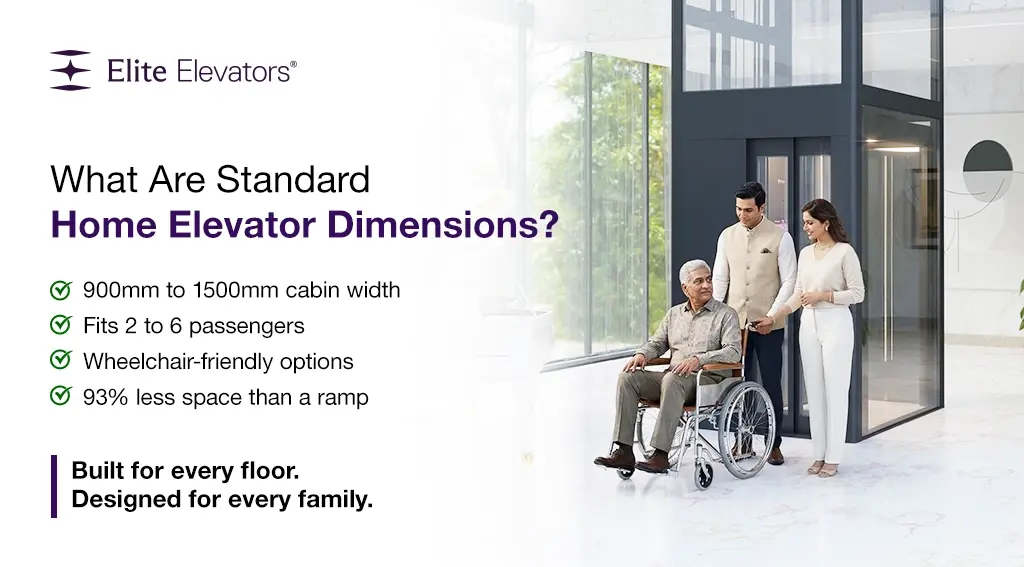
Table of Contents
- Understanding Standard Home Elevator Dimensions by Capacity
- Technological Innovations Reducing Residential Lift Dimensions
- 1. Machine-Room-Less (MRL) Design
- 2. Hydraulic System Optimisation
- 3. Gearless Technology
- Comparative Analysis: Home Elevators vs. Wheelchair Ramps
- Model-Specific Selection Guide: Matching Home Elevator Size to Requirements
- Installation Planning: Critical Dimensional Considerations
- Frequently Asked Questions
- Conclusion: Strategic Dimensional Planning for Home Elevators
According to industry data from elevator manufacturers serving the Indian market, proper dimensional planning reduces installation costs by up to 30% and prevents costly structural redesigns. This comprehensive analysis examines residential lift dimensions across all major elevator types, installation requirements, and comparative assessments against alternative accessibility solutions. This guide provides technical specifications, space optimisation strategies, and evidence-based recommendations for homeowners, architects, and contractors.
Understanding Standard Home Elevator Dimensions by Capacity
Small lift size for home applications varies systematically based on passenger capacity and intended usage patterns. The following classifications represent industry-aligned configurations:
1. Compact Home Elevators (2–3 Passengers)
Compact models serve urban apartments, duplex residences, and retrofit applications where spatial constraints limit installation options. Representative configurations include:
- X200 / X200 Plus Hydraulic Systems: Compact cabin configurations starting around 900 mm width, with 400 kg capacity
- E200 Hydraulic Configuration: Compact, customisable cabin layouts designed for residential use with low pit requirements
Typical applications:
Two-story residential buildings, elderly-accessible homes, compact urban dwellings
2. Standard Family Elevators (4 Passengers)
This category represents the most commonly installed residential lift size for multi-generational households and standard family homes:
- X300 Mk II / Mk II Plus Gearless Systems: Typically around 1200 × 1200 mm configuration (depending on layout)
- E300 Cogbelt Traction Elevators: Flexible, adjustable cabin dimensions designed for residential spaces
- Load capacity: 400–440 kg
Optimal for:
Three-story villas, joint family residences, homes with elderly or mobility-impaired residents
3. Large Capacity Elevators (5–6 Passengers)
Premium residential installations and wheelchair-accessible configurations require expanded dimensions:
- X300 Mk II Plus Premium Model: Up to 1500 × 1500 mm cabin dimensions (based on configuration) with 440 kg capacity
Enhanced accessibility features for wheelchair users and medical equipment transport
Target applications: Luxury villas, multi-story independent houses, barrier-free universal design homes
Critical Space Requirements: Pit Depth, Headroom, and Shaft Dimensions
House lift size calculations extend beyond cabin dimensions to encompass three essential spatial parameters:
Pit Depth Requirements
Pit depth—the excavation below the lowest floor landing—varies based on elevator technology:
- Minimal Pit Configurations: X300 Mk II series can operate with pit depths as low as ~50 mm, depending on model and site conditions, significantly reducing excavation compared to traditional systems
- Standard Hydraulic Pits: X200 series operates with low pit requirements typically within compact ranges, while E200 models are designed with minimal pit needs for residential installations
- Traction System Specifications: E300 cogbelt systems require slightly higher but still minimal pit depth for optimal operation
These reduced pit requirements translate directly to lower excavation costs and simplified retrofit installations in existing structures.
Headroom Specifications
Overhead clearance requirements have decreased substantially with machine-room-less (MRL) technology adoption:
- Standard headroom: Approximately 2600 mm to under 3000 mm, depending on the model
- X300 Mk II specific requirement: Around 2600 mm minimum (based on configuration)
- Comparative advantage: Traditional elevator systems historically required significantly higher overhead clearance
Shaft Dimensions and Clearances
home elevator dimensions for shaft construction follow this general approach:
- Shaft size is based on cabin dimensions plus required clearances, depending on model and configuration
Specific model considerations:
- X200 / X200 Plus: Compact shaft designs with minimal clearance requirements
- X300 series: Optimised shaft design reduces total footprint compared to conventional installations
- E300 systems: Streamlined traction configuration enables efficient and compact shaft construction
Technological Innovations Reducing Residential Lift Dimensions
Modern elevator engineering has achieved substantial dimensional reductions through three primary technological advances:
1. Machine-Room-Less (MRL) Design
MRL technology eliminates the separate machine room previously required above the elevator shaft. This advancement:
- Reduces total building height requirements by 2-3 meters
- Decreases shaft footprint by 30-40%
- Enables installation in existing structures with minimal structural modification
The X300 Mk II and E300 models exemplify MRL implementation, positioning drive machinery within the shaft or in compact adjacent spaces.
2. Hydraulic System Optimisation
Modern hydraulic elevators (X200 series, E200) achieve minimal pit depths through:
- Side-mounted hydraulic cylinders reduce underground excavation
- Compact pump unit configurations
- Efficient fluid management systems require less reservoir space
3. Gearless Technology
The X300 Mk II & Plus, E300 models employ advanced gearless drive technology, delivering:
- Compact motor design with a significantly reduced footprint compared to traditional geared systems
- Elimination of separate gearbox components for smoother and more efficient operation
- Optimised system design enabling efficient use of space within the shaft
Comparative Analysis: Home Elevators vs. Wheelchair Ramps
House elevator dimensions present compelling spatial advantages over alternative accessibility solutions, particularly wheelchair ramp installations:
1. Space Consumption Comparison
Wheelchair Ramps:
- Required slope: 1:12 ratio per Americans with Disabilities Act (ADA) standards
- Linear distance per floor (3 meters height): 36 meters (approximately 118 feet)
- Width requirement: Minimum 914 mm (36 inches)
- Total area for single-story access: 33+ square meters
Home Elevators (X300 Standard):
- Floor space: 1.44 square meters (1200×1200 mm)
- Space savings: 93% reduction versus comparable ramp installation
2. Weather Exposure and Maintenance
External ramps face continuous environmental exposure, resulting in:
- Annual maintenance requirements for surface degradation
- Ice and snow accumulation create safety hazards
- Material degradation requiring replacement every 7-10 years
Home elevators provide climate-controlled operation with:
- Enclosed weatherproof shaft construction
- Minimal annual maintenance (bi-annual safety inspections)
- Expected operational lifespan exceeding 25 years with proper maintenance
3. Accessibility and User Experience
Elevator installations deliver superior accessibility through:
- Zero physical effort required for vertical transport
- Simultaneous transport of mobility equipment, luggage, and multiple passengers
- Universal accessibility regardless of user strength or endurance
Model-Specific Selection Guide: Matching Home Elevator Size to Requirements
1. Urban Apartment Applications
Recommended configuration: X200 or E200 models
Spatial constraints in multi-story apartments and compact urban residences necessitate minimal-footprint solutions. The 900-1010 mm cabin dimensions accommodate personal mobility while requiring minimal structural intervention. Installation typically completes within 2-3 working days with pit depths of 50-120 mm, enabling retrofit installation without basement excavation.
2. Standard Family Residences
Recommended configuration: X300 Mk II, X300 Mk II Plus, or E300 models
The 1200 mm standard cabin dimension provides an optimal balance between capacity and spatial efficiency. These configurations serve typical family needs, including:
- Simultaneous transport of 3-5 passengers
- Grocery and household item conveyance
- Elderly family member assistance
- Future-proofing for ageing-in-place scenarios
Advanced features include AI-driven predictive maintenance systems (X300 Mk II Plus) and silent cogbelt operation (E300), enhancing long-term usability.
3. Luxury Villa and Premium Installations
Recommended configuration: X300 Mark II Plus model
The 1500×1500 mm cabin with 440 kg capacity delivers premium accessibility, including:
- Full wheelchair accommodation with attendant
- Medical equipment transport capability
- Enhanced comfort for 3-5 passengers
- Premium interior finish options
Installation Planning: Critical Dimensional Considerations
1. Existing Structure Retrofits
Retrofit installations require a comprehensive dimensional analysis, including:
- Structural load assessment: Verification of floor loading capacity for elevator machinery and shaft construction
- Vertical alignment verification: Ensuring floor-to-floor heights accommodate standard door configurations
- Access planning: Confirming adequate space for equipment delivery and installation
The X300 Mk II’s 59 mm pit requirement provides significant advantages in retrofit scenarios, often eliminating basement floor excavation entirely.
2. New Construction Integration
Optimal dimensional planning during design phases enables:
- Centralised elevator placement improves circulation efficiency
- Coordinated structural support, reducing installation costs
- Pre-positioned electrical and safety system infrastructure
Architects should allocate shaft space during initial planning: cabin dimensions plus 150 mm clearance provides appropriate design margins.
Frequently Asked Questions
1. What are standard home elevator dimensions for residential installation?
Standard home elevator dimensions range from 900 mm to 1500 mm cabin width, accommodating 2-6 passengers. The X300 Mk II offers a 1200×1200 mm standard configuration, while compact X200 models begin at 900 mm width. Total shaft requirements include cabin dimensions plus 100-150 mm clearance.
2. What is the smallest lift size for home use?
The smallest residential lift size is 900 mm cabin width (X200 model), suitable for 2-4 passengers with 400 kg capacity. This configuration requires only 50-100 mm pit depth, making it ideal for urban apartments and retrofit installations in Chennai and similar metropolitan areas.
3. How much total space does a home elevator require?
Total space requirements include shaft area (based on cabin dimensions and model-specific clearances), pit depth (typically starting from ~50 mm depending on the system), and headroom (approximately 2600 mm and above depending on the model). The X300 Mk II requires a compact footprint, making it significantly more space-efficient than traditional accessibility solutions.
4. Do home elevators require less space than wheelchair ramps?
Yes, significantly. Wheelchair ramps require long linear space due to slope requirements, while home elevators use a compact vertical footprint. A standard home elevator (around 1200 × 1200 mm) occupies far less space while providing better accessibility and weather-protected operation.
5. Can elevators be installed in existing homes without major renovation?
Modern machine-room-less designs like the X300 Mk II (59 mm pit depth) enable installation in existing structures with minimal modification. Most retrofits are completed within 2-3 weeks without requiring basement excavation or extensive structural changes.
Conclusion: Strategic Dimensional Planning for Home Elevators
Proper selection of home lift dimensions requires a comprehensive analysis of spatial constraints, user requirements, and long-term accessibility needs. The substantial dimensional reductions achieved through MRL technology, gearless drives, and optimised hydraulic systems have made home elevator installation feasible in virtually any home configuration—from compact urban apartments to expansive luxury villas.
The comparative advantages over wheelchair ramps—including 93% space savings, weatherproof operation, and superior accessibility—establish home elevators as the preferred accessibility solution for modern residential construction and retrofit applications.