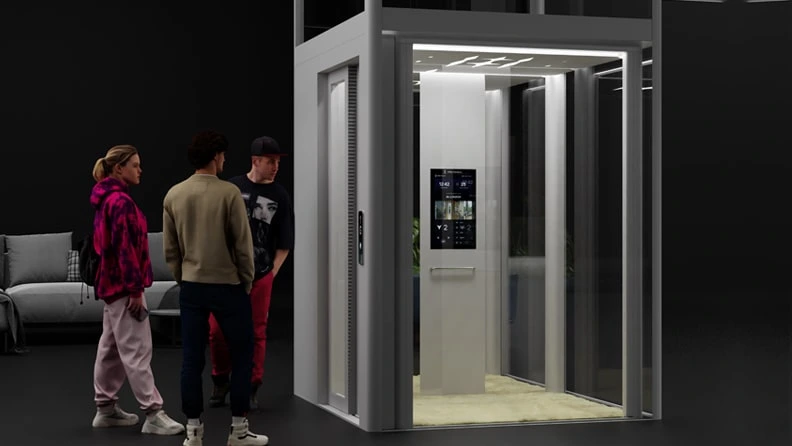
Lifts are compact systems suited for basic vertical movement with lower cost and simpler installation, but limited safety and capacity. Elevators offer advanced safety, smoother performance, higher capacity, and long-term value, making them the better choice for residential homes with Elite Elevators India.
Understanding Lifts and Elevators: Critical Knowledge for Homeowners
The choice between lifts and elevators represents a significant decision for modern homeowners seeking vertical mobility solutions. While these terms are frequently used interchangeably, substantial differences between lifts and elevators exist that directly impact safety, performance, installation complexity, and long-term investment value. With India’s residential elevator market experiencing rapid growth, understanding these distinctions has become essential for property owners considering home elevators and lifts.
Table of Contents
- Understanding Lifts and Elevators: Critical Knowledge for Homeowners
- What Are Lifts and Elevators? Technical Definitions
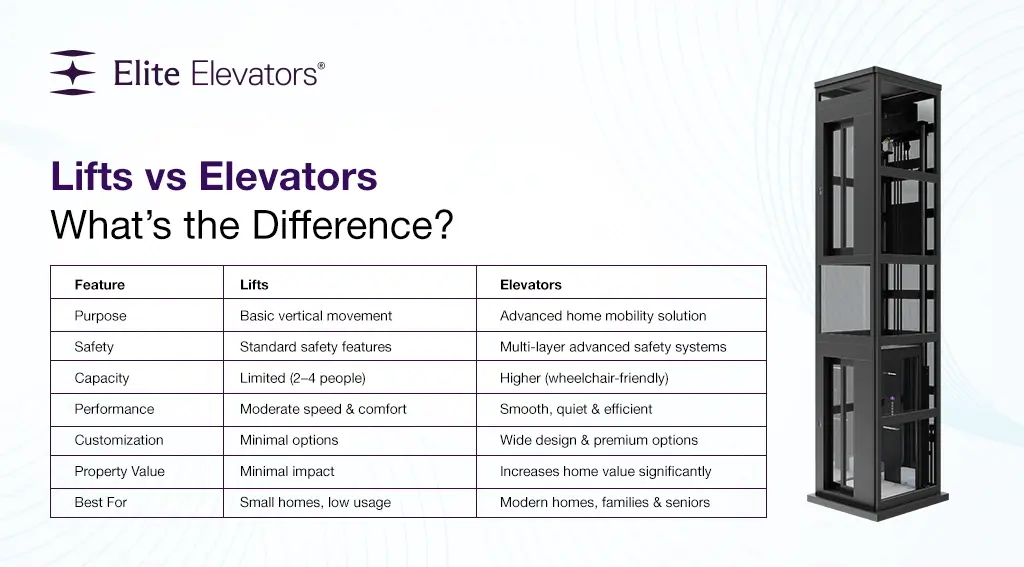
- Key Differences Between Lifts and Elevators: Comprehensive Comparison
- Advantages of Lifts for Residential Properties
- Disadvantages of Lifts: Critical Limitations to Consider
- Why Elevators Represent Superior Long-Term Investment
- Elite Elevators India: Redefining Home Elevators and Lifts
- Decision Framework: Choosing Between Lifts vs. Elevators
- Financial Analysis: Cost Comparison of Lifts and Elevators
- Market Trends Driving Elevator Adoption
- Conclusion: Making the Optimal Choice for Your Home
The decision between lifts for houses and comprehensive elevator systems extends beyond terminology. This choice influences daily functionality, accessibility compliance, property valuation, and household safety standards. Elite Elevators India has emerged as a trusted provider, offering systems engineered specifically for Indian homes while maintaining international safety certifications.
This analysis examines the technical specifications, operational characteristics, and practical applications of both lifts and elevators to facilitate informed decision-making for residential installations.
What Are Lifts and Elevators? Technical Definitions
Understanding Lifts
A lift represents a basic vertical transport mechanism designed for low-rise residential structures. These systems operate with simplified mechanical configurations, requiring minimal infrastructural modifications during installation. Lifts generally function with limited safety features, reduced load capacities, and restricted customisation compared to comprehensive elevator systems.
Standard lifts accommodate 2-4 floors with moderate speed capabilities, prioritising fundamental vertical movement over enhanced comfort or advanced safety protocols.
Understanding Elevators
An elevator constitutes an advanced vertical mobility system engineered for smooth, efficient, and safe transportation across multiple floors. These sophisticated systems incorporate comprehensive safety mechanisms, including emergency braking, backup power supplies, automatic rescue devices, and advanced control systems compliant with international safety standards such as EN 81-20.
The house elevator category represents premium solutions providing superior ride quality, extensive customisation capabilities, higher load capacities supporting wheelchair accessibility, and enhanced long-term reliability through robust engineering.
Key Differences Between Lifts and Elevators: Comprehensive Comparison
1. Safety Infrastructure and Standards
The most critical distinction in the lifts vs. elevators comparison lies in safety architecture. Elevators incorporate multi-layered safety protocols, including emergency response systems that activate during power failures; overload protection preventing operation when weight limits are exceeded; advanced door interlock mechanisms preventing opening when the cabin is misaligned; and fire-rated construction complying with safety regulations.
Basic lifts typically offer standard safety features without comprehensive backup systems, potentially compromising user security during emergencies. Industry research indicates that properly maintained elevators operate with 99.5% uptime reliability, while basic lifts may experience more frequent service interruptions.
2. Performance and User Experience
Home lift elevator systems from established manufacturers demonstrate superior performance characteristics, including smoother acceleration profiles, reduced operational noise levels below 50 decibels, enhanced speed consistency, and improved vibration dampening. These attributes significantly impact daily user experience, particularly for elderly residents or individuals with mobility challenges.
3. Installation Requirements
Contemporary elevator technology has transformed installation requirements. Elite Elevators India exemplifies this advancement with systems that require no machine room, minimal or no deep pit, operate on single-phase power, and can be installed within 2–3 weeks, depending on project conditions.
Traditional lifts, while requiring less initial planning, may necessitate modifications that compromise structural integrity or aesthetic appeal in existing buildings.
4. Load Capacity and Accessibility
Elevators from Elite Elevators India are designed to comfortably accommodate multiple passengers, including wheelchair users and individuals using assistive devices. With spacious cabins and accessibility-focused design, these systems support inclusive living and align with modern accessibility standards, making them ideal for multigenerational households and elderly residents.
In contrast, basic lift systems typically support fewer passengers and offer limited space, which can restrict usability for families with accessibility needs or those planning for long-term convenience.
Advantages of Lifts for Residential Properties
1. Space Optimisation
Lifts demonstrate particular advantages in properties with severe space constraints. Their compact footprint makes them viable for narrow stairwells or buildings where extensive structural modifications remain impractical.
2. Reduced Initial Investment
The financial accessibility of lifts appeals to budget-conscious homeowners. Initial installation costs typically range between ₹10 and ₹15 lakhs, representing approximately 40-50% less than comprehensive elevator systems.
3. Expedited Installation
Simplified mechanical configurations enable faster installation timelines, often completed within 1-2 weeks for standard applications, minimising household disruption.
4. Suitability for Limited Usage
Properties with occasional vertical transportation needs may find lifts adequate, particularly in vacation homes or properties with primarily ground-floor living arrangements.
Disadvantages of Lifts: Critical Limitations to Consider
1. Compromised Safety Infrastructure
Basic lifts frequently lack comprehensive emergency response systems, backup power capabilities, or advanced monitoring systems, potentially exposing users to elevated risk during power failures or mechanical malfunctions.
2. Restricted Load Capacity
Limited weight capacities constrain utility for larger families, wheelchair accessibility, or transportation of substantial items during household rearrangements.
3. Minimal Customisation
Standardised designs offer limited aesthetic integration with existing interiors, potentially compromising architectural harmony in premium residential properties.
4. Reduced Property Value Enhancement
Real estate market analysis indicates that basic lifts contribute minimally to property valuations compared to properly specified elevator systems, which can increase resale values by 10-15% in metropolitan markets.
Why Elevators Represent Superior Long-Term Investment
1. Comprehensive Safety Architecture
Modern elevators and lifts engineered to European standards provide multi-layered protection, including emergency evacuation systems ensuring safe egress during power failures; seismic protection in earthquake-prone regions; advanced door sensors preventing entrapment incidents; and remote monitoring capabilities enabling predictive maintenance.
Research from the National Safety Council indicates that properly maintained elevators demonstrate significantly lower incident rates compared to basic lift installations.
2. Enhanced Operational Performance
Elevators deliver superior ride quality through precision engineering, accommodating daily usage patterns without performance degradation. Variable frequency drive systems ensure smooth starts and stops, reducing mechanical stress and enhancing passenger comfort.
3. Accessibility and Universal Design
Compliance with accessibility regulations ensures that home elevators and lifts accommodate wheelchairs, walkers, and assistive devices, supporting ageing-in-place initiatives and multigenerational living arrangements increasingly prevalent in Indian households.
4. Property Value Appreciation
Independent real estate valuations consistently demonstrate that properties equipped with quality elevators command premium pricing. Mumbai and Delhi property markets show average appreciation of 12-18% for homes with professionally installed elevator systems compared to comparable properties without vertical transportation infrastructure.
Elite Elevators India: Redefining Home Elevators and Lifts
Elite Elevators India has established leadership in the residential elevator segment through technological innovation and customer-centric solutions. Their systems address traditional installation barriers through minimal structural requirements with no deep pit or dedicated machine room, electrical efficiency via single-phase power operation, rapid deployment with installation completion within 2-3 weeks, international compliance through EN 81-20/50 certification, and comprehensive warranty coverage.
These specifications position Elite Elevators India’s offerings as optimal solutions, bridging the gap between basic lifts and traditional elevator systems while maintaining premium performance standards.
Decision Framework: Choosing Between Lifts vs. Elevators
1. When to Select Lifts
Consider lifts when available space severely constrains installation options, budget limitations necessitate minimal initial investment, usage frequency remains consistently low, building permits restrict comprehensive installations, or temporary solutions address short-term mobility needs.
2. When to Prioritise Elevators
Choose elevators when safety represents a non-negotiable priority; daily usage patterns justify investment in reliability; accessibility compliance aligns with regulatory requirements; long-term property value optimisation drives decision-making; households include elderly residents or individuals with mobility impairments; or property positioning targets premium market segments.
Financial Analysis: Cost Comparison of Lifts and Elevators
1. Initial Capital Requirements
Current pricing from Elite Elevators India reflects home elevators starting from ₹14.5–₹23 lakhs for the X Series, while premium hydraulic elevators, such as the E200 range, range from ₹26–₹55 lakhs, depending on customisation and specifications.
While elevators require a higher initial investment, the total cost of ownership—considering maintenance, energy efficiency, durability, and long-term performance—demonstrates significantly better value over a 15–20 year lifecycle.
2. Return on Investment
Property value analysis across major metropolitan markets indicates homes with quality elevators appreciate 10-15% above comparable properties, rental properties with elevators command 15-20% premium monthly rates, resale velocity improves by 30-40% for elevator-equipped properties, and insurance considerations may favour properties with certified systems.
Market Trends Driving Elevator Adoption
1. Demographic Shifts
India’s rapidly ageing population creates increasing demand for accessibility solutions. Census projections indicate that citizens aged 60+ will constitute 19.5% of the population by 2050, necessitating age-friendly housing infrastructure.
2. Regulatory Evolution
Building codes increasingly mandate accessibility provisions, with elevator requirements expanding across residential classifications previously exempted from such standards.
3. Premium Housing Expectations
Homebuyer expectations have evolved, with elevators transitioning from luxury amenities to expected features in properties above ₹2 crore valuation thresholds in major metropolitan areas.
Conclusion: Making the Optimal Choice for Your Home
The fundamental distinction in the lifts vs. elevators comparison centres on long-term value delivery. While lifts provide basic vertical mobility at reduced initial investment, elevators offer comprehensive safety infrastructure, superior performance characteristics, enhanced accessibility, and substantial property value appreciation.
Elite Elevators has revolutionised residential vertical transportation through systems combining advanced elevator capabilities with simplified installation requirements. This technological convergence enables homeowners to access premium functionality without traditional infrastructure constraints or prohibitive costs.
The optimal selection depends on individual household requirements, budget parameters, and long-term property objectives. However, for families prioritising safety, accessibility, daily usability, and investment protection, properly specified home elevator systems consistently deliver superior outcomes.
Frequently Asked Questions: Lifts and Elevators
Q: What is the main difference between lifts and elevators?
The main difference between lifts and elevators lies in engineering sophistication. Lifts provide basic vertical movement with standard safety features, while elevators incorporate advanced safety systems, superior performance, and comprehensive customisation options suitable for daily residential use.
Q: Which is better for homes: lifts or elevators?
Elevators prove more suitable for residential applications due to enhanced safety infrastructure, improved operational reliability, better accessibility compliance, and significant contributions to property value. While lifts may suffice for limited usage, elevators provide optimal long-term value.
Q: Are lifts cheaper than elevators?
Yes, lifts typically cost 40-50% less than elevators initially (₹10-15 lakhs versus ₹14.5-20 lakhs). However, the total cost of ownership over 15-20 years often favours elevators due to superior reliability and substantial property value appreciation.
Q: Can elevators be installed in existing homes?
Modern elevator technology enables installation in existing buildings with minimal structural modifications. Elite Elevators India offers systems requiring no machine room, minimal pit depth, and single-phase power, making retrofitting feasible in most residential applications.
Q: What are the advantages of lifts?
Lifts offer compact footprints suitable for space-constrained properties, lower initial capital requirements, faster installation timelines, and adequate functionality for occasional usage scenarios where comprehensive elevator features prove unnecessary.