Add Elite as Preferred
 You’ve decided to install a home lift. You’ve researched models, compared brands, and maybe even visited an experience center. And then the salesperson asks: ‘Do you want a pit or a pitless lift?’ Suddenly, a decision that felt straightforward becomes confusing.
Quick Summary
Elite Elevators' pitless home lifts require only 59–100 mm of floor depth (compared to 300–600 mm for conventional pit-based elevators), making them ideal for existing Indian homes with slab floors. By eliminating the need for a deep pit, these home lifts help reduce civil work costs, avoid waterlogging concerns, and enable faster installation. Certified to EN 81-41 standards, Elite Elevators' pitless solutions deliver enhanced accessibility, convenience, and safety without compromising performance.
For most Indian homeowners, the idea of digging a 450 mm pit into their finished flooring is immediately unappealing, and in older homes, it can mean breaking through reinforced concrete slabs at considerable expense. The fear of structural disruption, waterlogging, and extended construction timelines keeps many families from installing a lift altogether.
The good news: modern pitless home lifts have eliminated this barrier entirely. This guide gives you a complete, honest comparison of pit vs pitless elevator systems covering installation, cost, safety, maintenance, and which type best suits common Indian home configurations.
Table of Contents
- Understanding Pit and Pitless Home Lifts: The Basics
- Pit vs Pitless Elevator: A Head-to-Head Comparison for Indian Homes
Understanding Pit and Pitless Home Lifts: The Basics
What Is a Pit-Based Home Lift?
Traditional residential elevators require a pit, a below-floor cavity that allows the home elevator cabin to descend fully to ground level. Standard pit depths range from 300 mm to 600 mm. This pit houses the buffer (which absorbs impact if the cabin travels too low) and is a core safety requirement for conventional elevator designs.
What Is a Pitless Home Lift?
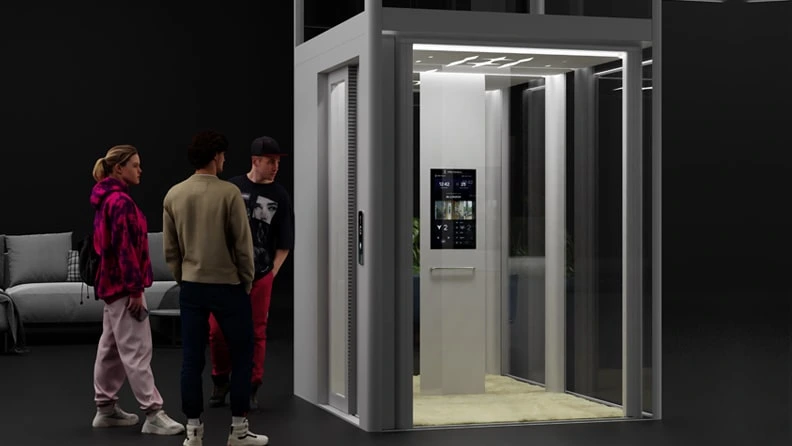
A pitless home lift achieves the same function using an engineered shallow-pit or no-pit design. Advanced safety and buffer systems are integrated into the base of the shaft structure itself. Elite Elevators’ X200 and X300 series require only 59–100 mm of pit depth, comparable to a door threshold, making them truly retrofit-friendly.
Pit vs Pitless Elevator: A Head-to-Head Comparison for Indian Homes
1. Civil Work and Installation Disruption
Pit-based: Requires breaking the ground floor slab and excavating 300–600 mm. In existing homes with reinforced concrete, this can cost ₹1–3 lakh in civil work alone and takes 2–4 weeks of construction activity.
Pitless: Requires only surface-level preparation at a depth of 59–100 mm, essentially a minor floor cut rather than excavation. Installation typically completes within 2–3 weeks with minimal dust and disruption.
2. Waterlogging and Maintenance Risks
Pit-based: In Indian cities prone to heavy monsoons, particularly Chennai, Mumbai, Bengaluru, and Kolkata, basement pits frequently accumulate water, leading to corrosion, electrical hazards, and maintenance issues.
Pitless Home Lifts for Easy Installation
✔ No Deep Pit Excavation
✔ Perfect for Existing Homes
✔ Ideal for G+1 to G+3 Homes
✔ Safe, Space-Saving Design
Pitless: Zero risk of waterlogging. The shallow configuration sits above natural water table levels, eliminating a major maintenance headache and electrical safety concern in Indian climatic conditions.
3. Suitability for Existing Homes (Retrofit)
Pit-based: Retrofitting is difficult and expensive. It’s practical mainly in new constructions where the pit can be planned at the slab stage.
Pitless: Highly retrofit-friendly. The X200 and X300 series from Elite Elevators are specifically designed to install in existing homes with finished floors, the reason they dominate residential elevator installations in India.
4. Safety Standards
Both configurations can meet identical safety standards when properly engineered. Elite Elevators’ pitless models comply with EN 81-41 European certification, including ARD, dual overspeed governors, and door safety sensors, at the same level of safety as any pit-based elevator. The misconception that pitless elevators are less safe is simply outdated.
5. Total Cost
Pitless lifts have a lower total installation cost when retrofitting, because civil work costs are dramatically reduced. For new constructions, the cost difference is narrower. Over a 10-year period, pitless models also tend to have lower maintenance costs due to the absence of pit cleaning, waterproofing, and corrosion management.
Who Should Choose Which? Target Buyer Profiles
1. Choose a Pitless Home Lift If:
You live in an existing home (G+1, G+2, G+3) with finished concrete floors. You want minimal civil disruption and a fast installation timeline. You live in a rain-heavy city or area with a high water table. You’re prioritising a combination of modern design, smart features, and affordability.
2. Consider a Pit-Based Configuration If:
You’re building a new home and can plan the pit into the foundation stage. You want a European E-series configuration (E300 Cogbelt or E200 Hydraulic) with a standard 120–140 mm pit that’s already spec’d into the new construction. Your architect or structural engineer recommends it as part of the overall building design.
Elite Elevators’ Pitless Models: Compact Home Lift Options for India
The X200 and X300 series represent Elite Elevators’ flagship pitless home lift range, the most popular residential elevator choice across Indian cities:
- X200 (Hydraulic Chain Drive): 59 mm pit (no shaft) / 100 mm (with shaft). 400 kg load. Up to 4 floors. Starting at ₹14.50 lakh. Ideal for compact urban homes.
- X300 MK II Plus (Gearless Belt Drive, AI-Powered): 59 mm pit (no shaft) / 100 mm (with shaft). 440 kg load. Up to 6 stops. Speed up to 1.0 m/s. Starting at ₹20.95 lakh. India’s only AI-powered home elevator. Both models install indoors and outdoors, with no machine room required maximising usable floor space in your home.
Find out which lift fits your home perfectly.
Book a home assessment with Elite Elevators at eliteelevators.com. Our engineers will evaluate your space and recommend the most suitable, cost-effective installation pit or pitless.
Related Posts:
✅ What Are the Top 10 Smart Locations to Install a Home Elevator
✅ How Much Does a Hydraulic Elevator Cost?
✅ How Much Does a Home Lift Cost for 2, 3 & 4 Floors in India in 2026?
✅ How Do You Select the Right Elevator for Your Building?
✅ Top 3 Popular Space-Saving Small Elevators for Homes in 2026
✅ Find the Best Hydraulic Lifts Cost in Bangalore
✅ New Build vs. Retrofit – When Should You Install a Home Elevator?