

 Add Elite as Preferred
 Before an Elite Elevator’s home lift is handed over, engineers verify critical safety parameters, including ARD functionality, door sensor response, overspeed governor activation, emergency lighting, and load testing. Control voltage checks and leveling accuracy. This comprehensive residential lift safety checklist ensures every Elite Elevators installation delivers safe, reliable, and zero-risk operation from day one.
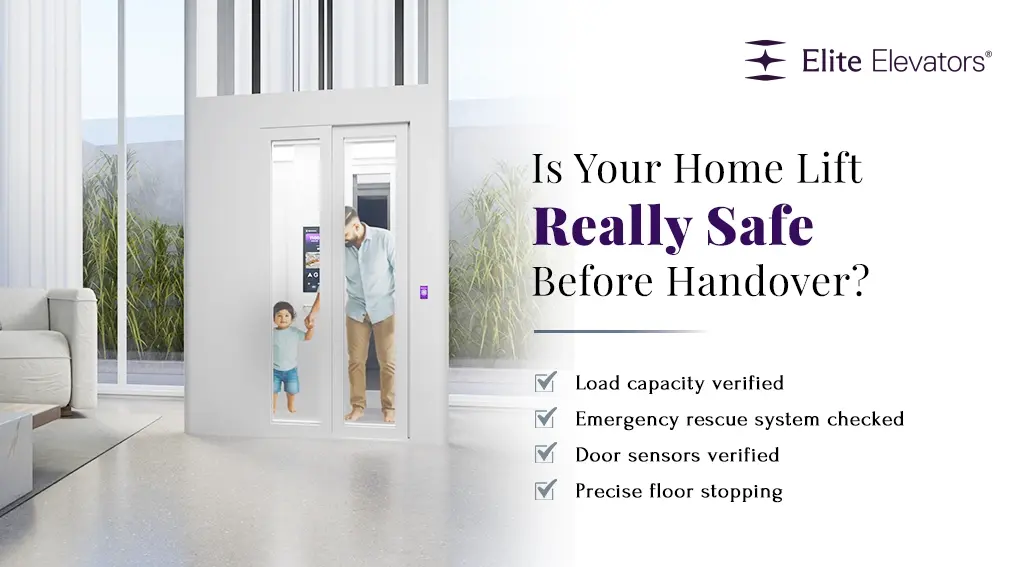
You’ve waited weeks for your home elevator to be installed. The cabin looks stunning, the finishes match your interiors, and the technician says it’s ready. But is it truly safe for your family, especially your elderly parents, young children, or anyone with mobility challenges?
Table of Contents
- Phase A: Pre-Installation Safety Checks
- Phase B: Mechanical and Drive System Testing
- 1. Load Test at 110% Capacity:
- 2. Overspeed Governor Test:
- 3. Belt/Drive System Inspection:
- 4. Floor Levelling Accuracy:
- 5. EGSS (Enhanced Gentle Start and Stop) Verification:
- Phase C: Safety System and Emergency Testing
- Phase 4: Smart Feature and Control System Verification
- The Handover Document: What You Must Receive
- Frequently Asked Questions
Most homeowners accept a lift handover without knowing what was or wasn’t tested. A missed safety check isn’t just an inconvenience; a faulty overspeed governor or an untested ARD can create real danger. In India, residential elevator incidents often trace back to inadequate pre-handover testing.
This guide gives you the complete home lift safety checklist that certified engineers use before signing off on any residential elevator. Whether you’re a homeowner taking delivery of a new lift or verifying a recently serviced one, this checklist tells you exactly what to ask and what to verify.
Phase A: Pre-Installation Safety Checks
The home elevator inspection process begins before the first component is installed. Reputable engineers assess:
1. Structural Load Assessment:
The floor slab and surrounding walls must support the static and dynamic loads of the fully loaded elevator. Engineers verify load-bearing capacity before drilling or anchoring.
2. Electrical Circuit Verification:
A dedicated electrical circuit (typically single-phase for residential lifts) with the correct breaker rating must be confirmed. Improper wiring is a leading cause of elevator malfunction in Indian homes.
3. Pit and Headroom Measurement:
Even pitless models like the X200 and X300 series require a minimum 59–100 mm pit. Engineers confirm exact measurements to ensure compliance with installation requirements and EN 81-41 standards.
Phase B: Mechanical and Drive System Testing
This is the most critical phase of the elevator testing checklist. Every mechanical component must be tested to specification:
1. Load Test at 110% Capacity:
The lift must operate safely at 110% of its rated load capacity. For the X300 series (440 kg rated), this means testing at 484 kg. The lift must start, travel, and stop smoothly under overload conditions.
2. Overspeed Governor Test:
Elite Elevators’ X300 models use dual overspeed governors monitoring movement in both directions. Engineers must verify that brakes engage correctly if speed exceeds the rated limit in either direction, a critical test absent in many lower-cost brands.
3. Belt/Drive System Inspection:
For gearless belt drive models, belt tension, alignment, and wear must be within specification. The X300 Mark II’s real-time belt monitoring system assists engineers in confirming belt health at handover.
4. Floor Levelling Accuracy:
The cabin must stop within +10 mm of floor level at every landing. MDR (Magnetic Driven Controls) technology in Elite Elevators’ X300 series achieves precise landings. Engineers verify this at every floor, both loaded and empty.
5. EGSS (Enhanced Gentle Start and Stop) Verification:
No jerks, jolts, or sudden movements should occur during start or stop. Engineers ride the lift multiple times with varying loads to confirm smooth acceleration and deceleration curves.
Phase C: Safety System and Emergency Testing
The residential lift safety checklist demands that every emergency system be physically triggered and verified, not just visually inspected:
1. ARD (Automatic Rescue Device) Simulation:
If there is a power cut while the lift is travelling. The ARD must automatically move the cabin to the nearest floor and open the doors within 30 seconds using battery backup. Any delay or failure in this test must be rectified before handover.
2. Emergency Lighting Test:
All cabin emergency lights must activate within 2 seconds of mains power failure.
3. GSM Emergency Call System:
Engineers must confirm that the in-cabin GSM phone connects to a live operator or emergency contact on a test call. For Elite Elevators’ Live SOS 2.0 system, they verify that photo notifications reach designated emergency contacts.
4. Door Safety Sensor Test:
An obstruction is deliberately placed in the door opening. The door must reverse immediately on contact without applying force. Light curtain sensors must detect objects throughout the full door height.
5. Trap Door and Manual Lowering:
The cabin trap door must open freely from inside, and engineers must demonstrate the manual lowering procedure to the homeowner. Every family member should know how to perform an emergency exit.
Phase 4: Smart Feature and Control System Verification
For modern smart home elevators like the X300 MK II Plus, the lift handover process includes additional technology checks:
- Mobile app connectivity: all controls responsive via smartphone
- Biometric access: fingerprint registration and floor auto-selection verified
- VisionLog camera: feed confirmed live and recording
- Dynamic ENS (fault detection system): test fault injected and notification confirmed
- PIN and biometric floor restriction: unauthorised floor access blocked as configured
- Unauthorized access photo alerts: trigger confirmed and photo received on registered device
The Handover Document: What You Must Receive
A proper lift handover process ends with documentation, not just a verbal all-clear. At handover, you should receive: Signed test report confirming all safety checks passed; Certificate of compliance with EN 81-41 or applicable standard; User manual and emergency procedure card; AMC (Annual Maintenance Contract) commencement date; warranty certificate (Elite Elevators provides 5 years post-installation); emergency contact numbers for the service team.
If any of these are missing, request them before accepting the handover. A reputable company like Elite Elevators provides all documentation as standard practice.
Frequently Asked Questions
Q1: How many safety parameters does a home elevator need to pass before handover?
European-certified models like the E200 and E300 from Elite Elevators undergo 194 integrated safety parameter checks. For the X300 series, this includes mechanical, electrical, software, and smart feature verification.
Q2: Can I do a safety inspection on a home lift myself?
While homeowners can perform basic visual checks (door operation, emergency light, cabin level), mechanical and electrical safety tests must be carried out by certified elevator engineers. Attempting internal inspections without training is dangerous.
Q3: How often should a home elevator be inspected after installation?
Annual professional inspections are recommended as a minimum. Under an AMC with Elite Elevators, scheduled maintenance visits cover all safety checks, software updates, and component wear assessment.
Q4: What is the most important safety feature in a home lift?
The ARD (Automatic Rescue Device) is universally considered the most critical safety feature. It ensures that if power fails mid-journey, passengers are never trapped in the cabin; it automatically brings the lift to the nearest floor and opens the doors.
Q5: Does Elite Elevators provide post-installation safety support?
Yes. Elite Elevators offers a 5-year post-installation warranty covering parts and labour, plus an AMC program. Their Dynamic ENS system provides real-time remote fault monitoring, and the Live SOS feature ensures 24/7 emergency response.
Note: * Prices listed are starting rates, exclude applicable taxes, and may vary based on customization.



Janani Reddy
Excellent guide for anyone planning a residential elevator. I never realized how detailed an elevator inspection checklist should be before the final handover. The step-by-step explanation of mechanical testing, emergency features, and documentation makes it much easier to understand what homeowners should verify before using their lift for the first time.
Karthi Vel
Very well explained article. The breakdown of the elevator testing checklist into installation, mechanical testing, emergency systems, and smart features makes the entire process easy to understand. This blog is a great resource for anyone who wants to learn what engineers actually test before approving a home elevator installation.
Shobana Iyer
This blog answered many questions I had about home elevator inspection before final handover. I especially liked the explanation about overspeed governors, emergency lighting, and ARD testing. It reminds homeowners that safety checks are just as important as selecting the right lift model for long-term reliability.
Naveen Raj
A detailed yet easy-to-understand guide. The home lift safety checklist shared here highlights several important inspections that many people may not even know exist. Learning about ARD simulation, emergency lighting, and safety documentation makes this article very informative for first-time buyers.