

 Add Elite as Preferred
 Belt-driven home lifts use a precision gearless belt system instead of traditional cables or hydraulics, delivering speeds up to 1.0 m/s, zero-jerk movement, and lower maintenance with a pit depth of just 59 mm. Elite Elevators’ X300 MK II starts from ₹18.70 lakhs in India.
Most Indian homeowners researching residential lifts are familiar with hydraulic systems. Some have heard of traction elevators. But belt-driven gearless home lifts, the technology that represents the genuine next step in residential elevator engineering, remain relatively unknown outside the premium segment.
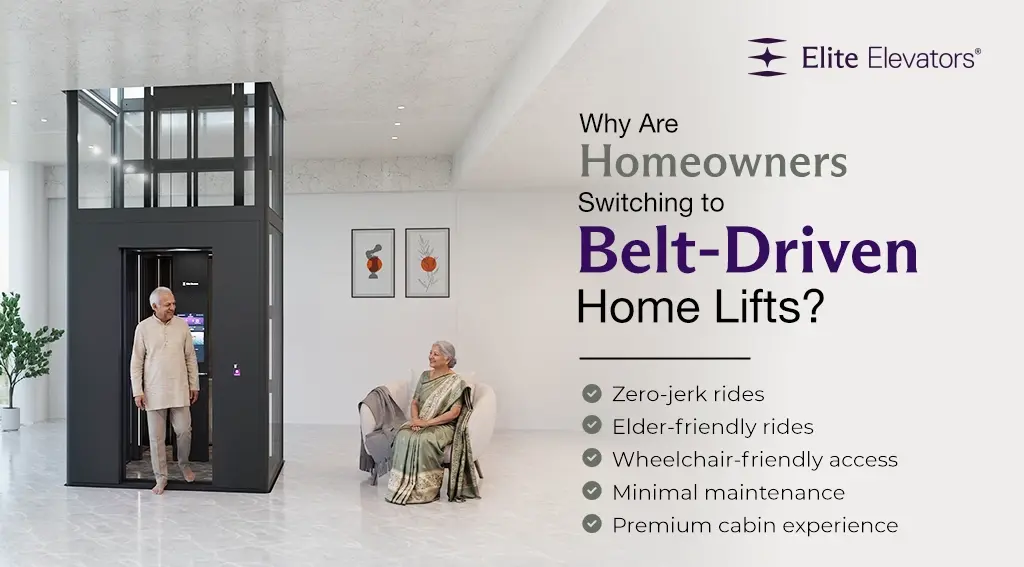
Table of Contents
That’s starting to change, and fast. As Indian families become more demanding about ride quality, smart home integration, and long-term value, belt-driven systems are moving from the “advanced option” into the mainstream consideration set.
But what exactly is a belt-driven elevator? How does it differ from hydraulic or traditional traction systems? And why are an increasing number of Indian homeowners choosing this technology for their homes?
What Is a Belt-Driven Home Lift?
A belt-driven lift moves the cabin using a precision belt connected to a gearless motor, rather than a hydraulic fluid system or a traditional cable-and-pulley mechanism. The absence of gears is the defining characteristic, and it has significant implications for performance, noise, and maintenance.
Elite Elevators’ X300 series, the X300 MK II (from ₹18.70 lakhs) and the X300 MK II Plus (from ₹20.95 lakhs), represent their gearless belt-drive range for residential use. These are among the most advanced home elevator systems available in India in 2026.
The gearless belt drive delivers speeds up to 1.0 m/s, a 440 kg load capacity, a pit depth of just 59 mm, travel heights up to 21,000 mm, and compatibility with the most advanced smart features in the residential elevator market.
How Belt Drive Technology Advances Residential Elevator Innovation
1. EGSS Technology — Zero Jerks, Every Time
The most noticeable difference between a belt-driven gearless lift and a traditional system is the movement quality. Elite Elevators’ X300 series features EGSS (Extra Gentle Soft Start & Stop) technology, an engineering system that eliminates jerks and jolts entirely.
Traditional elevator systems, even well-maintained ones, have a characteristic mechanical start and stop. EGSS replaces this with a smooth, controlled acceleration curve that builds gradually and decelerates with equal precision. For elderly family members, young children, and wheelchair users, this is more than a comfort feature; it’s a safety one.
2. MDR (Magnetic-Driven Controls) — Precision Landings
Conventional elevators use mechanical relays to control levelling. The X300 series uses Magnetic Driven Controls (MDR) magnetic sensors that replace mechanical relays for smoother, pinpoint-accurate landings at every floor. No bumps. No misalignment. The cabin stops exactly flush with the floor every time.
3. Four Ride Modes — Adaptable Performance
A conventional elevator has one speed and one behaviour. The X300 series offers four distinct ride modes:
- Sports Mode — High-speed travel with automatic sliding doors. For time-conscious daily use.
- Comfort Mode — Gentle pace with extended door-open times and lights on. Ideal for elderly users.
- Eco Mode — Slower speed, reduced lighting, smart standby. Minimises energy consumption.
- Personalisation Mode — Fully customisable combination of speed, lighting, door timing, and more.
This level of adaptability is exclusive to belt-driven gearless technology; hydraulic systems cannot offer the speed range or ride mode versatility that makes it possible.
Smart Home Lifts India: Belt Drive as the Foundation for Intelligence
The gearless belt drive is not just a performance upgrade, it’s the technological foundation that enables advanced elevator systems to integrate with smart home ecosystems.
The X300 MK II Plus Elite Elevators’ flagship smart home lift is built entirely around the gearless belt drive platform. Its AI-powered features, biometric access, VisionLog cabin camera, 21″ interactive display, and mobile app integration all depend on the precise digital control that gearless technology enables.
Elite AI learns your daily usage patterns and predicts your destination floor so the elevator is ready for you before you press a button. Biometric access replaces floor buttons with fingerprint recognition. VisionLog keeps a wide-angle record of every cabin ride for security and monitoring. The 21″ Live Board displays real-time weather, news, games, and customisable content inside the cabin.
None of this is possible with hydraulic technology. The belt-driven gearless system is what makes the smart elevator possible.
Why Belt-Driven Lifts Have Lower Maintenance Requirements
A traditional hydraulic system has a hydraulic control unit, fluid lines, and multiple mechanical components that interact under load. Each of these represents a potential maintenance point.
A gearless belt drive system simplifies this significantly. Fewer moving parts mean fewer wear points, longer service intervals, and lower cumulative maintenance costs over the elevator’s lifetime. Combined with Elite Elevators’ grease-free guide rails and Dynamic ENS fault detection, which monitors performance in real time and alerts both the homeowner and the service team to any irregularities, the X300 series is designed to minimise service requirements and maximise uptime.
Frequently Asked Questions
1. What is a belt-driven home elevator, and how does it work?
A belt-driven home elevator uses a precision belt connected to a gearless motor to move the cabin between floors, eliminating traditional gears, cables, or hydraulic fluid. Elite Elevators’ X300 series uses this technology, operating at up to 1.0 m/s with EGSS smooth-start technology and a pit depth of just 59 mm.
2. What is the price of a belt-driven gearless home lift in India in 2026?
Elite Elevators’ X300 MK II gearless belt-drive lift starts at ₹18.70 lakhs for G+1. The X300 MK II Plus with AI, biometric, and smart features starts at ₹20.95 lakhs for G+1. Both are all-inclusive prices, excluding taxes.
3. Is a belt-driven lift better than a hydraulic lift for Indian homes?
Belt-driven gearless lifts are faster, lower maintenance, and smart-feature compatible. Hydraulic lifts are smoother at lower speeds and more affordable at entry level. For homes with G+4 or G+5 requirements or smart home integration needs, belt-driven gearless is the superior choice.
4. How much maintenance does a belt-driven home elevator require?
Significantly less than hydraulic systems. Fewer moving parts, grease-free rails, and smart fault detection (Dynamic ENS) reduce service frequency. Elite Elevators backs all models with nationwide after-sales support and AMC options.
5. Can a belt-driven home elevator be installed in a small Indian house?
Yes. The X300 series requires only a 59 mm pit depth, the smallest in Elite Elevators’ range and no separate machine room. The compact XShaft glass-panelled enclosure can be installed indoors or outdoors with minimal civil work.
Experience the Future of Home Elevation
Belt-driven gearless technology is not a future concept; it’s available today, starting at ₹18.70 lakhs, from Elite Elevators. Visit an experience centre to ride the X300 series and feel the difference that gearless engineering delivers.
Note: * Prices listed are starting rates, exclude applicable taxes, and may vary based on customization.



Vaishnavi Iyer
I have been researching different lift technologies for my home, and this article answered many of my questions. The comparison between hydraulic systems and belt-driven elevator technology was clear and informative. It really helped me understand why residential elevator technology is moving towards smarter and quieter solutions.
Prakash Raj
Excellent blog with practical information explained in simple language. I didn't know that silent home lift technology could also offer such smooth movement and reduced maintenance. This article made it much easier to understand why next generation home lifts India are gaining attention among homeowners.
Charan Teja
This is one of the most detailed articles I have read about smart residential elevators. The information about ride modes, smart features, and gearless technology was very useful. Anyone planning a home elevator should definitely read this before making a decision about belt driven home lifts in India.
Murugan Selvam
Really informative content. I was looking for reliable information on smart home lifts india, and this blog explained everything from technology to maintenance in a very easy way. The details about precision control and smooth travel clearly show how next generation home lifts are improving residential living.
Haritha Menon
I appreciate how this article focuses on technology instead of only discussing prices. Learning about belt-driven elevator systems and their advantages over traditional lifts helped me understand modern residential elevator technology much better. The content is well structured and easy to follow.
Sindhu Priya
Thanks for sharing such informative content. I was searching for details about belt driven home lifts in India, and this article covered everything from ride quality to smart features. It clearly explains why modern belt-driven elevator systems are considered the future of residential mobility.