Add Elite as Preferred
 Something Has Quietly Changed in the Indian Home
A decade ago, a home elevator in India was a signal of exceptional, generational wealth found in a small number of ancestral bungalows, a handful of luxury developer projects, and the homes of India’s wealthiest families. Today, in 2026, that picture has completely transformed. What changed? Home elevators are being installed in 3 BHK villas in Hyderabad’s Kondapur, compact row houses in Pune’s Wakad, multi-generational family homes in Chennai’s Anna Nagar, and newly built duplexes in Tier 2 cities from Coimbatore to Jaipur. The conversation has shifted irreversibly from “can we afford this?” to “Which one should we choose?” And why that shift happened is more interesting than most people realise.
Story at a Glance
From practical necessity to lifestyle statements, personal home elevators are transforming Indian homes in 2026. Here is why demand is surging across all income segments, who is buying them, and everything you need to know before making your decision.
The Five Trends Driving Home Elevator Adoption in India
Why now? Why is this happening across income segments and cities simultaneously? The surge in residential elevator installations is not happening by accident. It is driven by the convergence of five powerful and interconnected trends.
Trend 1: An Ageing Population and the Realities of Multi-Generational Living
Who needs a top elevator brand most urgently in India today? The answer, in most households, is already living under your roof. India’s over-60 population is growing at a rate that is placing profound and practical demands on residential design. Stairs that were manageable at 55 become genuinely risky at 70, and the statistics on stair-related falls among Indian seniors are sobering. What happens when a parent can no longer safely reach the bedroom on the second floor? For most families, that is the moment they wish they had installed a lift two years earlier.
Table of Contents
- Something Has Quietly Changed in the Indian Home
- The Five Trends Driving Home Elevator Adoption in India
- Trend 1: An Ageing Population and the Realities of Multi-Generational Living
- Trend 2: The Rise of Multi-Storey Independent Homes
- Trend 3: Smart Home Ecosystems and Technology Expectations
- Trend 4: Lifestyle Differentiation in a Competitive Property Market
- Trend 5: Future-Proofing and Proactive Accessibility Design
- Who Is Actually Buying Personal Home Elevators in India in 2026?
- How to Begin Your Personal Home Elevator Journey
The models that serve this need best are the E50 Stairlift, which requires zero civil work, runs on any staircase type, and installs in existing homes without structural modification. For larger multi-generational homes, where multiple generations share different floors, the X300 Mark II and X300 MK II Plus add PIN and biometric floor restrictions, meaning specific floors can be locked to prevent unsupervised access by young children while remaining accessible to adults.
Trend 2: The Rise of Multi-Storey Independent Homes
Why are more Indian families building G+2 and G+3 homes than ever before? Driven by the desire for space, privacy, the ability to house extended families on separate floors, and the investment value of plotted land, millions of Indian families are building independent multi-story homes across cities and Tier 2 towns. And here is the question that follows naturally: if a home costs one or two crores to build, why should every floor not be fully accessible to every family member?
Which model fits which floor count? For G+1 homes, the X200 starts at just ₹14.50 lakhs and the X200 Plus at ₹16.75 lakhs hydraulic chain-drive, 100 mm shallow pit, no machine room. For G+2 and G+3 homes, the X300 Mark II and X300 MK II Plus bring gearless belt-drive performance at up to 1.0 m/s across travel heights of up to 21,000 mm. For G+4 and G+5 where sustained daily multi-floor performance is non-negotiable the E300 Cogbelt and E200 Hydraulic support up to 6 stops with full European-certified engineering.
Trend 3: Smart Home Ecosystems and Technology Expectations
Why should the way you move between floors be governed by a simple push button when every other system in your home responds to your voice, your phone, and your preferences? The Indian homeowner who has invested in a smart TV, voice-controlled AC, and automated security gates is asking exactly that question. What does a truly smart home elevator look like in 2026?
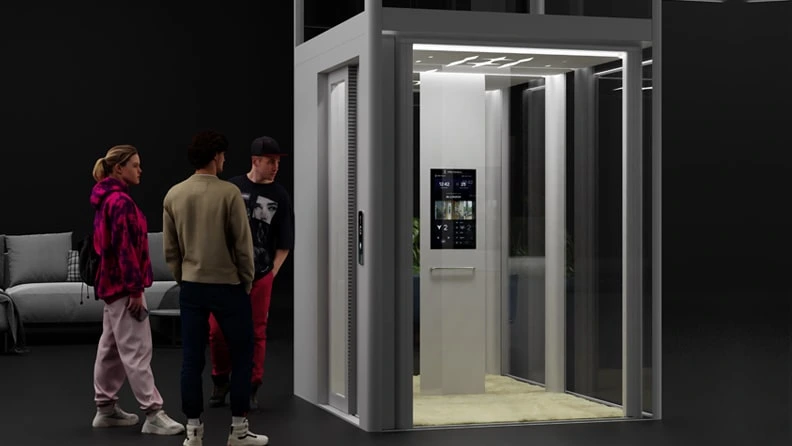
The X300 MK II Plus answers that question definitively: Elite AI that learns your daily movement patterns, biometric fingerprint floor selection, a 21-inch Live Board interactive display, custom voice announcements per floor, a VisionLog built-in cabin camera, and full mobile app control over lighting, fan speed, and door timing. What if you want smart performance at a step below? The X300 Mark II delivers SSD V2 touchscreen displays in the cabin and at every landing, four customisable ride modes, and smart lighting control via app. And for buyers who want app connectivity at an accessible price point? The X200 Plus includes mobile app connectivity, Live Board display, and PIN-based restricted floor access starting at ₹16.75 lakhs.
Thinking About Installing a Personal Home Elevator?
✔ Safe & Easy Access for Every Generation
✔ Ideal for New & Existing Homes
✔ Smart Features & Premium Designs
✔ Smart Technology with Premium Safety
Trend 4: Lifestyle Differentiation in a Competitive Property Market
What makes a luxury home genuinely stand out in India’s most competitive residential markets? Features that are visible, memorable, and not easily replicated. A home elevator in Chennai, particularly one from Elite Elevators achieves all three. Which model makes the strongest statement?
The E300 Cogbelt’s SIL 3 Certification, achieved by no other Indian home elevator manufacturer, is a specification that luxury buyers notice immediately. The X300 MK II Plus with its 21-inch Live Board, biometric access, and 16 premium RAL colour options across standard, metallic, and textured finishes creates an impression no competing elevator can match. The glass-panelled Xshaft, DRL arrival lighting, and colour-matched doors and cabin turn the elevator into an architectural feature, which is precisely why, in India’s top residential markets, a premium home elevator has moved from “nice to have” to “increasingly expected.”
Trend 5: Future-Proofing and Proactive Accessibility Design
When is the right time to install a home elevator in chennai? The honest answer: during construction, not after. Building a home elevator at construction costs much less than retrofitting one fifteen years later, and the civil works also reduce drastically. Why does this matter so much? Because forward-thinking homeowners in their 30s and 40s are designing their homes considering their life after a few more years not just for today.
Which model suits future-proofing best? For buyers planning ahead during construction, the X300 MK II Plus and X300 Mark II offer travel heights up to 21,000 mm, future-proof for homes that may add floors later. For existing homes where retrofitting must be minimally invasive, the X200 and X200 Plus need only a 100 mm pit and no machine room. And what if installing a shaft is simply not possible? The E50 Stairlift requires no structural modification at all, the fastest, least disruptive path to full home accessibility for any staircase already in place.
Who Is Actually Buying Personal Home Elevators in India in 2026?
Who exactly is making this decision today, and what are they choosing? The buyer profile is broader than most people expect:
- Affluent families building new multi-storey villas who gravitate toward the X300 MK II Plus, X300 Mark II, or E300 Cogbelt for premium performance and design
- Families with elderly parents who choose the X200 Plus or X200 for safety, smart features, and accessible pricing
- Developers who offer home elevators as a differentiating feature typically specify the X300 Mark II or X200 Plus
- Homeowners in their 40s and 50s who are planning long-term often choose the E50 Stairlift for immediate installation or the X200 for a permanent shaft solution
- Families with mobility-challenged members served by the E50 for staircase-based mobility
“As someone in my late 40s, I wanted something practical for my parents and comfortable for the future, too. We chose the Elite Elevators X200 Plus, and it has honestly made everyday life much easier for everyone at home.” — Rana, Chennai
How to Begin Your Personal Home Elevator Journey
How do you move from interest to the right decision without wasting time or money? The first step is not choosing a model. It is having a conversation with someone who knows elevators, knows Indian homes, and knows how to match the two. What does that conversation look like? Elite Elevators offers a free site survey, a professional visit from a certified installation specialist who assesses your home, understands your family’s requirements, and recommends the model that genuinely fits.
What do you walk away with? An expert opinion from a team with 3,000+ happy customers across India, Malaysia, and more and 35+ experience centers across India where you can ride every model before you decide.
Related Posts:
✅ Prices for 2-Floor, 3-Floor, and 4-Floor Home Elevators in India
✅ Top Benefits of Installing Hydraulic Lifts in Residential Buildings
✅ How Much Does a G+1, G+2, or G+3 Home Elevator Cost in India?
✅ Top 5 Best Home Elevators in India (2026): A Buyer’s Guide
✅ How to Choose the Right Hydraulic Lift for Your Home
✅ What Makes Elite Elevator Luxury Home Elevators Stand Out?
✅ What Italian Technology is Used in Elite Elevators E200?
✅ What Are the Latest Innovations in Residential Elevator Technology?