

 Add Elite as Preferred
 For senior safety, Staircase chair lifts offer quick, cost-effective stair access, but home elevators provide enclosed cabins, wheelchair support, and higher safety Elite Elevators recommends elevators for long-term, future-ready living.
As family members grow older and choose to stay at home as they continue their lives together, the question remains:
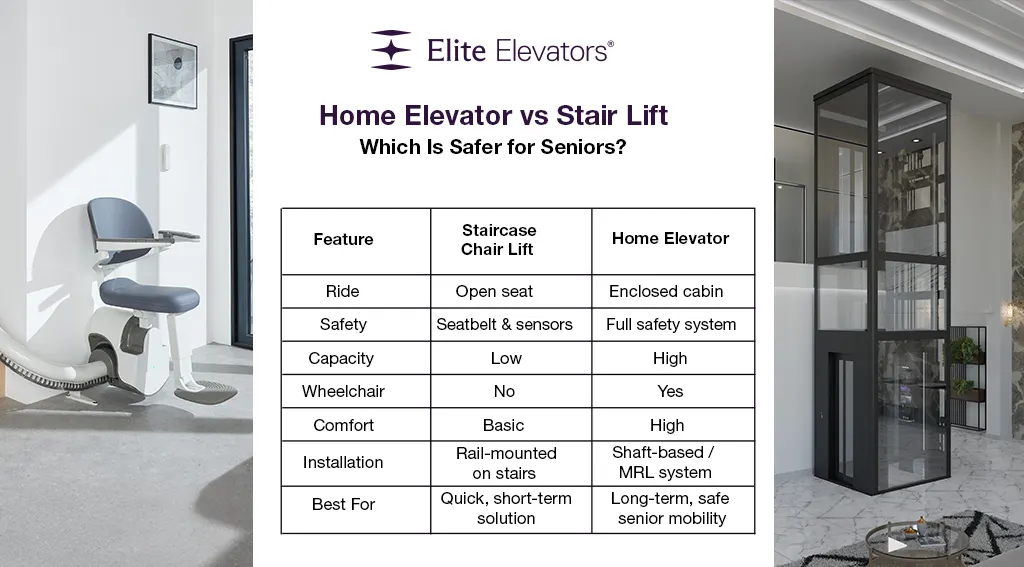
Table of Contents
- Which is safer – a Staircase chairlift or a home elevator for seniors?
- Why Safety Matters More Than Ever?
- The Stair Lift Solution: Practical, Safe, and Accessible
- SUPRA – Advanced Curved Stairlift Solution by Elite Elevators
- Why Do Staircase Chair Lifts Continue to Appeal to Homeowners?
- Limitations of Staircase Chair Lifts
- Home Elevators: A Long-Term Mobility Investment
- X Series (Smart & Luxury Residential Elevators)
- Premium European-Engineered Elevators
- Home Elevator vs Staircase Chair Lifts — Safety & Capability Comparison
- Which Is Safer for Seniors in 2026?
- Psychological Safety & Dignity
- Installation & Practical Considerations
Which is safer – a Staircase chairlift or a home elevator for seniors?
Many people no longer see vertical mobility options, like curved stair lifts or home elevators, as luxuries; they see them as required in order to live a comfortable, safe and dignified life. This blog provides an overview and comparison of the two key types of mobility solutions you may choose for someone you care about so that you can be confident with your decision.
Why Safety Matters More Than Ever?
Stairs usually represent one of the largest areas of risk in the home, and particularly so for people who have limited mobility. A number of everyday factors, such as decreased balance, arthritis, post-surgery recovery, normal age-related weakness and simply a fear of falling, make navigating stairs a potentially dangerous activity. Families typically begin their research with terms like ‘chair lifts near me’ or ‘chairlifts for seniors’; however, they often quickly get to an important question: Which type of mobility option gives seniors the greatest safety margin?
A staircase chair lift or a home elevator?
Before making any decisions, we will look at all of the options from a top Indian provider (Elite Elevators), who has developed a reputation as a high-quality, world-class manufacturer of products that comply with high safety standards according to European engineering specifications for residential homes.
The Stair Lift Solution: Practical, Safe, and Accessible
E50 Stairlift:
The E50 Stairlift is a reliable option for individuals looking for help getting upstairs or downstairs. It can be used for straight staircases, curved staircases, staircases with half-turned landings, and spiral staircases.
Key Features:
- Directly installed to the stair rails — no drilling into walls
- Will automatically stop if there is anything blocking the stairlift path
- Reclining, height-adjustable seat that includes a seatbelt
- Has comfortable armrests and can be operated with one hand
- Will fit in narrow stairways while still providing enough room to walk up/down the stairs
- Meets the requirements of the European safety standard.
SUPRA – Advanced Curved Stairlift Solution by Elite Elevators
SUPRA Stairlift:
The SUPRA Stairlift is a custom-engineered solution designed specifically for curved, spiral, and multi-landing staircases. It is ideal for homes where standard straight-rail systems are not suitable, offering smooth and secure travel along complex stair designs while maintaining safety and comfort.
Key Features:
- Custom-built rail system precisely designed to match curved and spiral staircases
- Smooth start and stop operation for stable, jerk-free movement
- Advanced safety sensors that automatically stop the lift if an obstacle is detected
- Ergonomic, foldable seat with integrated seatbelt for secure seating
- Space-efficient rail installation mounted directly on the staircase
- Battery backup system ensures operation during power outages
- Manufactured to meet stringent European safety standards
Why Do Staircase Chair Lifts Continue to Appeal to Homeowners?
Staircase Chair Lifts remain a popular mobility solution for homeowners seeking a practical and immediate way to navigate stairs safely. Their appeal lies in a combination of convenience, simplicity, and accessibility.
- Minimal Structural Changes Required
Chair lifts are mounted directly onto the staircase, eliminating the need for major civil work, structural alterations, or additional space within the home. - Fast & Cost-Effective Installation
Compared to full residential elevators, stairlifts can be installed quickly, making them an economical option for families looking for a swift mobility upgrade. - Immediate Mobility Support
A stairlift offers an instant solution for individuals facing difficulty climbing stairs, restoring independence and reducing the physical strain of daily movement between floors. - Ideal When Elevators Aren’t Feasible
In homes where installing a complete home elevator with a shaft is not practical due to space or structural limitations, a chair lift serves as a functional alternative.
Chairlifts for stairs are especially suitable as a transitional or interim solution for seniors experiencing mild mobility challenges – particularly those who can comfortably and safely move from standing to seated positions without assistance.
Limitations of Staircase Chair Lifts
While staircase chairlifts offer convenience, they are not without constraints – especially when mobility needs become more advanced.
- Open Design Structure
Unlike enclosed lift systems, chair lifts are not fully enclosed, which may create safety concerns for individuals with balance instability.
- Limited Weight & Seating Capacity
The seat size and weight limitations may restrict use by caregivers or individuals requiring assisted support.
- Independent Transfers Required
Users must safely transition from standing to seated and vice versa, which can pose challenges for those with reduced strength or coordination.
For seniors experiencing progressive mobility decline, these factors can become significant in determining whether a chair lift is a long-term solution.
Home Elevators: A Long-Term Mobility Investment
For homeowners seeking a more comprehensive and future-ready solution, Elite Elevators offers a complete range of residential elevator systems engineered for enhanced safety, seamless comfort, and everyday independence.
Unlike stair-based mobility devices, home elevators provide fully enclosed vertical travel, improved accessibility, and convenience for all family members – from seniors to children – making them ideal for residential homes.
Below are the primary home elevator categories available:
X Series (Smart & Luxury Residential Elevators)
Elite Elevators’ X Series includes home elevator models tailored for residential homes and families who want safety, smart technology, and future-ready features.
X200 Series:
X200 – This residential home lift features the best in hydraulic performance and contemporary style.
X200 Plus – The Plus version has additional smart digital technology, cabin ambience programming to match your mood and enhanced usability features.
X300 Series:
X300 Mark II – Offers the highest level of performance, comfort, and safety through the use of cutting-edge technology (greater comfort and less noise) and improvements in energy efficiency.
X300 Mark II Plus – This model is truly a deluxe unit and includes all-new features, such as biometric access control and AI-enabled controls, as well as an LCD display for live data, making it perfect for a luxury home.
Premium European-Engineered Elevators
Alongside the smart X Series, Elite Elevators also offers premium bespoke solutions:
E300 CogBelt Home Lifts:
A high-end European-engineered lift with cogbelt gearless drive technology. It delivers:
- Ultra-quiet performance
- Energy efficiency
- Smooth transitions between floors
- Strong safety architecture suited for long-term use in homes
E200 Hydraulic Home Elevators:
A classical hydraulic elevator that blends reliability, quiet performance, and comfort. It is ideal for homes that prefer a traditional hydraulic system with maximum smoothness and durability.
Both of these models are designed for safe, reliable long-term use, with robust safety systems built into the elevator mechanics.
Home Elevator vs Staircase Chair Lifts — Safety & Capability Comparison
| Feature / Safety & Mobility Aspect | Elite E50 Staircase Chair Lift | Elite SUPRA Stairlift (Curved Solution) | Elite Home Elevator (Residential Lift) |
| Ride Environment | Open chair on stairs | Open chair on curved/spiral staircase | Fully enclosed cabin with complete vertical support |
| Wheelchair Accessibility | Not wheelchair compatible | Not wheelchair compatible | Can be designed for wheelchair access |
| Weight Capacity | Up to ~125 kg seat capacity | Up to 325 Kg capacity (depending on degree of incline) | Higher load capacities up to 440 kg |
| Caregiver Support | Single-user only | Single-user only | Allows accompanying caregiver or family member |
| Emergency Functionality | Battery backup stop | Battery backup with safety stop sensors | Emergency lowering system with battery backup |
| Multiple Floors / Coverage | Single straight staircase | Single curved or multi-landing staircase | Seamless travel between multiple floors |
| Comfort & Privacy | Simple seating | Enhanced seating with custom rail comfort | Comfortable enclosed cabin with privacy and refined finishes |
| Installation Type | Rail-mounted on staircase | Custom rail-mounted on staircase | Shaft-based or machine-room-less vertical system |
| Long-Term Adaptability | Best for mild mobility needs | Suitable for mild to moderate needs | Future-ready solution for evolving accessibility needs |
Which Is Safer for Seniors in 2026?
The most appropriate option is based on existing mobility issues, home layout, and anticipated future requirements. This is an overview of the chair lift and home elevator options:
Chair Lift:
- Most suitable for seniors experiencing:
- Mild mobility impairment;
- Ability to transfer to/from the chair and maintain their balance when using the lift;
- Limited term mobility needs.
Home Elevators:
Most suitable for seniors who:
- Moderate or greater levels of mobility impairment;
- Seniors who have a current or anticipated need for wheelchair-accessible mobility options are the most suitable candidates.
- Will be able to have a carer assist;
- Planning on ageing in place/longer-term mobility.
Overall, based on real-world evaluations of elevators vs. chairlifts in 2026, elevators are found to be safer than chairlifts to use, more convenient than chairlifts to use, and, most importantly, ready for future use.
Psychological Safety & Dignity
Safety is more than just mechanical things; it involves comfort, confidence, and dignity as well. For example, a stair lift puts you in an exposed seated position, whereas with a home elevator you are inside of your own secure/private “cabin” – this helps seniors to feel confident and independent on a daily basis.
Installation & Practical Considerations
Chairlifts:
- Minimal structural modification
- Quick installation
- Cost-efficient short-term solution
Home Elevators:
- Designed to fit with or without a dedicated shaft
- Options for panoramic, glass-walled, or bespoke finishes
- Requires civil design planning but provides long-lasting vertical mobility
Home elevator installations add value, usability and peace of mind — turning long staircases into safe, no-effort pathways between floors.
FAQs
1. What is the main difference between a Home Elevator and a Staircase Chair Lift?
A stairlift moves a seated user along a rail fixed to the staircase and is ideal for mild mobility challenges. A home elevator is an enclosed lift system that travels vertically between floors, supports higher weight capacity, accommodates carers, and offers better long-term safety.
2. Are chairlifts safe for daily use?
Yes. Chairlifts include safety belts, obstacle sensors, battery backup, and automatic stop features. However, for users who need wheelchair access or assistance, a home elevator is a safer long-term solution.
3. How do I choose between a Stair Lift and a Home Elevator?
Consider current and future mobility needs, wheelchair access, need for caregiver assistance, and number of floors. Stairlifts suit short-term or mild mobility needs, while home elevators are better for long-term use.
4. What should I check before buying a chair lift?
Ensure the provider meets safety standards, includes battery backup and obstacle sensors, offers certified installation, and provides warranty and after-sales support.
5. Are chairlifts cheaper than home elevators?
Yes, chairlifts typically cost less to install. However, home elevators offer greater safety, accessibility, and long-term value.
Conclusion
Vertical mobility in homes is no longer optional — it’s essential. Whether you’re considering a staircase chair lift or a home elevator, your decision impacts daily safety and independence.
- For immediate stair support: Staircase Chair Lift
- For long-term, future-ready mobility: Home Elevator
While both serve different needs, a home elevator offers greater safety, comfort, and peace of mind — especially for seniors. Before deciding, evaluate mobility needs, home layout, and future accessibility to choose the safest and most practical solution.
Note: * Prices listed are starting rates, exclude applicable taxes, and may vary based on customization.



Suman
This blog on home elevators vs. staircase chair lifts is extremely informative. I was confused about choosing between a chair lift and a home elevator for my parents, but this clearly explains safety and long-term benefits. Really helpful content!
Chitra Menon
Great breakdown of staircase chair lifts vs. home elevators. I was searching for chair lifts for seniors and came across this article. The safety comparison and future-ready approach toward home elevators made a lot of sense.
Ajit Dutta
This is one of the best articles I’ve read on home elevators vs. staircase chair lifts. It clearly explains safety, comfort, and usability. Perfect for families planning ahead for senior mobility.
Neerja Pandey
Very well-explained blog! The section on staircase chairlift advantages and disadvantages is especially helpful. It gave me clarity on when a chair lift works and when a home elevator is a better option.
Sameera Bhat
This blog simplifies the confusion between a staircase chair lift vs. a home elevator. The explanation of mobility levels and safety needs is very realistic. Definitely worth reading before making a decision.
Rohit Kuldeep
Great explanation of home elevator vs. staircase chair lift. The safety and comfort comparison is detailed and easy to follow. Helped me make a more confident decision for my home.
Aakash
This article is perfect for anyone researching chair lifts for seniors. It explains not just installation but also long-term usability and safety. A very practical guide.