

 Add Elite as Preferred
 Wide cabin home elevators with cabin sizes up to 1500×1500 mm, barrier-free entry, and certified safety systems are the most practical long-term solution for wheelchair users and seniors in Indian homes. Elite Elevators India, certified compliant with EN 81-41 European safety standards, leads this space with elevators engineered in Germany and built in Italy.
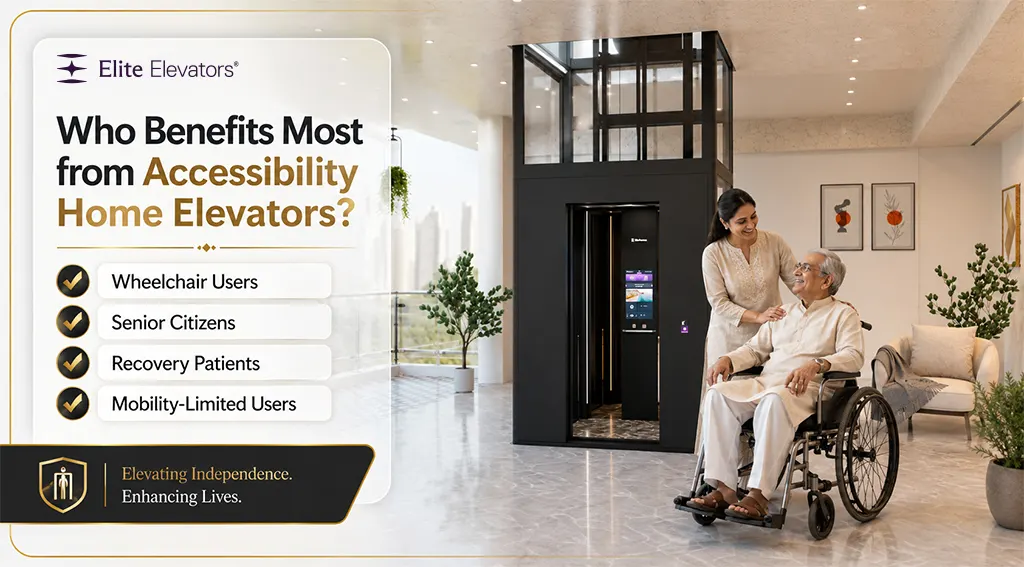
Mobility should never be a barrier inside your own home. Wheelchair-friendly home elevators with wide cabin designs are transforming how seniors and families with accessibility needs experience multi-floor living, restoring independence, reducing fall risks, and future-proofing homes across India.
Table of Contents
- What Are Wheelchair-Friendly Home Elevators and How Are They Different?
- Why Do Seniors Specifically Need Wide Cabin Home Elevators?
- How Wide Does a Cabin Need to Be for Wheelchair Access?
- What Safety Features Should a Wheelchair-Accessible Home Elevator Have?
- Comparison: Standard vs. Wheelchair-Friendly Wide Cabin Home Elevators
- How Easy Is It to Install Accessible Home Elevators in Existing Indian Homes?
- What the Installation Process Looks Like
- When Is the Right Time to Install a Wheelchair-Friendly Home Elevator?
- How Do These Elevators Support Multi-Generational Indian Homes?
- FAQs: Wheelchair Friendly Home Elevators in India
- Final Word: Accessibility Is a Decision, Not a Reaction
What Are Wheelchair-Friendly Home Elevators and How Are They Different?
Wheelchair-accessible home elevators are residential lift systems specifically designed with enlarged cabin dimensions, wider door clearances, smooth start-stop operation, and accessible control panels to allow safe, effortless movement for wheelchair users and people with limited mobility.
Unlike standard residential lifts, which prioritise compact footprints, wheelchair-friendly models are engineered around the user’s physical needs, including turning radius, carer space, and barrier-free entry and exit.
Key Design Differences at a Glance
- Cabin dimensions: Up to 1500×1500 mm versus 720–900 mm in standard models
- Door clearance: 800–900 mm wide versus standard door widths
- Entry: Flush, stepless thresholds for smooth wheelchair roll-in
- Capacity: 3–4 users plus a wheelchair, typically supporting up to 400–440 kg
Elite Elevators India’s models, including the E200, E300, and the dedicated SUPRA platform lift, are built from the ground up with these accessibility principles integrated into their design, not added as afterthoughts.
Why Do Seniors Specifically Need Wide Cabin Home Elevators?
Here’s a scenario many Indian families know well: An elderly parent quietly stops visiting the upper floor of the home. Not because they don’t want to, but because the stairs have become a source of anxiety. Over months, their world quietly shrinks to one floor. A residential wheelchair elevator changes that dynamic entirely.
Falls on staircases are one of the leading causes of injury among Indian seniors. Beyond the physical risk, restricted mobility leads to isolation, reduced independence, and psychological distress. A wide cabin home elevator addresses all three by giving seniors a safe, private, dignified way to move through their own home on their own terms.
Specific Benefits for Seniors
- Eliminates fall risk on stairs entirely
- Enables independent movement without needing to ask for help
- Reduces physical strain on joints for those with arthritis or post-surgery conditions
- Supports carers — wide cabins mean a carer can enter the cabin alongside the senior.
- Provides psychological reassurance through an enclosed, stable, smooth-ride design
How Wide Does a Cabin Need to Be for Wheelchair Access?
The right cabin size depends on the type of wheelchair and whether a carer will accompany the user.
Minimum viable: ~1200×1200 mm — workable for a standard manual wheelchair, tight for manoeuvring.
Recommended standard: 1500×1500 mm allows a full 180° turning radius, comfortable entry and exit, and career assistance without physical strain.
Door width: 800–900 mm clearance is essential. A narrower door can make entry awkward and potentially unsafe, particularly for powered wheelchairs.
Elite Elevators India offers cabin configurations that meet and exceed these dimensions, ensuring the lift is genuinely usable, not just technically compliant.
What Safety Features Should a Wheelchair-Accessible Home Elevator Have?
Safety and accessibility are two sides of the same coin. A wide cabin means nothing if the lift isn’t reliable when it matters most.
Elite Elevators India’s home lifts come equipped with emergency lowering mechanisms, door interlocks, overspeed protection, and obstruction sensors. These aren’t optional extras; they are standard across all models.
Core Safety Features to Look For
- Automatic Rescue Device (ARD): If the elevator loses power, it safely descends to the nearest landing rather than trapping passengers between floors.
- EN 81-41 certification: This European standard is specifically designed for low-speed residential lifts serving people with reduced mobility, covering 194 parameters of safe operation.
- Smooth start and stop: Gradual acceleration prevents sudden lurches, which are critical for wheelchair users and seniors with vestibular issues
- Door interlocks: Prevent movement unless doors are fully and safely closed
- Battery backup system: Ensures operation continues during short power interruptions
Comfort Features That Matter
- Handrails at appropriate heights for standing and seated users
- Non-slip cabin flooring
- Low-noise operation is important for anxious users and busy households
- Adequate interior lighting
Elite Elevators’ home lifts are certified to comply with EN 81 European safety standards, ensuring the highest level of protection for families.
Comparison: Standard vs. Wheelchair-Friendly Wide Cabin Home Elevators
| Feature | Standard Home Elevator | Wheelchair-Friendly Wide Cabin Elevator |
| Cabin Size | 720–900 mm | Up to 1500×1500 mm |
| Door Width | Standard (600–700 mm) | 800–900 mm clearance |
| User Capacity | 1–2 persons | 3–4 persons + wheelchair |
| Turning Radius Support | Not designed for it | Full 180° turn possible |
| Caregiver Space | Limited | Comfortable side-by-side access |
| Certification Standard | Varies | EN 81-41 (accessibility-specific) |
| Load Capacity | Up to 250 kg typical | Up to 400–440 kg |
| Suitable For | General household use | Seniors, wheelchair users, multi-generational families |
How Easy Is It to Install Accessible Home Elevators in Existing Indian Homes?
This is often the question that holds families back, and the answer is more reassuring than most people expect.
Elite Elevators’ home lifts are engineered to install with minimal civil work, making them perfect for existing homes. No deep pit is required, and no machine room is needed.
What the Installation Process Looks Like
- Home survey by manufacturer-trained technicians who assess your space and recommend the optimal cabin placement
- Customisation of cabin dimensions, door style, flooring, and finish to suit your interior
- Modular delivery from the manufacturing facility in Pisa, Italy, lifts arrive in a Completely Knocked Down (CKD) format for efficient on-site assembly.
- Installation is typically completed within a few days to a week, with minimal disruption to daily life
- Demonstration and handover — your family is walked through every safety feature and operation mode.
Elite Elevators has installed lifts across India, meaning its teams have real-world experience navigating the constraints of Indian home architecture, from narrow stairwells to tight lobbies.
When Is the Right Time to Install a Wheelchair-Friendly Home Elevator?
The honest answer: earlier than you think.
Many families install accessible home elevators reactively after a fall, after a surgery, or when a condition has already progressed significantly. This creates urgency, limits customisation options, and adds stress to what should be a carefully considered decision.
Situations That Signal It’s Time to Act
- A senior family member is avoiding stairs or expressing hesitation.
- A family member is recovering from hip or knee surgery.
- You are building or renovating a multi-floor home and want to future-proof it.
- A family member uses a walking aid, cane, or wheelchair, even part of the time.
- You are planning for aging in place over the next 5–10 years.
Installing a luxury accessible home elevator before mobility becomes critical gives you the full range of customisation options and allows the whole family to benefit from day one not just the person with the immediate need.
How Do These Elevators Support Multi-Generational Indian Homes?
The joint family structure is still central to Indian life. In a home where grandparents, parents, and children share space across multiple floors, a wide cabin home elevator serves every generation.
Grandparents move independently. Parents carry groceries or laundry without strain. Children, especially young ones, travel between floors safely, without parents worrying about stair accidents. And when guests visit, including elderly relatives, the home is genuinely welcoming rather than a logistical challenge.
A wheelchair-accessible home elevator is not a medical device installed in the corner of a life. It is infrastructure, the same way a lift in an apartment block serves everyone equally.
FAQs: Wheelchair Friendly Home Elevators in India
1. What is the minimum cabin size required for a wheelchair-accessible home elevator?
A cabin of approximately 1200×1200 mm is the practical minimum, though 1500×1500 mm is the recommended standard for comfortable movement, turning, and career assistance. Door clearance of at least 800 mm is equally important.
2. Are Elite Elevators home lifts safe for daily use by seniors?
Yes. Elite Elevators’ home lifts are certified and comply with EN 81 European safety standards. Every model includes an automatic rescue device, door interlocks, overspeed protection, and obstruction sensors as standard features.
3. Can a wheelchair-friendly home elevator be installed in an existing home without major construction?
Yes, Elite Elevators’ systems require no deep pit, no shaft, and no machine room, making them well-suited to installation in homes that are already built and occupied, with minimal structural intervention.
4. What certifications should I look for when buying an accessible home elevator in India?
Look specifically for EN 81-41 certification (the European standard for residential lifts serving people with reduced mobility) and compliance with the EU Machinery Directive 2006/42/EC. Elite Elevators India is unique because all of their products are made in Italy, engineered in Germany, and certified according to European safety codes.
5. Do accessible home elevators increase property value?
Yes. A certified, well-installed home elevator, especially one with a wide cabin and accessibility features, adds measurable resale value by making a property attractive to a wider pool of buyers, particularly in a market where ageing in place is a growing priority among Indian homebuyers.
6. How long does the installation of a wide cabin home elevator take?
Installation typically takes a few weeks, depending on site readiness, structural preparation, model type, and customisation requirements. Elite Elevators’ modular, pitless systems are designed to minimise this timeline and keep disruption to a minimum.
Final Word: Accessibility Is a Decision, Not a Reaction
The best time to install a wheelchair-friendly home elevator is before the need becomes urgent. Wide cabin home elevators certified, silent, and seamlessly installed, give seniors their independence back, give families their peace of mind, and give your home a future it is ready for.
Elite Elevators India brings together European engineering, EN 81-41 safety compliance, and real-world installation experience across Indian cities to deliver exactly that — not just a lift, but a long-term upgrade to how your home works for every person in it.
If someone in your home is hesitating at the foot of the stairs, that hesitation is the sign. Act before it becomes a limitation.
Note: * Prices listed are starting rates, exclude applicable taxes, and may vary based on customization.



Vasanth Ravi
This was a very informative and well-structured article. I was researching wheelchair-friendly home elevators for my elderly parents, and the explanation about wide cabin sizes and safety features answered many of my questions. The details on accessibility, caregiver space, and installation requirements make this guide extremely useful for families planning long-term mobility solutions at home.
Praveen Kumar
This blog provided valuable information about residential wheelchair elevators. I found the explanation of door widths, turning radius requirements, and safety certifications very helpful. Families often think accessibility is only needed later in life, but this article shows why planning ahead with a wide cabin home elevator can make daily living easier for everyone.
Karthi Vel
I was searching for information on senior-friendly home elevators, and this guide covered everything from cabin size to emergency safety systems. The explanation of wide cabin designs and caregiver support features was especially useful. It is encouraging to see such detailed information that helps families make informed accessibility decisions.
Murugan Selvam
Very informative read. The section explaining how wide cabin home elevators accommodate both wheelchair users and caregivers stood out to me. Accessibility is often discussed in general terms, but this article provides practical measurements and recommendations that help homeowners better understand what to look for in a residential lift.
Suresh Babu
Very well-written article. The explanation of how wheelchair-friendly home elevators benefit every generation in the household was insightful. Beyond mobility support, these elevators also improve convenience and safety for daily activities, making them a valuable addition to modern multi-level homes.