

 Add Elite as Preferred
 Top 10 smart home elevator locations include staircase voids, corners, living rooms, bedrooms, courtyards, and external shafts. Elite Elevators ensures space-efficient, machine room-less installs with modern safety.
As homes in India are increasingly being built taller rather than wider, many families are now considering the purchase of a residential elevator as a way to enhance access to their living areas and increase usable space on each floor. In addition, the “smart” design of residential elevators provides long-term accessibility and enhances the overall architectural design of any duplex or villa (or multi-storey unit) you are contemplating building in Chennai, Coimbatore, or Bengaluru. During the planning phases of building your home, one of the most important questions you need to consider is:
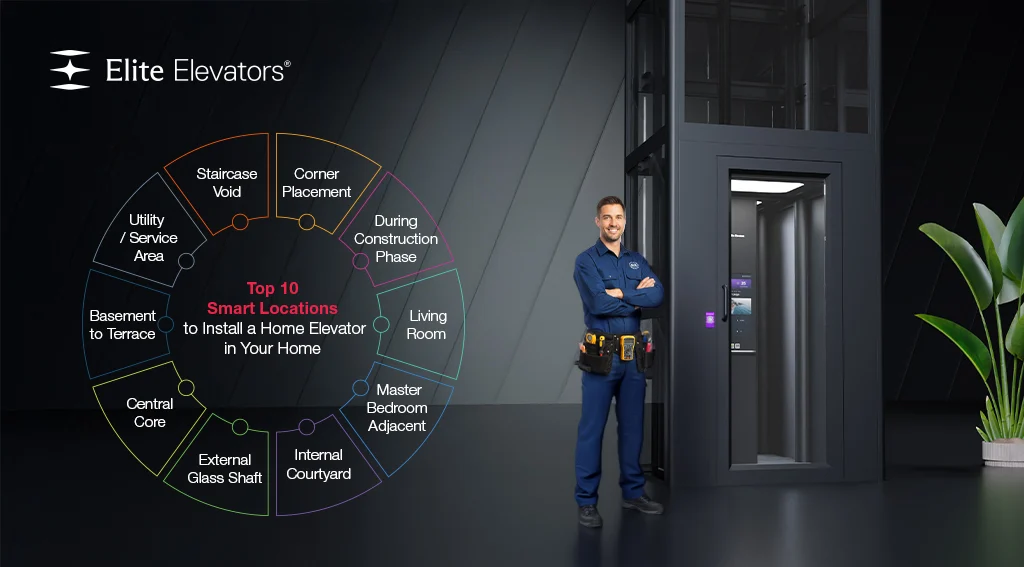
Table of Contents
- Where are the best locations to install home elevator systems in my home?
- 1. Why Is the Staircase Void the Most Popular Location?
- 2. Where Can a Corner Installation Save Maximum Space?
- 3. When Should You Plan Installation During the Construction Phase?
- 4. How Can a Living Room Integration Enhance Luxury Appeal?
- 5. Who Should Consider Installing Near the Master Bedroom?
- 6. What Makes Internal Courtyard Installation Architecturally Smart?
- 7. Why Is External Glass Shaft Installation a Growing Trend?
- 8. Where Is the Best Location for Multi-Generational Homes?
- 9. When Is Basement to Terrace Connectivity Essential?
- 10. How Does Utility Area Installation Reduce Disruption?
- Comparison Table: Smart Locations for Home Elevator Installation
- What Should You Consider Before Home Elevator Installation?
Where are the best locations to install home elevator systems in my home?
The location of your elevator has a significant impact on your home’s structural integrity, the utility of the space on a daily basis, the aesthetic value of your home, and its future value. As a result of the evolution of hydraulic technology and innovations in the home elevator market, Elite Elevators India can install residential elevators with varying load capacities of up to 440 kg, travel speeds of between 0.15 m/s and 0.4 m/s and do so without requiring a machine room with no requirement of machine rooms.
1. Why Is the Staircase Void the Most Popular Location?
The staircase void remains one of the best placement options for a home elevator in Indian homes. The majority of duplex and G+2 properties currently feature a centrally positioned staircase shaft in the building. Therefore, utilizing the existing vertical axis of the building will require minimal civil modification to accommodate the additional load of an elevator. With the use of an Elite Elevator hydraulic model (such as the X200) or a gearless model (such as the X300), the installation of a machine room-less elevator will require only a defined vertical clearance, whereas, historically, a separate machine room was required for conventional elevators.
Technical Advantage:
- Load capacity up to 440 kg
- Single-phase power supply
- No separate machine room
- Soft start and stop technology
- Suitable for G+1 to G+5 configurations
Using the staircase void minimizes structural disruption while maximizing vertical efficiency.
2. Where Can a Corner Installation Save Maximum Space?
Installing a lift in a structural corner is a highly efficient solution, especially in compact urban homes. Corner installations work well when architectural design includes sufficient shaft provision. Hydraulic lifts such as the E200 require moderate space allocation, while gearless models like the E300 operate without deep pits, allowing easier adaptation.
Technical Considerations:
- Requires defined shaft dimensions
- Moderate civil reinforcement
- Cabin sizes configurable for 2 to 5 passengers
- EN 81-41 certified safety systems
A corner installation often preserves central living space and maintains interior flow.
3. When Should You Plan Installation During the Construction Phase?
The ideal time to install a home elevator is during the initial architectural planning stage.
Early planning allows:
- Proper shaft alignment
- Correct load distribution
- Integrated electrical routing
- Optimized ventilation
- Structural reinforcement planning
Elite Elevators systems operate on single-phase residential power and are engineered with modular installation methods. Planning early reduces retrofit costs and ensures compliance with safety norms such as EN 81-41 and EN 81-20.
Construction phase integration ensures the best locations to install a home elevator are architecturally seamless.
4. How Can a Living Room Integration Enhance Luxury Appeal?
Homeowners often choose visible living room integration for design impact. Glass cabin elevators, such as Elite’s gearless models, provide panoramic aesthetics while maintaining structural safety. These systems include:
- Enclosed cabin design
- Automatic doors
- Overload sensors
- Pressure stabilisation
- Anti-slip flooring
A living room installation becomes a statement feature while maintaining daily practicality.
5. Who Should Consider Installing Near the Master Bedroom?
Families with elderly parents or mobility concerns benefit from bedroom adjacency.
Installing near a master bedroom ensures:
- Minimal walking distance
- Immediate access
- Enhanced safety at night
- Reduced fall risk
Hydraulic models like the X200 provide stable piston-driven motion, while gearless systems use cog belt drive technology to reduce vibration. Speed remains controlled between 0.15 and 0.4 m/s to ensure comfort. Bedroom proximity enhances independence for seniors.
6. What Makes Internal Courtyard Installation Architecturally Smart?
Many Indian homes feature internal courtyards or light wells.
These vertical spaces provide:
- Natural shaft alignment
- Ventilation compatibility
- Aesthetic enhancement
- Balanced weight distribution
Elite Elevators’ machine room-less systems allow installation without additional external structures. Courtyard installation maintains structural symmetry while offering excellent vertical access.
7. Why Is External Glass Shaft Installation a Growing Trend?
In retrofit scenarios, homeowners may lack internal shaft space.
External shaft installation allows:
- Minimal internal modification
- Reduced demolition
- Modern glass facade appearance
- Structural independence
Hydraulic and gearless systems can be mounted externally with proper structural framing. These systems maintain a 440 kg load capacity while preserving interior floor area. This option is ideal for renovation projects.
8. Where Is the Best Location for Multi-Generational Homes?
In multi-generational Indian homes, central placement is strategic.
A centrally aligned shaft ensures:
- Equal access from all rooms
- Efficient vertical distribution
- Balanced load transfer
- Improved daily usability
Elite Elevators systems support multiple stops from G+1 to G+5, depending on design, making them suitable for larger villas and joint family residences. Central installation often represents the most future-ready approach.
9. When Is Basement to Terrace Connectivity Essential?
Houses with basements, parking garages, or terrace access need complete vertical integration.
Incorporate a lift to serve all levels of the house as follows:
- Basement parking
- Ground floor level
- Upper floors and
- Terrace level
Doing so can greatly enhance the overall level of convenience provided to users. A hydraulic lift system will provide smooth load movement of both groceries and luggage, while the gearless belt drive type will provide low noise operation suitable for residential applications. This configuration allows for continuous daily use.
10. How Does Utility Area Installation Reduce Disruption?
In compact houses, allocating lift space near service zones like utility areas can reduce living space compromise.
Utility zone placement:
- Minimizes visual interference
- Preserves main hall aesthetics
- Keeps structural load near reinforced walls
- Simplifies wiring
Elite Elevators’ modular systems allow defined shaft installation without excessive overhead headroom requirements.
Comparison Table: Smart Locations for Home Elevator Installation
| Location Type | Civil Work Required | Best For | Design Impact | Accessibility Advantage |
| Staircase Void | Moderate | Duplex homes | Subtle | Central access |
| Corner Placement | Moderate | Compact homes | Minimal | Space efficient |
| Living Room | Moderate | Luxury villas | High | Statement feature |
| Bedroom Adjacent | Moderate | Senior users | Low visibility | Safety focused |
| Courtyard | Low | Traditional homes | Architectural | Natural alignment |
| External Shaft | Higher | Retrofit homes | Modern facade | No interior disruption |
| Central Core | Moderate | Large villas | Balanced | Equal access |
| Basement Connect | Moderate | Parking homes | Practical | Full vertical mobility |
| Utility Area | Moderate | Small houses | Hidden | Space preservation |
What Should You Consider Before Home Elevator Installation?
When deciding where to install a home elevator, consider:
- Structural load-bearing capacity
- Shaft dimensions
- Power supply availability
- Civil work feasibility
- Long-term accessibility planning
- EN safety compliance
- Maintenance accessibility
Elite Elevators India provides machine room-less hydraulic and gearless solutions engineered for Indian homes, combining European safety standards with localized installation expertise.
Conclusion
The location of your home elevator system will depend on the design of your home, your family unit, and your long-term mobility plans, as well as the structural integrity of your house. Whenever a lift is installed in one of the previously listed areas, it will create an environment that is safer, more comfortable, and more valuable than if you had not installed the elevator.
Elite Elevators India offers elevators with load capacities of up to 440 kg, travel speeds of 0.15 to 0.4 m/s, that are compatible with single-phase power, and that are certified for European safety standards. A lift is more than vertical transport; it promotes a future-ready lifestyle.
Frequently Asked Questions
1. What is the best placement for a home elevator in Indian homes?
The staircase void or central core is typically the most efficient placement due to structural alignment and balanced access across floors.
2. Is it possible to install a home elevator in an existing house?
Absolutely! Elite Elevators offers both hydraulic and gearless models suitable for retrofit installations that require vertical space for installation without the requirement of a separate machine room.
3. How much space is required for a home elevator?
Depending on the cabin size and the design of the elevator shaft, the amount of required space for installation will vary from cabin to cabin, as well as from one type of shaft to another. In general, all residential elevators need to be housed in a clearly defined and compactly configured vertical area.
4. Is a machine room required for a home elevator?
No! All of our systems use a machine room-less design, meaning that no separate motor room will be needed for your new home elevator.
5. How many floors can a home elevator serve?
All of our systems can be configured to service 1, 2, 3, or 4 stops, depending upon the type of elevator shaft and the model of the home elevator purchased.
Note: * Prices listed are starting rates, exclude applicable taxes, and may vary based on customization.



Snehal Desai
Great insights on where to install a home elevator! I never considered utility areas before, but this blog explained how they can be the best place for a home elevator without affecting the main interior design.
Gopal Krishnan
Very informative content! The explanation about home elevator installation in living rooms and bedrooms was especially useful. Now I can better decide the best placement for a home elevator based on convenience and design.
Bhavesh Joshi
This blog is a great resource for anyone planning to install a home elevator. The comparison of different locations helped me identify the best place for a home elevator in my layout.
Nandini Pillai
Very helpful article! The idea of using the central core for installing a home elevator seems very efficient. It clearly explains the best locations to install a home elevator for maximum accessibility.
Arjun Bora
This is a well-structured blog with practical insights. The staircase void and corner installation options are perfect examples of smart home elevator installation planning.
Mahesh Pawar
This article is a great guide for anyone planning to install a home elevator. The variety of options discussed makes it easier to find the best locations to install a home elevator based on different needs.