

 Add Elite as Preferred
 To reduce home elevator installation costs in India without compromising safety, choose a pitless model (saves ₹1–3 lakh in civil work), plan during construction (not after), select the right floor count, opt for a standard cabin size, choose a certified brand with inclusive pricing, and sign an AMC to prevent expensive emergency repairs. Safety certifications should never be sacrificed to reduce cost.
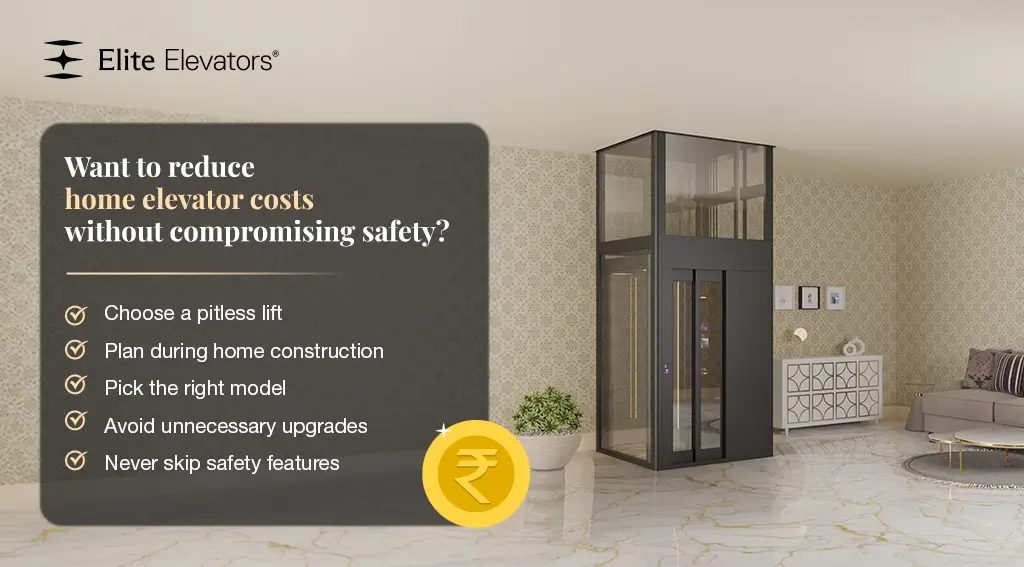
Home elevators in India are no longer reserved for the ultra-wealthy. With prices starting from ₹13.41 lakh for a stairlift and ₹14.50 lakh for a hydraulic home elevator, residential lifts have entered the mainstream. But for many Indian families, even these prices can feel like a stretch, and the instinct is to find ways to cut costs.
Table of Contents
- 1. Choose a Pitless Model and Save on Civil Work
- 2. Plan During Construction — Not After
The danger? The wrong cost-cutting decisions choosing uncertified brands, skipping safety features, and using unqualified installers can turn a ₹2 lakh saving into a ₹10 lakh repair bill, a safety incident, or a lift that fails within two years. The Indian market has too many examples of cheap lifts that delivered expensive regrets.
The good news: there are legitimate, intelligent ways to reduce your home lift installation cost significantly without compromising on safety, quality, or long-term reliability. This guide covers seven of them.
1. Choose a Pitless Model and Save on Civil Work
The biggest hidden cost in elevator installation is civil engineering, particularly pit excavation and shaft construction in existing homes. A conventional pit-based elevator may require 300–600 mm of excavation through a reinforced concrete slab, costing ₹1–3 lakh in civil work alone.
Pitless models like Elite Elevators’ X200 and X300 series require only 59–100 mm of floor preparation, essentially cutting civil costs to near zero. The X200 starts at ₹14.50 lakh with no excavation required, no machine room, and no shaft structure needed if you use your home’s existing walls. This single decision can save ₹1.5–3 lakh compared to a pit-based equivalent.
2. Plan During Construction — Not After
This is the single most impactful cost-saving advice for anyone building a new home: involve your best lift company at the design stage, not after the slabs are poured.
Retrofitting a lift into a completed home requires breaking existing floors, routing new electrical circuits through finished walls, and potentially modifying the stairwell. In new construction, the shaft opening, electrical conduit, and structural provisions can be built in at minimal marginal cost.
Elite Elevators provides home assessment visits and can work directly with your architect or contractor during construction, a service that literally pays for itself in civil savings.
3. Match the Model to Your Actual Needs
Over-specifying is a major source of unnecessary cost. If your home is G+2 and you need a reliable, comfortable lift for daily family use, you don’t need India’s most advanced AI-powered elevator. A well-specified X200 at ₹14.50–16.50 lakh delivers everything you need.
Equally, under-specifying creates problems. Buying a lift rated for 3 floors when you need 4 will require an expensive upgrade or replacement. Here’s a practical matching guide:
- G+1 to G+2, moderate use, elderly parents at home: X200 or X200 Plus — most cost-effective choice
- G+2 to G+3, frequent use, residential home with design focus: X300 Mark II — smart features, faster speed, 16 RAL colours
- G+3 to G+4, luxury villa, smart home integration: X300 MK II Plus — premium investment that adds significant property value
4. Choose Standard Cabin Size Unless You Need XL
Cabin size directly affects price. The standard 1200×1200 mm cabin in Elite Elevators’ X200 and X300 series comfortably accommodates two adults or one wheelchair user. Upgrading to the 1500×1500 mm XL cabin adds cost, and in most Indian homes, the standard size is more than adequate.
Exception: If a family member uses a full-sized wheelchair and requires comfortable boarding space, the XL cabin is the right call, and the additional cost is justified by the functional benefit. For all other use cases, standard size delivers better value.
5. Choose a Brand with Transparent Pricing and Long-Term Value
Many buyers focus solely on the initial purchase price, only to discover later that installation, customization, maintenance, or other services may incur additional charges. That’s why it’s important to understand exactly what’s included in your quotation before making a decision.
Elite Elevators offers extensive customisation options across its home elevator range, including cabin finishes, colour selections, ceiling designs, and flooring choices, depending on the model chosen. Since inclusions may vary by product and project requirements, homeowners should evaluate the total cost of ownership (TCO) rather than comparing headline prices alone.
When assessing a home elevator investment, consider factors such as installation requirements, maintenance costs, elevator energy efficiency, safety certifications, product longevity, and after-sales support. A premium, certified home elevator in chennai can often deliver greater value over time through enhanced reliability, safety, comfort, and long-term performance.
6. Use Your Own Masonry Shaft Where Possible
If your home’s stairwell already has an enclosed shaft space (a lift well built into the architecture), using it for your elevator installation can save significantly on shaft structure costs.
Elite Elevators’ engineers will assess whether your existing architecture can accommodate the lift during the home visit, a conversation worth having before finalising your model and configuration.
7. Invest in an AMC to Prevent Expensive Repairs
This advice runs counter to the instinct to cut costs, but an annual maintenance contract is one of the most cost-effective investments a homeowner can make.
Standard AMC charges for lifts range between 3-5% of lift prices, scope of contract coverage, and location.
What You Should Never Compromise On
Cost optimisation has limits. These safety elements must be non-negotiable in any home elevator:
- ARD (Automatic Rescue Device): A lift without ARD is dangerous in India’s power-cut-prone environment. Never accept a lift without it.
- EN 81-41 or equivalent safety certification: All Elite Elevators models carry this certification. Uncertified lifts may not meet basic safety requirements.
- GSM emergency communication: Standard in all Elite Elevators models. Essential for multi-generational homes.
Frequently Asked Questions
Q1: What is the most affordable home lift in India that is still certified safe?
The Elite E50 Stairlift starts at ₹13.41 lakh (G+1, excl. taxes) and is certified to EN 81-41 European standards, the most affordable certified mobility solution. For a full home elevator, the X200 starts at ₹14.50 lakh with complete safety certification.
Q2: Can I reduce the home elevator cost by installing it myself?
No, and it’s not safe or legal. Residential elevators must be installed by certified engineers to comply with safety standards. DIY (do it yourself) installation voids warranties and certifications and creates serious liability in the event of an accident.
Q3: Does a cheaper elevator brand cost less to maintain?
Not necessarily. Budget brands often have higher long-term maintenance costs because replacement parts are harder to source, service networks are limited, and build quality leads to more frequent failures. Certified brands with nationwide service networks often have lower total lifetime costs.
Q4: Does a home elevator increase or decrease property resale value?
A certified, well-maintained home elevator consistently increases property value, particularly in the luxury villa and premium apartment segment. An uncertified or poorly maintained lift can complicate property sales and reduce buyer confidence.
Q5: Are there financing options available for home elevators in India?
Elite Elevators can advise on payment and financing options during your consultation. Visit eliteelevators.com to discuss the best plan for your budget.
Note: * Prices listed are starting rates, exclude applicable taxes, and may vary based on customization.



Hari Krishnan
This blog was genuinely helpful for anyone researching home elevator installation cost before making a decision. I liked how it explained practical ways to reduce expenses without compromising home elevator safety. The tips about planning during construction and selecting the right model make a lot of sense. Definitely one of the most informative articles I have read on home elevator installation.
Nikita Sharma
I was searching for reliable information about elevator installation cost, and this article answered many of my questions. The explanation about avoiding shortcuts while keeping safety as the priority was excellent. The breakdown of civil work savings and maintenance advice gives homeowners a realistic perspective before installing an elevator in a house.
Gopinath R
This was a very informative read. The article explains home elevator installation cost in a simple way and also highlights why safety should never be compromised. I appreciate the practical examples and long-term cost-saving suggestions. It helped me better understand what to expect before choosing a home elevator solution.
Shruthi Menon
Excellent blog with useful guidance for homeowners. I was searching for home elevator installation near me, and this article gave me valuable insights into budgeting, planning, and selecting the right system. The advice on avoiding hidden expenses while maintaining home elevator safety is something every buyer should know.
Lokesh Kumar
Thank you for writing such a detailed article. Understanding elevator installation cost can be confusing, but this guide explains everything clearly. I especially liked the section about using an existing shaft and planning the installation during construction. It will definitely help many homeowners make smarter decisions.
Aditi Verma
This blog provides genuine value for anyone considering installing an elevator in a house. Instead of only focusing on pricing, it explains the importance of certified safety features and preventive maintenance. The balance between affordability and reliability makes this one of the best articles I have come across.
Chandru Raj
Very well written and easy to understand. I was researching home elevator installation options, and this blog covered almost every important point. The explanation about pitless elevators reducing civil work costs was new to me. Thanks for sharing practical advice that can actually help homeowners save money.