

 Add Elite as Preferred
 Classic home elevators in India are redefining luxury living with timeless aesthetics, compact engineering, and custom interiors. From villas to urban duplexes, Elite Elevators India offers stylish, EN 81- 41-certified solutions that blend beautifully into every home design.
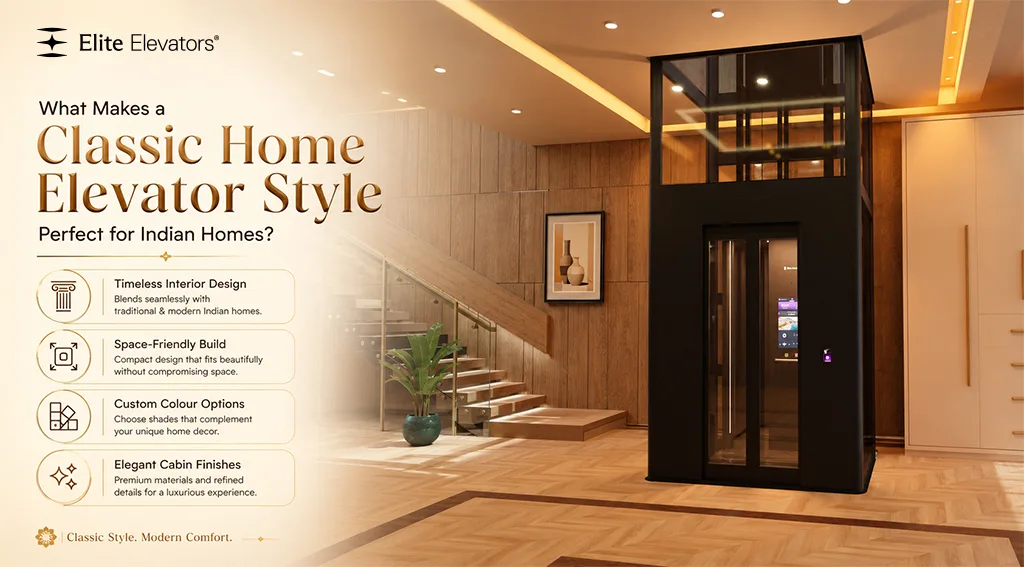
Walk into any thoughtfully designed Indian home today, and you’ll notice something immediately: every element feels deliberate. The flooring, the lighting, the furniture, all of it speaks the same design language. So when a family decides to install a home lift, the question is no longer just “Will it fit?” It’s “Will it belong?”
Table of Contents
- What Defines a “Classic” Home Elevator in India Today?
- Why Are Indian Homeowners Returning to Classic Elevator Styles?
- Which Classic Home Elevator Styles Are Actually Popular Right Now?
- Comparison: Classic Home Elevator Styles at a Glance
- Who Should Consider a Classic-Style Home Elevator?
- When and Where Should You Install a Classic Home Elevator?
- FAQs: Classic Home Elevator Styles in India
- The right elevator doesn’t stand out; it belongs.
The most popular classic elevator India styles today blend timeless aesthetics, warm wood finishes, panoramic glass, subtle metallic tones, and curated pre-designed interiors with compact, residential-first engineering. Elite Elevators India, certified compliant with EN 81-41 European safety standards, builds elevators that are specifically designed to integrate with Indian homes, not retrofit into them as an afterthought.
What Defines a “Classic” Home Elevator in India Today?
A classic home elevator in the current context is not about dated or ornate design; it is about timeless appeal that does not age with trends. The best classic lifts are quiet presences: refined enough to be noticed and subtle enough not to dominate.
In Indian homes, particularly, where interiors often carry strong design identities from traditional Chettinad woodwork to minimalist contemporary concrete, the elevator must earn its place by respecting what is already there.
What Separates Classic from Generic
- Softer finishes that age gracefully rather than date quickly
- Proportions that feel residential, not commercial
- Materials that echo what is already present in the home: wood, glass, stone, or steel
- Lighting that creates warmth rather than utility
Elite Elevators India approaches this directly: their elevators are designed for homes, not adapted from commercial or industrial systems.
Why Are Indian Homeowners Returning to Classic Elevator Styles?
The answer lies in how Indian homes themselves have evolved.
A home today is not a purely functional space. It is an emotional investment, a long-term asset, and increasingly a reflection of personal identity. When you introduce something as prominent as an elevator into that environment, it must respect, not disrupt, what you have built.
Several converging trends are driving this shift toward classic styles:
- Homes are more design-conscious than at any previous point in India’s residential market.
- Multi-generational families are planning for long-term accessibility, not just immediate convenience.
- Renovation projects are growing in number, with homeowners prioritising upgrades that preserve rather than alter the character of their spaces.
- There is a clear and growing preference for solutions that require minimal structural interference.
This is precisely where Elite Elevators India’s residential-first philosophy is most relevant: elevators built around your home’s structure and character, not the other way around.
Which Classic Home Elevator Styles Are Actually Popular Right Now?
1. Wood-Inspired Heritage Cabins
This remains the most consistently requested style in traditional villas, independent bungalows, and heritage properties across India, from Jaipur and Mysuru to Chennai and Kolkata.
Wood-finished cabins carry warmth, depth, and an organic quality that resonates deeply in homes built around teak staircases, handcrafted furniture, and earthy palettes. The finish does not fight the existing interior; it continues it.
What this style typically includes:
- Cabin walls in warm wood laminate with visible grain texture
- Swing doors with matching wood or frosted glass inserts
- Recessed warm-white or amber LED ceiling panels
- Non-slip flooring in stone or wooden laminate aligned with existing floors
Elite Elevators India offers wood finishes across multiple cabin configurations, with the material available as a cabin wall option alongside glass, stainless steel, and custom designer panels.
2. Glass Integrated Cabins
Glass elevators have made a confident move from hotel lobbies into Indian private homes, and the reasons are both aesthetic and spatial. A glass cabin creates immediate openness, turns vertical movement into a visual experience, and makes compact floor plans feel considerably larger than they are.
For homes with double-height living rooms, internal atriums, or architecturally prominent staircases, a glass integrated cabin becomes a feature, not just a function.
Where panoramic glass works best:
- Contemporary villas with open-plan layouts or double-height volumes
- Homes where natural light is a deliberate design element
- Outdoor installations on terraces or in garden-facing spaces
- Urban homes where the elevator anchors a central visual axis
Elite Elevators India’s aluminium shaft system supports glass installations, with powder-coated frames available in custom colours and weather-resistant construction suitable for outdoor use.
3. Subtle Metallic Finishes
Stainless steel cabin interiors have evolved significantly from the cold, utilitarian aesthetic of commercial lifts. In classic home elevator design today, the metallic finish is restrained, brushed rather than polished, and muted rather than reflective.
This style pairs naturally with monochromatic interiors, marble flooring, and the architectural restraint that defines contemporary homes in Mumbai, Pune, Hyderabad, and Gurugram. It is a finish that ages without showing it durable, low-maintenance, and quietly elegant.
4. The Elegance Cabin Curated Pre-Designed Interiors
Not every homeowner wants to design from scratch, and Elite Elevators India has a specific solution for exactly that: the Elegance cabin range, a collection of curated, pre-designed interiors where every detail has already been resolved as a cohesive whole.
This is the equivalent of choosing a carefully tailored finished product over a bespoke commission. The aesthetic integrity is equal; the starting point is simply different. Pre-designed elegance cabins are available with multiple finish combinations, ceiling styles, and flooring options, all ready for installation without compromising on quality.
5. Mirror-Panel Cabins for Compact Urban Homes
In apartments and compact urban duplexes, every design decision must work harder. The mirror-panel cabin is a particularly intelligent classic choice because it solves two problems simultaneously: it creates an illusion of depth that makes tight cabins feel more generous, and it carries a timeless glamour that references classic hotel and Art Deco design traditions.
For homeowners who want a classic feel without the spatial footprint of a large wood or glass installation, mirrored panels offer an elegant middle path.
Comparison: Classic Home Elevator Styles at a Glance
| Style | Best Suited For | Overall Feel | Key Advantage |
| Wood-inspired heritage | Traditional villas, heritage homes | Warm, organic, timeless | Blends with existing wooden interiors |
| Glass integrated cabins | Contemporary open-plan homes, outdoor | Open, premium, spatial | Enhances light and perceived space |
| Subtle metallic finish | Urban apartments | Minimal, durable, elegant | Low maintenance, long-lasting appeal |
| Elegance pre-designed | Any home type, faster decisions | Cohesive and curated | Professionally resolved aesthetic |
| Mirror-panel | Compact duplexes, urban apartments | Glamorous, space-enhancing | Creates depth in smaller cabins |
Who Should Consider a Classic-Style Home Elevator?
Classic-style elevators are not a niche product for a narrow audience. They are a practical choice for a wide range of Indian homeowners:
- Families with elderly members who need safe, dignified access across floors without the home feeling clinical
- Villa and bungalow owners undertaking renovation projects who want long-term solutions that preserve existing design character
- Urban apartment residents who want to add mobility infrastructure that complements rather than contradicts a contemporary interior
- Homeowners building from scratch who want to integrate the elevator as a design feature from the beginning, not as a late addition
- Multi-generational households planning for a range of users, seniors, children, and guests over many years
The classic-style elevators serve all of these groups because the underlying principle is the same: the elevator should feel like it has always been there.
When and Where Should You Install a Classic Home Elevator?
Ideally, the decision is made during construction or renovation; that is when integration is most seamless, and costs are most efficient. But modern residential elevator systems no longer make this a hard requirement.
Because Elite Elevators India’s systems require no deep pit, no separate machine room, and no shaft construction, installation in a fully built and occupied home is entirely practical. The elevator adapts to your home’s existing structure, not the reverse.
Where classic-style elevators can be placed:
- Corners of living rooms or entrance lobbies
- Staircase voids and landings
- Central open areas in multi-floor layouts
- Near balconies or garden-facing walls for outdoor glass installations
Placement becomes a design decision, not a structural constraint.
FAQs: Classic Home Elevator Styles in India
1. What does “classic elevator India” style actually mean in practice?
It refers to home elevators that use timeless materials, wood, glass, and subtle metals, combined with residential-scale engineering, so the lift feels like a natural part of the home rather than an imported piece of industrial equipment.
2. Can I match my home elevator’s interior to my existing décor?
Yes, Elite Elevators India offers up to 16 premium RAL colour options, multiple cabin wall finish materials, flooring types, ceiling designs, and door styles, all customisable to align with your home’s existing aesthetic.
3. Do classic-style home elevators require major construction work?
No. Modern residential elevator systems, including all models offered by Elite Elevators India, are designed to be pitless, machine-room-less, and shaft-optional, requiring minimal civil intervention even in fully built homes.
4. Are these styles available for compact homes or apartments?
Yes. Elite Elevators India offers cabin footprints starting from 720×720 mm, and styles like mirrored panels and stainless steel finishes are specifically well-suited to smaller urban spaces.
5. Does choosing a particular cabin style affect the elevator’s safety certifications?
No. Every Elite Elevators India model, regardless of finish or cabin configuration, is EN 81-41 certified. Design choices operate entirely within the certified safety framework.
The right elevator doesn’t stand out; it belongs.
India’s relationship with home design has matured considerably. Homeowners are no longer asking whether they need an elevator. They are asking how it can fit into the home they have already carefully built without changing what they love about it.
The answer lies in choosing the right style from the start. Elite Elevators India, with European engineering, Italian manufacturing, EN 81-41 safety certification, and a design process built entirely around Indian residential architecture, makes that choice straightforward. Whether it is a warm wood heritage cabin in a Chennai villa or a panoramic glass installation in a Bengaluru duplex, the goal is the same: an elevator that earns its place, not one that simply occupies it.
Note: * Prices listed are starting rates, exclude applicable taxes, and may vary based on customization.



Arjun Kumar
This was a very informative read. I was researching classic home elevator styles India and this blog explained the differences clearly. The comparison between wood-inspired cabins, glass cabins, and metallic finishes made it much easier to understand which style suits different homes. The practical insights and design-focused approach were especially helpful for homeowners planning a long-term investment.
Priya Sharma
Great content with a perfect balance of design inspiration and useful information. The comparison table made it simple to evaluate different classic elevator styles based on home type and personal preference. I also appreciated the discussion on installation flexibility. This guide will help many homeowners choose the right classic home elevator India solution.
Rahul Verma
I found this article very helpful because it goes beyond basic elevator information and focuses on how a lift becomes part of a home's overall design. The section on wood-inspired heritage cabins was especially interesting. Anyone looking for a top classic home elevator should find plenty of useful insights here.
Sneha Reddy
Very insightful article. The section covering mirror-panel cabins for compact homes was something I had not considered before. It was interesting to learn how a classic elevator can create a sense of space while maintaining an elegant appearance. The content was detailed, informative, and easy to relate to.
Karthik Raj
One of the most comprehensive articles I have read on classic home elevator styles India. The breakdown of different cabin finishes and their ideal applications was excellent. I especially liked the practical advice on installation locations and how modern systems can fit into existing homes without major structural changes.
Divya Nair
This was a very useful guide for homeowners who want both accessibility and style. The article explains how modern classic home elevators can become an architectural feature rather than just a functional addition. The examples and recommendations provided a clear picture of current design trends.
Vivek Anand
I was looking for information about classic lift designs and this article answered many of my questions. The explanation of metallic finishes and curated cabin interiors was particularly interesting. The writing style was engaging and made technical concepts easy to understand for non-experts.
Meera Krishnan
Very informative and professionally written. The article highlights how a classic home elevator India solution can enhance both convenience and visual appeal. I liked the focus on preserving a home's existing character rather than forcing major structural modifications. A valuable resource for future homeowners.
Naveen Kumar
This article provided a clear understanding of current trends in classic home elevator styles India. The explanations were detailed, and the examples made it easier to identify which style would work best for different types of homes. I particularly appreciated the focus on timeless design choices.